

July 9, 2026
Zimbabwe’s ruling party accused of hollowing out parliamentary oversight


Zimbabwe’s ruling party accused of hollowing out parliamentary oversight
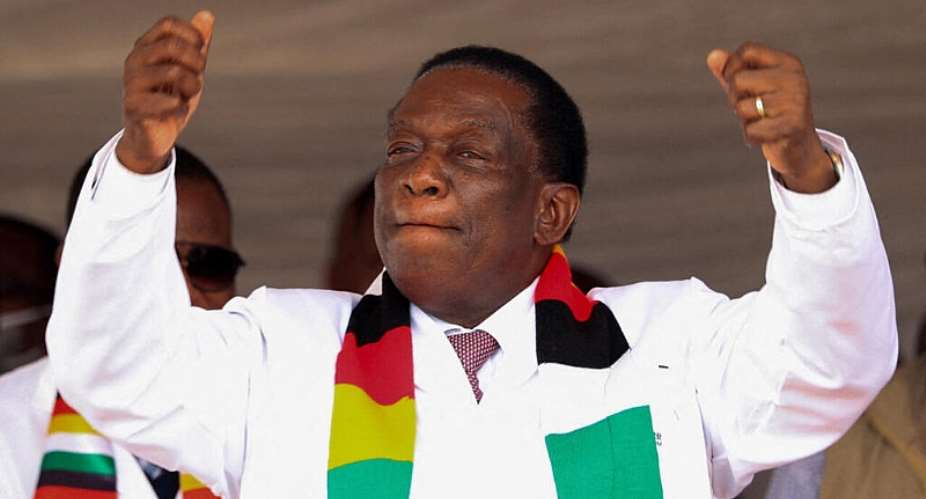
Emmerson Mnangagwa has signed into law amendments to the constitution that will extend his power by two years. – © AFP
Government spokesperson Nick Mangwana confirmed the change on Tuesday 7 July through a post on social media, announcing that the bill was now law.
The main changes contained in the new bill include: an extended term from five to seven years for the president, parliament and local authorities; the president being elected by a joint sitting of parliament rather than by popular vote; an increase in the number of Senate members from 80 to 90, including 10 additional presidential appointees; and the removal of public interviews for certain senior judicial appointments.
Reactions began circulating on social media, with some welcoming the news, while others questioned the impact and lawfulness of the change.
Mthuli Ncube, Zimbabwe’s finance minister, thanked President Mnangagwa for “listening to the people of Zimbabwe” in a post on his X account.
Political commentator Dereck Goto also posted on X, saying he “would like to sincerely thank his Excellency, President Dr Emmerson Dambudzo Mnangagwa for assenting to Constitution of Zimbabwe Amendment (No.3) Act, 2026”.
RFI reached out to Zanu-PF and to Tatenda Mavetera, the minister of information, communication technology, postal and courier services, for comment, but received no reply.
MP Fortune Daniel Molokele told RFI that “this new law… is an assault on democracy. It’s taking away the power of the electorate and allocating it to a few political elite”. He added that, as an MP, he has effectively been given the power to extend his own term in office. “There is nothing that stops me in 2029 from pushing for extra years without an election.”
Could Zimbabwe’s constitutional changes take it back to the Mugabe era?
‘Calculated constitutional coup’
When Mnangagwa took power in 2017, following a military coup that ousted longtime leader Robert Mugabe, many believed he would steer the country towards a new era.
Mugabe had been one of the longest-serving presidents in Africa before his forced resignation after 37 years in power. His presidency was born from the embers of Zimbabwe’s independence from British colonial rule, and was thus filled with hope and promise. Instead, its end was marked by tyranny and corruption.
In 2018, just ahead of his inauguration, the UK’s Sky News asked Mnangagwa, in a sit-down interview, whether he would guarantee to “the people of Zimbabwe” that he would stick to the mandate of two five-year terms. “Perfectly. And I always say it, that I will obey the constitution to the letter, the spirit of the constitution to the letter. If I am elected for a second term, I will do my second term. But I will not go beyond that.”
“What happened on 7 July is the culmination of a calculated constitutional coup,” says Makomborero Haruzivishe, spokesperson for the Constitution Defenders Forum (CDF) International. The CDF was founded by Zimbabwe’s former finance minister and founder of the opposition movement MDC under Mugabe.
Speaking to RFI, Haruzivishe adds: “President Mnangagwa has signed into law a measure that removes the people’s direct right to elect their president and extends his own term by two years. This is not a technical reform. It is a deliberate stripping away of popular sovereignty. From CDF’s perspective, the worry is real because the very document that was supposed to protect us from indefinite rule has been turned into a tool for entrenching it.”
Storm brews over Zimbabwe presidential extension plan
Checks and balances
A bicameral legislature, comprising an upper and lower house, is often intended to provide checks and balances within the legislative process, improve oversight of legislation, and ensure broader representation of different interests or regions.
In Zimbabwe’s case, parliament is supposed to provide that oversight. “But when parliament itself elects the president, that oversight becomes circular and weak,” notes Haruzivishe.
Parliament currently sits with a two-thirds majority held by the presidential party, Zanu-PF. If MPs are now the ones choosing the next president, how can opposing voices, whether within parliament or among citizens, be heard?
As MP Molokele put it: “As we speak right now in Zimbabwe, the opposition is no longer viable as it used to be. We are a de facto scapegoat already.”

RFI
All the news from France, Europe, Africa and the rest of the world.Page: rfi

Top Stories


<!–
–>
Originally published on www.modernghana.com
