

July 16, 2026
The Law Is the Law: Balancing Public Accountability with Constitutional Safeguards in Ghana
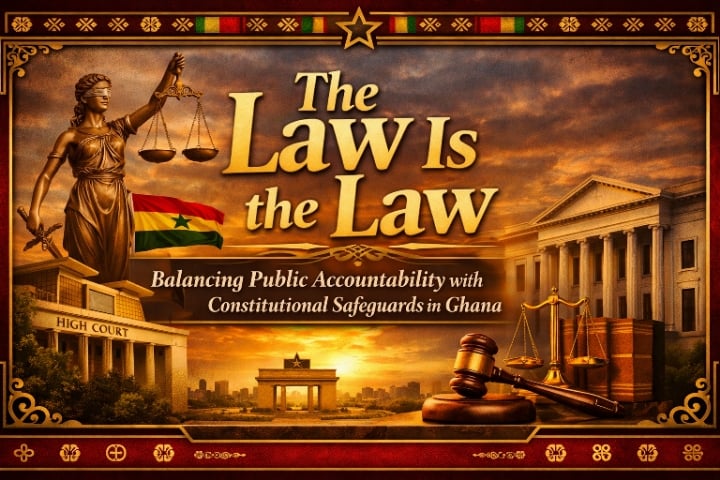


The Law Is the Law: Balancing Public Accountability with Constitutional Safeguards in Ghana
Why State Institutions Must Uphold Due Process, Regardless of Political Affiliation or Status
The recent arrest, three-day detention, and GH¢50 million bail conditions imposed on Dennis Miracles Aboagye by the Economic and Organised Crime Office (EOCO) have reignited a fierce national debate. While some view the actions as a necessary step toward state accountability, others see them as a dangerous case of political overreach. Stripped of partisan rhetoric, this situation underscores a fundamental pillar of democratic governance: the law must be applied equally, transparently, and strictly within the boundaries of the Constitution, no matter whose ox is gored.
The Constitutional Mandate for Personal Liberty
Public accountability and the prosecution of financial crime are vital, but they cannot coexist with the violation of fundamental human rights. The state’s power to arrest must always bow to supreme constitutional limitations:
- Article 14(3) of the 1992 Constitution: This clause explicitly mandates that any person arrested or detained must be brought before a court of law within 48 hours, or else be granted bail. Any detention extending beyond this 48-hour window without judicial oversight is an explicit breach of constitutional law.
- Article 19(2)(c) – The Presumption of Innocence: Every citizen, regardless of public standing or the severity of the allegations against them, is constitutionally presumed innocent until proven guilty by a competent court. Punitive pre-trial measures undermine this right.
- The Purpose of Bail: Under Ghanaian jurisprudence, bail is not a tool for pre-judgment punishment. Its sole legal purpose is to ensure that a suspect returns to stand trial. Setting astronomically high bail conditions—such as GH¢50 million—can inadvertently function as a de facto denial of bail, conflicting with the spirit of the law.
The Double-Edged Sword of Selective Enforcement
When institutional processes are perceived to bend based on political cycles, it erodes public trust in the entire justice system:
- The Danger of a Dual System: A democracy cannot thrive if ordinary citizens face immediate, rigid legal consequences for minor offenses while political elites appear to switch between total immunity and highly publicized, politically charged detentions.
- The “Tomorrow” Precedent: The parliamentary warning that “it can be you tomorrow” serves as a structural truth. If state agencies are permitted to bypass Article 14(3) for high-profile figures, it sets a precedent that leaves ordinary, less-connected Ghanaians completely defenseless against institutional overreach.
Recommendations for Institutional Realignment
To ensure that law enforcement remains fair, professional, and insulated from political cycles, structural reforms are required:
- Strict Judicial Enforcement of the 48-Hour Rule: The Judiciary must hold investigative bodies strictly accountable for detentions exceeding 48 hours, penalizing institutional lapses to deter future unlawful detentions.
- Codification of Standardized Bail Benchmarks: The Rules of Court Committee should establish clear, transparent, and standardized guidelines for financial crime bail conditions to remove perceptions of arbitrariness or punitive intent.
- Depoliticization of Security Head Tenures: Securing the tenures of heads of institutions like EOCO and the Office of the Special Prosecutor (OSP) across administrations would reduce political pressure and foster independent, objective law enforcement.
Ghana’s constitutional democracy depends entirely on the supremacy of the rule of law. True accountability demands that anyone suspected of misappropriating public funds must face thorough investigation and prosecution. However, this process must never happen at the expense of the constitutional safeguards that protect us all. We must reject the cyclical habit of defending civil liberties only when allies are targeted, and demanding legal shortcuts when opponents are arrested. For Ghana to progress, our institutions must operate with absolute professionalism, proving to every citizen that the law is supreme, uniform, and binding—no matter whose ox is gored.
✍️ Retired Senior Citizen
For and on behalf of all Senior Citizens of the Republic of Ghana 🇬🇭
Teshie-Nungua
[email protected]

Atitso Akpalu, © 2026
A Voice for Accountability and Reform in Governance. More Atitso Akpalu is a prominent Ghanaian columnist known for his incisive analysis of political and economic issues. With a focus on transparency, accountability, and reform, Akpalu has been a vocal critic of mismanagement and corruption in Ghana’s governance. His writings often highlight the need for decentralization, local governance empowerment, and robust anti-corruption measures. Akpalu’s work aims to foster a more equitable and just society, advocating for policies that benefit all Ghanaians.
He is a passionate advocate for transparency and accountability. His columns focus on critical analysis of political and economic issues, with a particular interest in the energy sector, financial services, and environmental sustainability. He believes in the power of informed citizenry to drive positive change and am committed to highlighting the challenges and opportunities facing Ghana today.Column: Atitso Akpalu
Disclaimer: “The views expressed in this article are the author’s own and do not necessarily reflect ModernGhana official position. ModernGhana will not be responsible or liable for any inaccurate or incorrect statements in the contributions or columns here.”
Follow our WhatsApp channel for meaningful stories picked for your day.

Top Stories


<!–
–>
Originally published on www.modernghana.com
