

July 7, 2026
The Fiscal and Jurisprudential Imperative of Penal Reform: Why Ghana’s Community Service Bill, 2026 Demands Structural Redesign over Bureaucratic Expansion
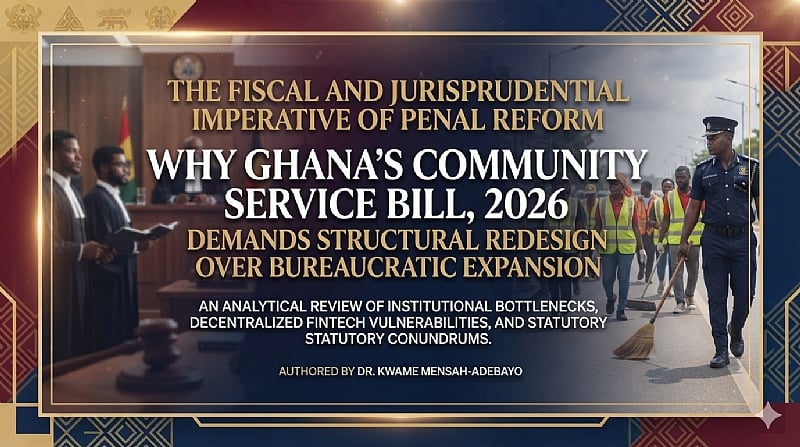


The Fiscal and Jurisprudential Imperative of Penal Reform: Why Ghana’s Community Service Bill, 2026 Demands Structural Redesign over Bureaucratic Expansion
An Analytical Review of Institutional Bottlenecks, Decentralized FinTech Vulnerabilities, and Statutory Conundrums in Ghana’s Pending Non-Custodial Architecture
Abstract & Preamble
Ghana’s contemporary correctional architecture stands at a critical jurisprudential and macroeconomic crossroads. For decades, the administration of criminal justice has maintained a heavily punitive model, forcing state penitentiaries to operate at an unsustainable 35% over maximum design capacity. This systemic over-reliance on custodial sentencing for minor, non-violent infractions places an immense, unproductive fiscal burden on the consolidated fund. Taxpayers shoulder vast recurrent expenditures to house, feed, and secure low-risk offenders within facilities that function more as congested vectors for criminal recidivism than institutions of genuine rehabilitation.
To mitigate this socio-economic and structural strain, the Ministry of the Interior introduced the Community Service Bill, 2026 to Parliament. While this legislative framework introduces a long-overdue paradigm shift toward restorative justice, rigorous policy analysis reveals severe design flaws embedded within its current text. If the state fails to secure decentralized funding channels, eliminate duplicate administrative structures, and simultaneously codify a matching parole framework, this progressive statute risks collapsing under its own institutional weight. This article provides a comprehensive academic analysis of the bill’s structural pillars, operational dynamics, and systemic vulnerabilities, offering actionable policy recommendations for state stakeholders.
The Statutory Blueprint: The Seven Thematic Pillars
The draft legislation currently under review by the Parliamentary Committee on Constitutional, Legal, and Parliamentary Affairs is systematically organized into seven distinct thematic areas spanning 66 clauses:
- Administrative Establishment: Formally institutes the National Community Service Secretariat alongside regional and district management organs.
- Judicial Guidelines: Outlines standard legal frameworks enabling judges to issue community labor mandates instead of custodial terms.
- Operational Shift Structures: Sets strict operational limits requiring offenders to work 4 to 8 hours daily for up to six months.
- Supervision Protocols: Outlines how local government assemblies and supervisors manage, assign, and protect workers on-site.
- Fiscal Management: Establishes the new Rehabilitative Fund to support municipal logistics, tools, and supervisor needs.
- Enforcement & Breaches: Details the precise legal mechanisms to flag truancy, revoke orders, and initiate swift re-sentencing.
- Transitional Provisions: Standardizes institutional handovers, information sharing, and criminal record management systems.
Operational Field Execution: Institutional Mandates for Prison Officers
Rather than remaining confined strictly within penitentiary walls, personnel from the Ghana Prisons Service will transition into active field enforcement agents under the Ministry of the Interior:
- Biometric Intake and Profiling: Officers lead field check-ins, record biometric data, and match an offender’s skills with available civic projects.
- Field Monitoring and Security: Uniformed officers maintain discipline at municipal sites, ensuring public safety and task compliance.
- CTS Infrastructure Management: Personnel log real-time hours worked directly into Ghana’s electronic Case-Tracking System (CTS).
- Court Escalation Liaison: Officers serve as primary witnesses to process arrest warrants if an offender defaults on their mandated hours.
An Academic Diagnosis of Systemic Vulnerabilities
Despite the progressive nature of the non-custodial framework, independent legal and economic analysis uncovers four primary structural vulnerabilities that threaten its operational viability:
1. Institutional Redundancy and Bureaucratic Expansion
The bill mandates the creation of an entirely new, multi-tiered National Community Service Secretariat. Establishing an independent administrative apparatus creates an unnecessary layer of bureaucratic bloat. Ghana’s public sector can avoid this extra cost by routing coordination through existing channels within the Department of Social Welfare and the Prisons Service probation units.
2. Penal Code Ambiguity and Judicial Discretionary Risk
The bill states that community sentencing applies broadly to offenses carrying a maximum prison term of three years. However, it completely omits a master list of matching crimes, leaving these definitions to future amendments by the Attorney General. This missing clarity creates a dangerous judicial gap, running the risk of inconsistent sentencing across different regions.
3. Decentralized Fiscal Fragility
The framework relies heavily on siphoning 5% of the District Assemblies Common Fund (DACF) to feed its new Rehabilitative Fund. Historically, the central government suffers from chronic delays when releasing DACF money. If these distributions stall, local governments will lack the cash to buy safety gear, field tools, or pay supervisor transport allowances—causing local enforcement to fall apart.
4. The Non-Retroactivity Paradox
The bill operates solely as a front-end diversion tactic for new cases. It provides zero relief or retroactive options for the thousands of inmates currently serving short-term sentences for minor thefts. As noted on the floor of Parliament, the bill will fail to clear current prison overpopulation unless the state simultaneously passes the delayed Parole Regulations.
Targeted Strategic Recommendations for Key Stakeholders
To the Parliament of Ghana & The Attorney General
- Pass Concurrent Legal Amendments: Avoid judicial confusion by introducing the bill alongside explicit updates to the Criminal Code that clearly list all eligible minor crimes.
- Fast-Track Parallel Parole Legislation: Pass the stalled parole regulations concurrently to ensure short-term prisoners can transition out of cells and into public labor.
- Curb Unnecessary Police Remands: Amend the constitutional provisions on remand to stop law enforcement from exploiting bail terms and over-relying on pre-trial detention.
To the Ministry of Finance & Ministry of the Interior
- Slash Bureaucratic Bloat: Reject the creation of an independent Secretariat; instead, run operations through existing Ministry staff and prison probation units.
- Ring-Fence the Rehabilitative Fund: Protect local operational budgets by establishing strict rules that shield community service funds from broader DACF delays.
- Expand Digital CTS Infrastructure: Provide reliable funding to expand the electronic Case-Tracking System to every district court and municipal assembly in the country.
To Local Governments (MMDAs) and Civil Society
- Create Productive Civic Work Portfolios: Move past basic cleaning tasks and design community programs around local agriculture, public building maintenance, and drainage improvements.
- Launch Broad Public Sensitization Campaigns: Educate local communities on the true meaning of non-custodial sentencing to prevent social stigma and encourage local integration.
Key Statutory and Constitutional Citations
To anchors its arguments, this policy paper grounds its analysis in the following active constitutional, statutory, and regulatory provisions of the Republic of Ghana:
- The Constitution of Ghana, 1992 (Article 14 & 15): Governs the fundamental human rights to liberty and protection against degrading treatment, forming the baseline requirements for non-custodial labor safety.
- Criminal and Other Offences (Procedure) Act, 1960 (Act 30): The foundational penal code requiring sweeping amendments from the Attorney General to legally define the specific statutory offenses targeted by the 2026 alternative sentencing framework.
- Prisons Service Act, 1972 (NRCD 46): Sets out the institutional mandates for prison officers, requiring expansion to legally authorize custodial staff to act as community field enforcement agents.
- Local Governance Act, 2016 (Act 936): Governs the institutional capabilities and fiscal responsibilities of Metropolitan, Municipal, and District Assemblies (MMDAs) relative to handling public works.
- District Assemblies Common Fund Act, 1993 (Act 455): Dictates the allocation mechanics of the DACF, highlighting the legal friction created by siphoning a mandatory 5% toward the new Rehabilitative Fund.
Conclusion
The Community Service Bill, 2026 marks a vital turning point away from a purely punitive criminal justice system toward a more humane, restorative framework. By keeping low-risk offenders out of cells and putting them to work on local public projects, the state can save millions of Cedis while helping individuals reform within their own communities. However, good intentions require sound, practical execution. Parliament must act swiftly to fix the bill’s administrative bloat, secure its funding streams, and pass matching parole and penal amendments. Only by addressing these structural flaws can Ghana build a leaner, more transparent justice system that balances true public accountability with fiscal discipline.
Sidebar: Frequently Asked Questions (FAQ)
Q1: Will offenders placed on community service be paid a government wage?
A1: No. The Community Service Bill, 2026 explicitly defines the program as unpaid public labor. It does not establish a public payroll for offenders.
Q2: What happens if an offender fails to show up for their assigned community service hours?
A2: Attendance is tracked electronically. If an offender defaults on their hours, local prison officers log the breach in the Case-Tracking System (CTS), triggering an automatic arrest warrant to return the individual to court for immediate custodial sentencing.
Q3: Can someone convicted of an armed robbery or financial fraud apply for community service?
A3: No. The law is strictly limited to minor, non-violent offenses that carry maximum statutory prison sentences of three years or less.
Q4: How is the community service program funded if the government isn’t paying salaries?
A4: The program is funded by a new Rehabilitative Fund, which siphons 5% of the District Assemblies Common Fund (DACF). This money pays for tools, safety gear, local administration, and transport allowances for supervising officers.
Q5: Does this bill automatically release short-term prisoners currently serving jail time?
A5: No. The bill acts as a front-end diversion for future sentences. Releasing current inmates requires the parallel passage of the heavily delayed Parole Regulations.
✍️ Retired Senior Citizen
For and on behalf of all Senior Citizens of the Republic of Ghana 🇬🇭
Teshie‑Nungua
[email protected]

Atitso Akpalu, © 2026
A Voice for Accountability and Reform in Governance. More Atitso Akpalu is a prominent Ghanaian columnist known for his incisive analysis of political and economic issues. With a focus on transparency, accountability, and reform, Akpalu has been a vocal critic of mismanagement and corruption in Ghana’s governance. His writings often highlight the need for decentralization, local governance empowerment, and robust anti-corruption measures. Akpalu’s work aims to foster a more equitable and just society, advocating for policies that benefit all Ghanaians.
He is a passionate advocate for transparency and accountability. His columns focus on critical analysis of political and economic issues, with a particular interest in the energy sector, financial services, and environmental sustainability. He believes in the power of informed citizenry to drive positive change and am committed to highlighting the challenges and opportunities facing Ghana today.Column: Atitso Akpalu
Disclaimer: “The views expressed in this article are the author’s own and do not necessarily reflect ModernGhana official position. ModernGhana will not be responsible or liable for any inaccurate or incorrect statements in the contributions or columns here.”
Follow our WhatsApp channel for meaningful stories picked for your day.

Top Stories


2 hours ago


<!–
–>
Originally published on www.modernghana.com
