

August 6, 2026
When Fuel Prices Bite — Why the Gov’t Must Urgently Review Pay for Civil and Public Servants


When Fuel Prices Bite — Why the Gov’t Must Urgently Review Pay for Civil and Public Servants
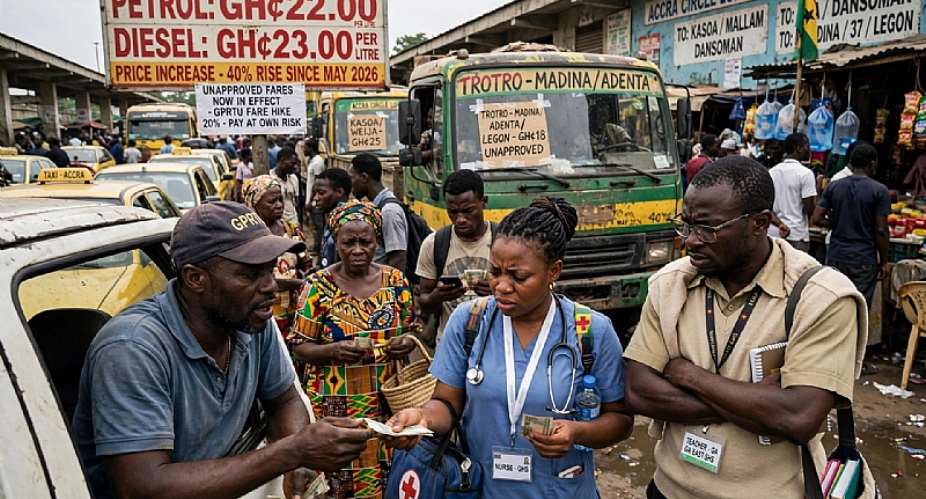
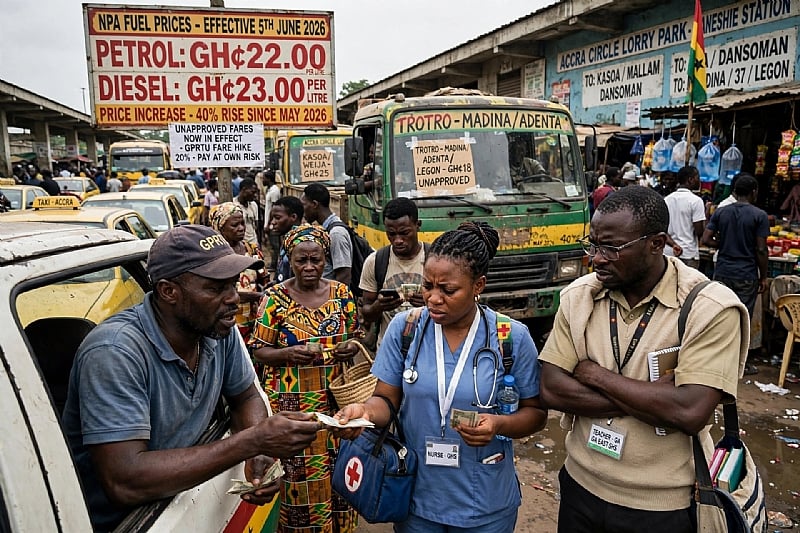
At the lorry park in Accra, the conversation is no longer about traffic. It is about money.
“Accra to Kasoa? That’s 15 cedis now,” a driver tells a passenger. The approved fare is 10 cedis. When questioned, he shrugs: “Fuel is 20 cedis per litre. What do you want me to do?”
But it gets worse. Instead of loading straight to Kasoa, some drivers now do what passengers call ‘short-distance loading’. They break the journey into three stops before Kasoa. That way, passengers end up paying more than even the 15 cedis direct fare.
That scene, repeated in bus terminals and taxi ranks across the country, tells the story of Ghana in 2026. Fuel prices have hit a record high, and the ripple effect is crushing ordinary commuters.
The New Economics at the Trotro Station
With pump prices at their highest ever, commercial drivers have adopted survival strategies. Some load only short distances and charge unapproved fares. Others reduce trips. Many simply park their vehicles as bait to coerce passengers to accept to pare irrational fares.
The result is the same: the ordinary Ghanaian pays more to move less. Market women, students, and traders are feeling it. But the group hit hardest is clear — civil and public servants.
Stagnant Pay, Rising Everything
For teachers, nurses, clerks, police officers, and thousands of other public workers, salaries have remained largely stagnant. Yet the cost of living has not stood still.
Utility bills keep climbing. Electricity Company of Ghana (ECG) and Ghana Water Company Ltd (GWCL) tariffs have gone up multiple times. School fees have been reviewed upward. Food prices at the market follow fuel prices weekly.
A mid-level civil servant in Accra who earns 3,500 cedis a month now spends over 1,300 cedis on transport and feeding alone. Add rent, utilities, and school fees for two children, and there is nothing left.
Some civil and public servants in cities like Accra and Tema are now working to pay bills. Sad to note that most of these public sector workers are not given rent and transport allowances.
The Human Cost of Inaction
This is not just an economic problem. It is a governance problem.
When the people who run our schools, hospitals, courts, and ministries cannot afford to get to work, service delivery suffers. When a nurse has to take two trotros to reach the hospital, she arrives tired. When a teacher spends half his salary on transport, morale drops.
More dangerously, desperation breeds compromise. Some public workers are forced into second jobs. Others look for “ways” to survive. The integrity of the public service itself is at risk.
What Needs To Happen Now
Ghana cannot control global oil prices overnight. But we can control how we protect our own people from the shock.
Government and the Fair Wages and Salaries Commission must urgently review the pay structure for poorly paid civil and public servants. The last cost-of-living allowance was not enough to match this inflation.
Adjusting the base salary of civil servants can go long way o cushion them. An immediate upward adjustment that reflects current fuel, food, and utility costs. Anything less than 25-30% for workers in the lowest pay brackets will be swallowed by inflation within months.
The government should also consider paying the civil servants rent and transport allowances. These allowances must be realistic enough to reflect the current situation. For instance, transport allowance should reflect actual commuting costs in Accra, Kumasi, Tamale, and other major cities.
Morever, the government can consider introducing fuel-linked support stipend for public sector workers until prices stabilize. Other countries have done it. We can too.
The Argument Against Delay
Some will argue there is no money. But there is also no money in a system where workers are too broke to be productive. There is no money in high absenteeism, low morale, and a public service that cannot retain talent.
Civil and public servants are not asking for luxury. They are asking to be able to get to work, pay their bills, and feed their families without borrowing every month.
They were on the frontline during COVID. They are on the frontline of service delivery now. To ask them to absorb this fuel crisis without support is to ask too much.
Conclusion
Fuel prices may be global, but the pain is local. And the people feeling it most are those who keep the state running.
If Ghana wants a functional public service in 2026 and beyond, then we must pay the people who run it a living wage. That means higher base pay. That means realistic rent and transport allowances. That means recognizing that a worker who cannot afford transport cannot deliver service.
The drivers have adjusted their fares. The market women have adjusted their prices. The utilities have adjusted their tariffs.
It is time government adjusted the pay of its workers. Before the public service collapses under the weight of the fuel crisis.
The author is an Information Officer.

Bala Ali, © 2026
Bala Ali is a Pan Africanist with biased interest towards the continent’s progress. More I am a Pan Africanist and a utilitarian who is passionate about the progress of the African continent. I believe that the progress of Africa is the duty of Africans and until Africans realise this and begin to entrust the administration of their countries into the hands of selfless Pan Africanists, the growth of the continent will forever remain a phantasmagoria of the fantasies of the real Pan Africanists.Column: Bala Ali
Disclaimer: “The views expressed in this article are the author’s own and do not necessarily reflect ModernGhana official position. ModernGhana will not be responsible or liable for any inaccurate or incorrect statements in the contributions or columns here.”
Follow our WhatsApp channel for meaningful stories picked for your day.

Top Stories


3 hours ago


Originally published on www.modernghana.com
