

August 28, 2026
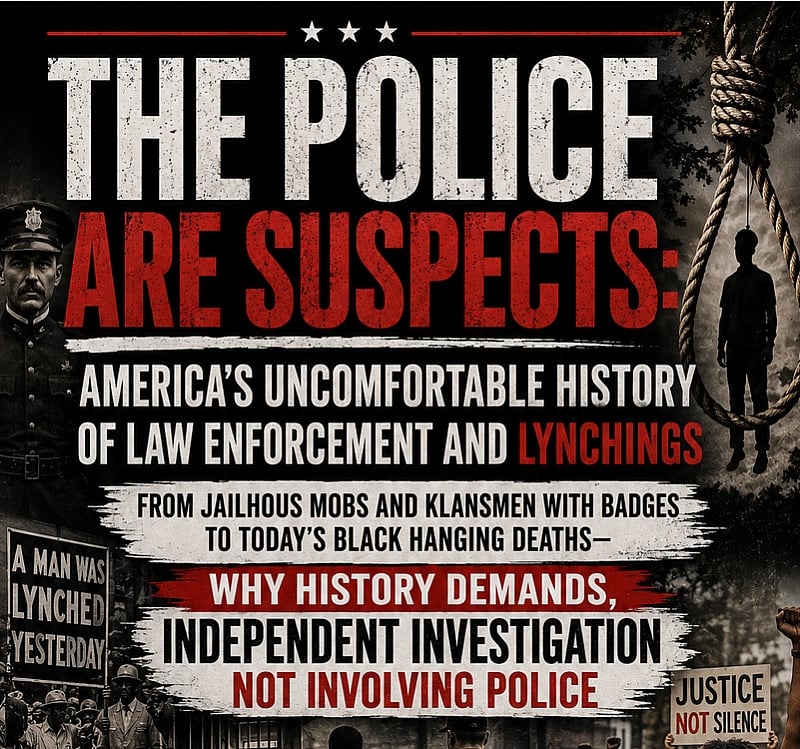
The Police Are Suspects: America’s Uncomfortable History Of Law Enforcement And Lynchings


Fri, 28 Aug 2026 Feature Article
The Police Are Suspects: America’s Uncomfortable History Of Law Enforcement And Lynchings
From Jailhouse Mobs and Klansmen With Badges to Today’s Black Hanging Deaths—Why History Demands Independent Investigation Not Involving Police
America has spent generations discussing lynching as though the rope acted alone.
It did not.
Behind America’s history of racial terror were not only Klansmen and mobs. There has always been and still is a brotherhood between law enforcement and the KKK. The historical record includes sheriffs, deputies, police officers, state troopers, and other government officials who sometimes protected Black citizens—but in documented cases also assaulted or killed Black Americans, collaborated with white supremacists, surrendered prisoners to mobs, obstructed justice, or failed to protect people in their custody.
That history deserves renewed attention as Black families and communities confront a series of highly publicized cases involving Black Americans found hanging during 2025–26.
Let me establish an important distinction at the beginning: historical evidence of law-enforcement involvement in racial killings does not prove that police committed any particular contemporary hanging death. The modern cases must stand on their own forensic evidence. Some have been ruled suicides; others have
generated questions or remained under investigation. No established evidence shows that all are connected.
But history also provides no reasonable basis for declaring law enforcement categorically beyond scrutiny. Not everything you see on YouTube, social media, or the internet is AI.
My position is simple: when circumstances surrounding a hanging are genuinely suspicious, police should not automatically be treated solely as investigators. Any credible possibility of officer involvement, evidence mishandling, conflicts of interest, or institutional misconduct should itself be independently investigated.
That conclusion does not come from imagination.
It comes from American history, but you must read it before it’s banned.
WHEN THE BADGE AND RACIAL TERROR OCCUPIED THE SAME SPACE
Consider the 1921 Tulsa Race Massacre.
A 2025 U.S. Department of Justice review concluded that Tulsa police deputized hundreds of white residents, including people who had been agitating for Dick Rowland’s lynching.
Law-enforcement officers helped organize special deputies and other white residents into forces that devastated Greenwood. The Equal Justice Initiative reports that the DOJ further found credible reports that some officers participated in murder, arson, and looting.
That is not speculation from social media.
That is the United States Department of Justice examining America’s historical record.
Then consider Elbert Williams.
Williams was an NAACP organizer working around Black voter registration in Brownsville, Tennessee. DOJ records state that Sheriff Samuel “Tip” Hunter abducted Williams and fellow NAACP member Thomas Davis from their homes in June 1940 and took them to jail for questioning about NAACP activities. Days earlier, the same sheriff, police officer Charles Reed, and a white mob had abducted another organizer, Elisha Davis, and threatened to kill him unless he left town. Williams disappeared after his detention and was found dead in the Hatchie River three days later. The historical investigation never established who killed him. Thank you, Dr. Henrietta Giles, for the work done at the University of Memphis with your dissertation for this article.
Notice the necessary precision: documented police involvement in the intimidation and detention is established; responsibility for Williams’s killing was never proven.
That distinction strengthens history rather than weakening it.
MISSISSIPPI BURNING: SOMETIMES THE KLAN WORE A BADGE
Perhaps no case makes the point more dramatically than the murders of civil rights workers James Chaney, Andrew Goodman, and Michael Schwerner. In this age of stranger fruit, it is now Mississippi Burning 2.0.
On June 21, 1964, Neshoba County Deputy Sheriff Cecil Price arrested the three men. According to the DOJ’s case summary, they were detained for six hours and released with the intent that they would be intercepted. Price and other Klan members subsequently stopped them, took them to a secluded location, and participated in the conspiracy that resulted in their murders. Historically, the cast and concert of ungodly activities where Black bodies are the human instruments were always played by law enforcement and other white narcissistic groups (formerly called supremacists).
Think about that.
The law-enforcement officer wasn’t merely accused of failing to stop the conspiracy.
He was part of it.
This is why “police could never be involved” is not a historically defensible assumption.
SOMETIMES POLICE WERE THE ONES WHO KILLED
Fifteen-year-old James Powell was killed in New York City in 1964 by an off-duty NYPD lieutenant. The officer maintained that he acted in self-defense. More than 25 witnesses saw portions of the confrontation, and the DOJ’s historical record notes significant differences among witness accounts. A grand jury ultimately declined to indict the officer.
Larry Payne was only 16 when a Memphis police officer fatally shot him during unrest surrounding the 1968 sanitation workers’ strike. The officer maintained self-defense; federal authorities ultimately declined prosecution. Yet DOJ’s historical file preserves dramatically conflicting witness evidence, including an account alleging that Payne had his hands behind his head immediately before he was shot.
It’s apparent that police, the courts, and the judicial system all had and still have a fetish for killing young Black males historically. There are numerous cases of executions of Black kids, the majority being Black males, as in the case of 14-year-old, 90-pound George Stinney. The youngest person executed in U.S. history. So sad, but so American. This is an experiment, yet its so intentional.
Then there is James Earl Motley.
The DOJ records that Elmore County Sheriff’s Deputy Harvey Conner stopped a vehicle carrying Motley in 1966 and struck Motley several times in the head with a slapjack or similar object. Motley later died in the county jail with multiple skull fractures and brain injuries. A federal civil-rights prosecution followed, but the deputy was acquitted.
Again, history requires precision. An acquittal matters. So does the documented conduct that caused federal authorities to prosecute the case in the first place.
JIMMIE LEE JACKSON: JUSTICE 45 YEARS LATER
Jimmie Lee Jackson’s story should permanently caution Americans against assuming that the first official outcome necessarily represents history’s final verdict.
Alabama State Trooper James Bonard Fowler shot Jackson following a civil-rights protest in Marion, Alabama, in February 1965. A state grand jury declined to indict Fowler that year.
Forty-five years later, Fowler pleaded guilty to manslaughter.
The FBI assisted the later state investigation, and Fowler received a six-month prison sentence in 2010.
That case should humble everyone.
“No indictment” in 1965 did not mean history had nothing more to discover.
AND SOMETIMES THE ALLEGATION COULD NOT BE PROVEN
Frank Morris provides another lesson—and an important warning against overstating evidence.
Two white men burned Morris’s Louisiana shoe shop in 1964, causing injuries that killed him. During investigations, information surfaced alleging possible involvement by local law-enforcement personnel, including a Concordia Parish sheriff’s deputy. The FBI investigated those allegations extensively but could not independently corroborate them and never definitively established who murdered Morris.
That case belongs in this conversation precisely because it demonstrates what responsible historical inquiry looks like:
Investigate the allegation. Follow the evidence. Report what can be established. Admit what cannot.
THE HISTORICAL RECORD—IN BRIEF
Here is a condensed list readers should remember:
- Tulsa Race Massacre (1921): DOJ found police deputized white residents and helped organize forces that devastated Greenwood; credible reports implicated some officers in murder, arson and looting.
- Elbert Williams (1940): A Tennessee sheriff abducted and detained the NAACP organizer amid a campaign of police-backed intimidation; Williams was later found dead. His killer was never established.
- Chaney, Goodman & Schwerner (1964): Deputy Sheriff Cecil Price arrested the civil-rights workers and participated with Klansmen in the conspiracy culminating in their murders.
- James Powell (1964): The 15-year-old was fatally shot by an off-duty NYPD lieutenant; conflicting witness accounts followed, and no indictment resulted.
- Frank Morris (1964): His murder generated allegations of local law-enforcement involvement that the FBI investigated but could not substantiate.
- Jimmie Lee Jackson (1965): Alabama State Trooper James Fowler shot him; 45 years later Fowler pleaded guilty to manslaughter.
- James Earl Motley (1966): A sheriff’s deputy struck him with a slapjack; Motley died with severe head injuries. The deputy was federally prosecuted and acquitted.
- Larry Payne (1968): A Memphis police officer fatally shot the 16-year-old; witness accounts and the officer’s self-defense claim conflicted, and no prosecution resulted.
These are different cases with different evidentiary records. They should not all be labeled “lynchings” in the same legal or historical sense. What connects them is something narrower but undeniable: law enforcement repeatedly appears inside America’s historical record of racial violence—not merely outside it investigating afterward.
WHAT THAT HISTORY MEANS IN 2026
Several Black Americans have recently been found hanging, producing understandable fear and historical comparisons. But these contemporary deaths cannot responsibly be declared lynchings simply because earlier lynchings occurred, says who? These are lynchings, as Emmett Till wasn’t found in a tree. Till was drowned, stabbed, shot, and brutally beaten—yes, a lynching! Till’s body was recovered from the Tallahatchie River in Mississippi. Here is that old fetish with young Black males being killed by white mobs or officers, generally white males.
My existing argument has made that distinction explicitly: contemporary lynching/hanging cases are not collectively proven lynchings, but historical analogy can by itself establish homicide—but for whom? History has linked law enforcement in some capacity to lynchings between the 1880s and the 1960s; how is it different today?
But the opposite shortcut is equally dangerous.
When circumstances genuinely warrant further investigation, families should be able to ask for independent forensic review without being dismissed as conspiratorial.
Preserve body-camera footage. Preserve surveillance.
Audit dispatch records.
Document everyone who entered the scene. Protect physical evidence and chain of custody. Examine cellphone and location data.
Complete toxicology and forensic pathology. Investigate conflicts of interest.
And when credible evidence creates a conflict involving the investigating department, bring in an outside agency or genuinely independent investigative authority.
My earlier formulation remains the standard: law enforcement should not automatically occupy only the investigator’s chair when evidence creates legitimate questions about law-enforcement conduct.
This isn’t a declaration that “the police did it.”
It is a demand that no institution be placed beyond evidence.
America’s Black communities did not invent this mistrust. They inherited a historical record containing slave patrols, Jim Crow enforcement, jailhouse mobs, Klansmen with badges, police violence against civil rights demonstrators, and killings for which accountability sometimes took generations.
History does not prove who caused today’s deaths. But history absolutely tells us why independent scrutiny matters.
The police were there before.
When credible evidence warrants the question, America must be courageous enough to investigate whether anyone wearing a badge was involved this time—and disciplined enough to accept whatever the evidence ultimately proves. The police are suspects.
ABOUT THE AUTHOR
Edmond W. Davis is a social historian, media strategist, professor, and documentary host. Davis is the founder of the National HBCU Black Wall Street Career Fest. A native of Philadelphia, PA, he, his wife, and his son currently live in the Little Rock, Arkansas. area. Davis is committed to cultural empowerment and educational equity through storytelling and civic engagement. In 2026, Davis was a grand marshal at the 38th Annual African American History Month Celebration Parade, the largest in the U.S. during Black History Month.
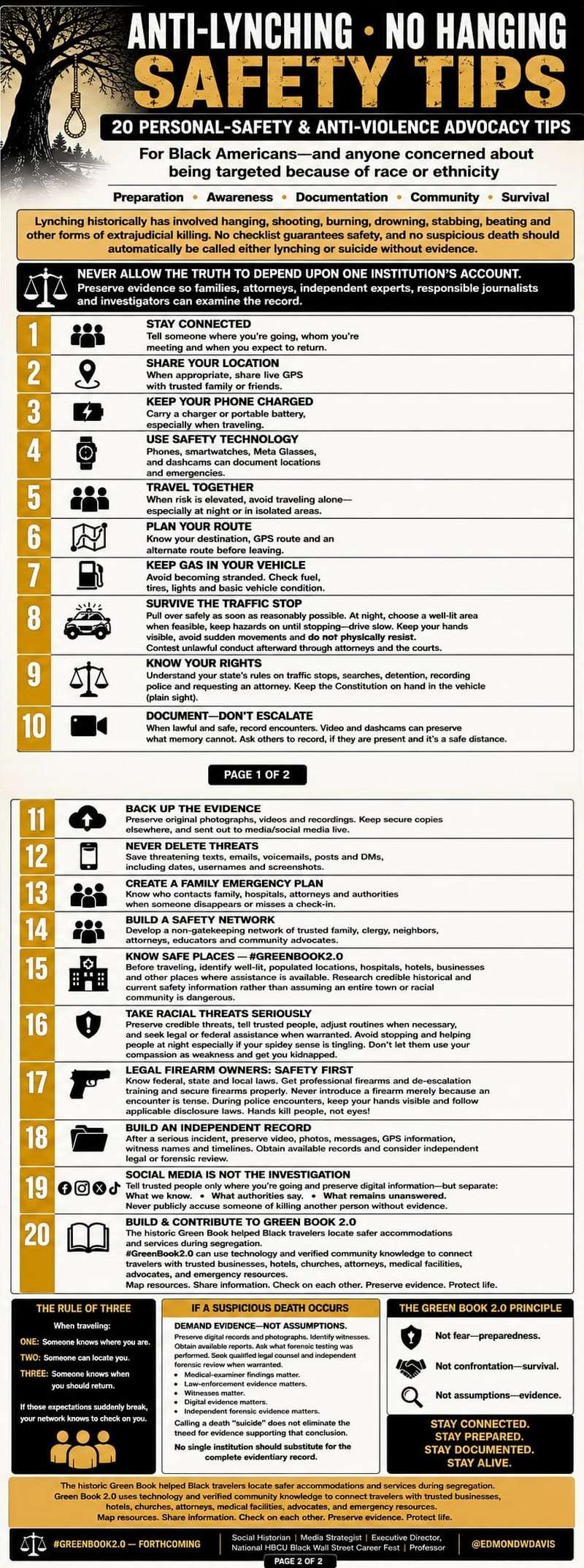
Attached are the 20 American Anti-lynching Tips for U.S. citizens who are targeted, in particular, Black Americans or African Americans:

Edmond W. Davis, © 2026
This Author has published 97 articles on modernghana.comColumn: Edmond W. Davis
Disclaimer: “The views expressed in this article are the author’s own and do not necessarily reflect ModernGhana official position. ModernGhana will not be responsible or liable for any inaccurate or incorrect statements in the contributions or columns here.”
Follow our WhatsApp channel for meaningful stories picked for your day.

Top Stories


Originally published on www.modernghana.com
