

July 14, 2026
The Illusion of Democratic Progress: Why Ghana Must Move Beyond Rhetoric to Real Governance
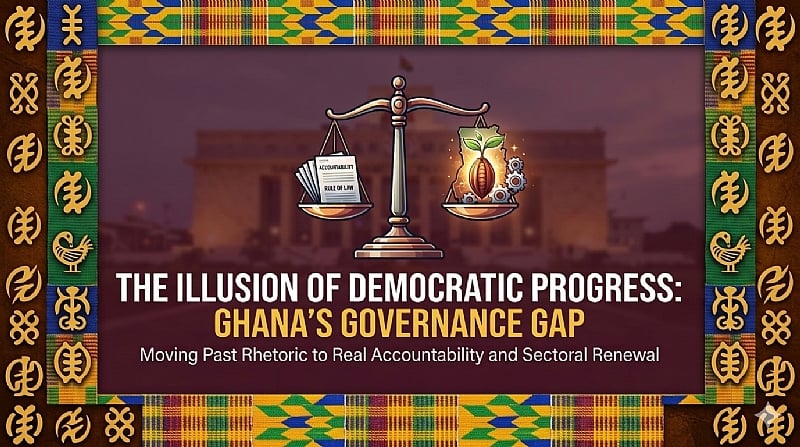


The Illusion of Democratic Progress: Why Ghana Must Move Beyond Rhetoric to Real Governance
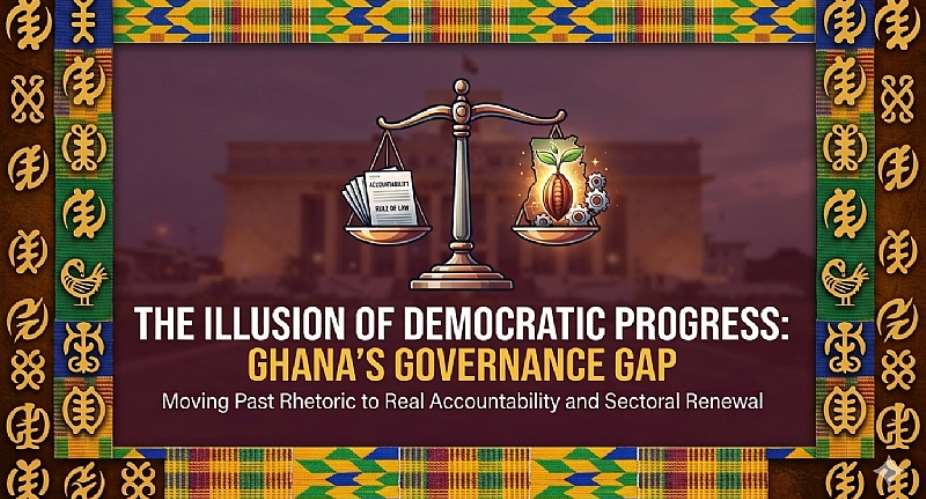
Ghana frequently receives praise as a beacon of democracy in West Africa. However, a widening gap exists between political rhetoric and the daily realities of its citizens. True democracy requires robust accountability, the strict enforcement of the rule of law, and tangible development across critical sectors. When governance fails to deliver these essentials, the foundations of the state weaken, leaving the population to question the utility of their vote.
The Reality of Ghana’s Democratic Deficit
While political transitions between the New Patriotic Party (NPP) and the National Democratic Congress (NDC) occur peacefully, institutional systemic gaps persist.
- Accountability Gaps: Public office holders rarely face stringent penalties for financial mismanagement or administrative failures.
- Selective Enforcement: The rule of law often appears compromised, with enforcement mechanisms favoring political elites over ordinary citizens.
- Political Polarization: The duopoly of the NPP and NDC shifts focus from long-term national development planning to short-term electoral gains.
- Regional Comparison: Neighboring nations like Burkina Faso have made targeted strides in specific sectors, highlighting the costs of Ghanaian bureaucratic inertia.
Sectoral Stagnation and Neglect
A critical look at the country’s core sectors reveals structural vulnerabilities that hinder sustainable growth.
- Agriculture: Limited modernization, inadequate storage infrastructure, and high post-harvest losses threaten national food security.
- Healthcare: Universal health coverage remains unfulfilled due to poorly equipped rural facilities and logistical bottlenecks within the NHIS.
- Housing: A massive urban housing deficit persists, driven by high construction costs and a lack of affordable public housing schemes.
- Ecosystem: Illegal mining (Galamsey) continues to devastate major water bodies and forest reserves with minimal regulatory deterrence.
- Infrastructure: Routine road networks remain incomplete or poorly maintained, inflating transit costs and impeding domestic trade.
Strategic Recommendations for National Renewal
To bridge the gap between democratic ideals and developmental realities, Ghana must implement decisive structural reforms.
- Independent Institutional Oversight: Empower anti-corruption bodies with full prosecutorial powers, completely insulated from executive interference.
- Enforce Strict Legal Sanctions: Apply public procurement laws equally to ensure mandatory penalties for every instance of misappropriated state funds.
- Binding National Development Plan: Legislate a long-term development framework that all successive governments must follow by law.
- Aggressive Agro-Processing Investment: Shift from raw commodity exports to localized processing to boost rural economies and stabilize food prices.
- Stricter Environmental Enforcement: Deploy non-partisan security task forces to permanently halt illegal mining in protected ecological zones.
Ghana’s democracy cannot survive solely on its past reputation or the peaceful conduct of elections. A functional democracy is measured by the quality of its public services, the integrity of its institutions, and the economic security of its people. If the nation continues to prioritize partisan politics over structural development, it risks total stagnation while its regional neighbors advance. It is time for Ghanaian citizens to demand absolute accountability, forcing leadership to transition from high-decibel rhetoric to measurable, impactful governance.
✍️ Retired Senior Citizen
For and on behalf of all Senior Citizens of the Republic of Ghana 🇬🇭
Teshie-Nungua
[email protected]

Atitso Akpalu, © 2026
A Voice for Accountability and Reform in Governance. More Atitso Akpalu is a prominent Ghanaian columnist known for his incisive analysis of political and economic issues. With a focus on transparency, accountability, and reform, Akpalu has been a vocal critic of mismanagement and corruption in Ghana’s governance. His writings often highlight the need for decentralization, local governance empowerment, and robust anti-corruption measures. Akpalu’s work aims to foster a more equitable and just society, advocating for policies that benefit all Ghanaians.
He is a passionate advocate for transparency and accountability. His columns focus on critical analysis of political and economic issues, with a particular interest in the energy sector, financial services, and environmental sustainability. He believes in the power of informed citizenry to drive positive change and am committed to highlighting the challenges and opportunities facing Ghana today.Column: Atitso Akpalu
Disclaimer: “The views expressed in this article are the author’s own and do not necessarily reflect ModernGhana official position. ModernGhana will not be responsible or liable for any inaccurate or incorrect statements in the contributions or columns here.”
Follow our WhatsApp channel for meaningful stories picked for your day.

Top Stories




<!–
–>
Originally published on www.modernghana.com
