

July 27, 2026
The Cycle of Retribution: Why Ghana Must Smash the Political ‘Table’ Instead of Turning It
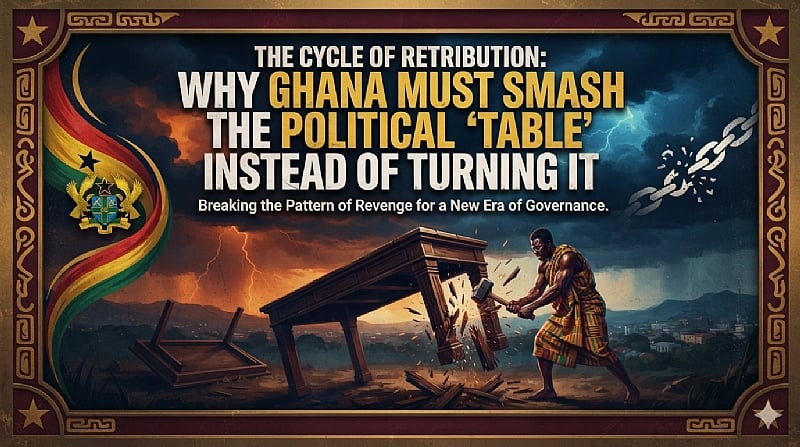


The Cycle of Retribution: Why Ghana Must Smash the Political “Table” Instead of Turning It
Moving Beyond Partisan Score-Settling Toward Lasting Institutional Safeguards
The Illusion of Rotational Justice
For over three decades, Ghana’s Fourth Republic has thrived on a fragile democratic consensus. Yet beneath the surface of peaceful transfers of power lies a destructive political idiom that threatens our democratic health: “The tables will turn.” It is a phrase whispered in courtrooms, bellowed from political stages, and weaponized on social media whenever the opposition faces state crackdowns, legal trials, or perceived victimization.
But as the digital landscape evolves and political actors boldly declare that “the table has already turned,” Ghanaians must pause to reflect. This continuous cycle of waiting for one’s turn to wield the whip does not strengthen our democracy—it paralyzes it. As the iconic French philosopher Voltaire once warned, “Those who can make you believe absurdities can make you commit atrocities.” True democratic progress is not about switching who holds the weapon; it is about disarming the weapon entirely.
The Warning on the Floor of Parliament
The fragility of this “table-turning” mindset was put on full display on the floor of Parliament during heated debates over governance and the legal targeting of politicians. Addressing the ruling government directly, Minority Leader Alexander Afenyo-Markin issued a stark warning regarding what he described as targeted intimidation and political persecution:
“You are threatening Members of Parliament with prosecution. Be careful; in 2028, you will be in opposition. … All you know is persecution, all you know is arrest them. But I want to assure you that we in the Minority and the NPP, we will walk through this valley of the shadow of death. We will not fear any evil.”
This parliamentary clash perfectly mirrors the biblical warning found in Galatians 5:15: “If you bite and devour each other, watch out or you will be destroyed by each other.” When our leaders view the law not as a shield for the innocent but as a boomerang meant to be thrown at opponents every eight years, the entire state infrastructure begins to decay.
The Wisdom of the Market Square
To understand why this retaliatory mindset is so toxic, we can turn to the legendary “King of Proverbs,” former Member of Parliament Alhaji A.B.A. Fuseini. His sharp, witty, and deeply philosophical sayings serve as a mirror to Ghana’s political realities.
- On the inevitability of political consequences: Hon. A.B.A. Fuseini reminds us that “When pepper settles on the forehead of a person, it is a sign of danger to the eyes.” When a sitting government normalizes the abuse of state power, they are simply placing pepper on their own foreheads for when they inevitably return to opposition.
- On trying to mask bad governance behind empty threats: He famously observed that “The man who is supposed to do his nightly duties blames errant mosquitoes when he fails.” Our leaders cannot continue to blame the opposition or future “tables turning” to justify their current administrative shortfalls.
- On the ultimate transparency of political actions: As the proverb goes, “A man who has died in the market needs no announcement for his funeral.” The abuse of power is entirely visible to the public; it cannot be hidden under the guise of “national security” or “due process.”
The Anatomy of the “Table-Turning” Mentality
To fix our political culture, we must first understand how this rhetoric actively undermines governance:
- Normalizing Retribution: The phrase shifts the goalpost from genuine judicial accountability to state-sponsored revenge. It implies that current prosecutions are merely political, justifying a reciprocal vendetta in the next administration.
- Weakening Institutions: It reduces critical bodies like the Judiciary, the Police Service, and state prosecutors to mere political chess pieces that change masters every electoral cycle.
- Chilling Free Speech: Citizens and journalists become caught in the crossfire. Instead of debating policies, public discourse becomes a game of survival, where dissenting voices are suppressed based on which party holds the executive seat.
- Stifling National Development: Continuity in governance suffers. New administrations routinely abandon viable national projects initiated by their predecessors, simply because they view them through the lens of a “turned table.”
Key Recommendations for a Mature Democracy
If Ghana is to break free from this transactional approach to state power, strategic structural reforms must be implemented:
- Insulate State Institutions: We must aggressively pursue constitutional amendments that decouple the appointments of the Inspector General of Police (IGP), the Chief Justice, and the Director of Public Prosecutions from direct presidential loyalty.
- Enforce Public Service Permanence: Chief Directors and institutional heads should be strictly career public servants protected from arbitrary dismissals during political transitions.
- Repeal Laws Prone to Political Abuse: Sections of the Criminal Offences Act (such as Section 207 and 208 regarding “false news”) must be clarified or reformed to ensure they are never weaponized to silence legitimate journalistic scrutiny or political speech.
- Pioneer a Binding National Development Plan: The National Development Planning Commission (NDPC) should be legally empowered to ensure that major infrastructure and economic projects transcend partisan timelines.
Actionable Suggestions for Citizens and Civil Society
Democracy does not change from the top down; it requires a fundamental shift in the mindset of the electorate:
- Reject Partisan Defense Teams: Civil Society Organizations (CSOs) and citizens must hold public figures accountable based on the rule of law, regardless of whether the accused wears an NPP or NDC badge.
- De-escalate Online Rhetoric: Social media communicators and political influencers should pivot from threats of future retribution to constructive policy criticisms that demand immediate institutional transparency.
- Demand Legislative Accountability: Constituents must actively pressure their Members of Parliament (MPs) to prioritize bipartisan legislation that limits executive overreach over state institutions.
Smashing the Table for a Shared Future
Ghana’s democracy cannot survive indefinitely on a diet of generational score-settling. As the ancient proverb wisely notes, “An eye for an eye only ends up making the whole world blind.” When political communicators argue over whether the table has already turned or is yet to turn, they miss the fundamental crisis of our time. The “table” itself represents an over-centralized executive power that is too easily weaponized against the very citizens it is meant to protect.
As we advance through successive electoral cycles, the youth, the working class, and the intellectuals of Ghana must refuse to be cheerleaders in this perpetual game of musical chairs. Let us stop celebrating the turning of the table. Instead, let us demand a robust, resilient democratic framework where the law protects everyone equally—no matter who sits at the head of the country.
A Powerful National Prayer for the Republic of Ghana
Almighty God, Creator of the Universe, and the Anchor of our great nation,
We lift our hearts to You today in deep gratitude for the peace, stability, and enduring democratic journey of our beloved motherland, Ghana. You have preserved us through turbulent seasons and kept our flag flying high as a beacon of hope, freedom, and justice on the African continent.
Lord, we come before You with a humble plea for the heart and soul of our democracy. We pray for our leaders across all political divides—grant them the wisdom of Solomon, the integrity of Joseph, and a spirit of true statesmanship. Uproot from their hearts any desire for malice, vengeance, or the weaponization of power. Replace the destructive hunger for political retribution with a profound passion for national development, justice, and the common good.
Forgive us, Lord, for the times we have allowed partisan colors to blind us to truth, fairness, and human dignity. Purge our airwaves, our social media spaces, and our parliamentary floors of bitterness, insults, and divisiveness.
We pray for our state institutions—the Judiciary, the Security Agencies, the Electoral Commission, and the Legislature. Anoint them with absolute independence, fearlessness, and impartiality. Let our laws be a shield for the weak and a guide for the strong, ensuring that justice flows like a mighty river across our cities, towns, and villages.
Bless the youth of Ghana with discerning minds. May they never become tools for violence or engines for political discord, but rather architects of a prosperous, united future. Guard our borders, protect our peace, and prosper our economy.
As we match forward into the future, let Your hand remain firm upon Ghana. Deliver us from the trap of a divided house, for Your Word reminds us that a house divided against itself cannot stand. Let righteousness exalt our nation, and let the peace that surpasses all human understanding guard our hearts and minds.
We commit the destiny of our Republic into Your holy hands.
God bless our homeland Ghana, and make our nation great and strong.
Amen.
✍️ Retired Senior Citizen
For and on behalf of all Senior Citizens of the Republic of Ghana 🇬🇭
📍 Teshie-Nungua
📧 [email protected]

Atitso Akpalu, © 2026
A Voice for Accountability and Reform in Governance. More Atitso Akpalu is a prominent Ghanaian columnist known for his incisive analysis of political and economic issues. With a focus on transparency, accountability, and reform, Akpalu has been a vocal critic of mismanagement and corruption in Ghana’s governance. His writings often highlight the need for decentralization, local governance empowerment, and robust anti-corruption measures. Akpalu’s work aims to foster a more equitable and just society, advocating for policies that benefit all Ghanaians.
He is a passionate advocate for transparency and accountability. His columns focus on critical analysis of political and economic issues, with a particular interest in the energy sector, financial services, and environmental sustainability. He believes in the power of informed citizenry to drive positive change and am committed to highlighting the challenges and opportunities facing Ghana today.Column: Atitso Akpalu
Disclaimer: “The views expressed in this article are the author’s own and do not necessarily reflect ModernGhana official position. ModernGhana will not be responsible or liable for any inaccurate or incorrect statements in the contributions or columns here.”
Follow our WhatsApp channel for meaningful stories picked for your day.

Top Stories


Originally published on www.modernghana.com
