

July 26, 2026
The Arrogance Of Environmental Impunity: Demanding A Permanent Restraining Order And Eco-Restoration After The Massacre Of A 200-Year-Old Kapok Heritage Tree At Tegbi-Kpota
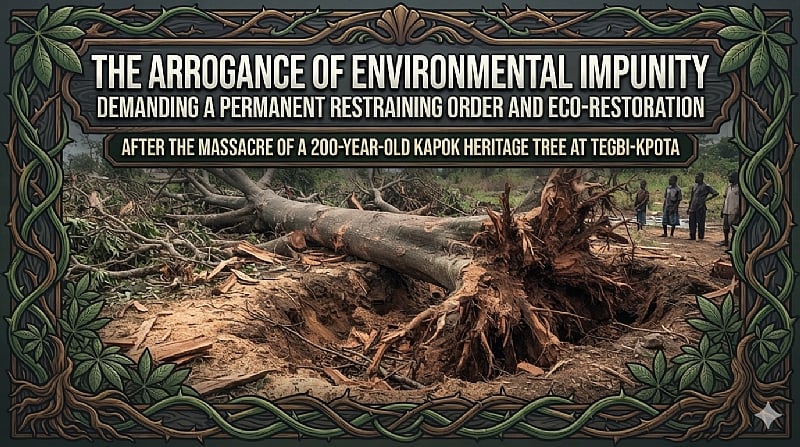


The Arrogance Of Environmental Impunity: Demanding A Permanent Restraining Order And Eco-Restoration After The Massacre Of A 200-Year-Old Kapok Heritage Tree At Tegbi-Kpota
The Massacre at Tegbi-Kpota and the Defiance of Law
Every rainy season, our airwaves fill with predictable, routine lamentations regarding choked storm drains, flooded coastal communities, and structural devastation across our wetland plains. While regulatory bodies look away, the underlying cause remains unchanged: the absolute, unchecked arrogance of speculative developers who treat Ghana’s designated wetlands and ecological treasures with deep contempt.
The recent environmental tragedy at Tegbi-Kpota, within the strictly protected boundaries of the globally recognized Keta Lagoon Complex Ramsar Site, highlights a dangerous reality. An aggressive developer, Mr. Bright Oneal Fiagbey—operating under the cover of an unrelated local reference code painted on a nearby wall (AnDA/Sect-Tegbi/2020/131)—deliberately crossed visible, ancestral family boundaries. With absolute malice, he executed the unlawful felling of an irreplaceable, 200-year-old historic Kapok heritage tree (Ceiba pentandra) rooted deep within our ancestral family territory.
This was not a mistake; it was an act of eco-vandalism committed without a Salvage Permit, a Timber Utilization Permit, or any regulatory clearance from the Forestry Commission. Worse still, the suspect continues to occupy the encroached zone and has issued active threats to fell the remaining five (5) standing ancient Kapok trees in the grove. This acts as a direct, lawless challenge to state authority, local police enforcement, and the sovereign laws governing our environment.
STATUTORY VIOLATIONS CHARGED AGAINST THE DEVELOPER
1. CRIMINAL OFFENCES ACT, 1960 (ACT 29) SEC. 157 & 172 – Aggravated Criminal Trespass & Malicious Destruction of Property
2. TIMBER RESOURCES MANAGEMENT ACT, 1997 (ACT 547) – Illegal Harvesting of Naturally Occurring Timber Without Permit
3. WETLAND MANAGEMENT (RAMSAR SITES) REGULATIONS, 1999 (L.I. 1659) – Unauthorized Destruction of Keystone Flora in Protected Wetlands
Grounded in an Unwavering Track Record of Environmental Advocacy
This is not an isolated complaint from a passive bystander. My dedication to protecting Ghana’s critical ecosystems is thoroughly documented on this very platform, where I have consistently exposed systemic encroachment and fought to preserve our ecological sanctuaries. For verification and context on this ongoing national crisis, readers can access my previously published exposés:
- Sakumo Ramsar Site Protection Campaign: SAKUMO RAMSAR SITE: A Sacred Trust, Not a Negotiable Parcel
- Kpeshie Lagoon Encroachment Analysis: Reviving The Kpeshie Lagoon: A Blueprint For Restoration And Protection
Just as I argued in those previous publications, the destruction of a 200-year-old Kapok tree is a direct hit to our survival infrastructure. Its vast root network stabilizes coastal soils, anchors the local water table, and shields Tegbi-Kpota from severe seasonal flooding. For the Besah Akpalu and Geoffrey Klu Akpalu Family, these groves are sacred customary spaces that connect modern generations to their ancestry. Allowing a reckless developer to destroy these trees to put up concrete structures is an insult to our national identity, environmental laws, and the community’s future.
Our Uncompromising Demands: Restraining Orders and Restoration
We have formally petitioned the Anloga District Police Headquarters and the Protected Area Site Manager of the Wildlife Division, with official duplicate copies sent to the Attorney-General and Minister for Justice in Accra to track this case directly. We state clearly that standard, slap-on-the-wrist fines are entirely unacceptable. We are demanding the following strict legal remedies in the strongest terms possible:
- A Permanent, Absolute Restraining Order: We request that the judiciary and state security apparatus issue a permanent restraining order completely barring Mr. Bright Oneal Fiagbey, his agents, assigns, and workers from ever stepping foot on our ancestral family land again. Any further entry must be treated as a direct, arrestable criminal offense.
- Mandatory Eco-Restoration Order: The suspect must be compelled by a court-mandated order to fund the full scientific replanting and long-term care of a mature replacement Kapok tree at the exact spot of destruction, alongside paying full financial restitution to the family for the lost ecological heritage.
- Swift Custodial Prosecution: The state must initiate an immediate criminal trial to impose the maximum custodial sentencing allowed under Act 29 and Act 547.
If a developer can destroy a 200-year-old heritage tree within a protected Ramsar site without consequences, then no ecological asset in Ghana is secure. The state must act firmly now to save the remaining five trees and restore what was broken.
THE AUTHOR’S UNCOMPROMISING RECORD ON RAMSAR SITES PROTECTION
The crisis at Tegbi-Kpota is not an isolated complaint; it is the latest battleground in a continuous, documented crusade to protect Ghana’s collapsing ecosystems. As a writer and advocate on this platform, my public voice has mirrored the escalating severity of Ghana’s climate and enforcement crises—evolving from strategic policy proposals to direct demands for state and security intervention:
- The Visionary Blueprint (March 2025): In Proposal for The Preservation And Restoration Of Ghana’s Six Ramsar Sites (20 March 2025), I laid out a comprehensive, hopeful national policy blueprint. I argued for aggressive lagoon dredging, massive mangrove restoration, and strict boundary enforcement, urging the state to treat wetlands as sacred, untouchable national assets.
- The Spatial Justice Framework (2025): In National Cathedral and Environmental Justice and my subsequent analyses of the Adenta Green Housing Project, I expanded this lens to look at broader land-use abuse. I explicitly warned that allowing unchecked, speculative development—whether commercial, residential, or religious—to override ecological boundaries was actively eroding the physical foundations of our republic.
- The Shift to Emergency Action (June 2026): Following the devastating, preventable Accra floods, the time for patient diplomacy ended. In Call a Spade a Spade: President Mahama Must Deploy the Military and VRA to Reclaim Our Ramsar Sites (30 June 2026), my tone shifted to urgent alarm. Seeing areas like the Kpeshie Lagoon completely suffocated by lawless developers, I openly declared that local government structures had failed and called for the immediate deployment of the military and the Volta River Authority (VRA) to forcefully reclaim our wetlands.
- Endorsing Strict Enforcement (July 2026): Days later, in President Mahama’s Bold Gambit: Why Ghanaians Must Support the Military’s Mission to Save Our Ramsar Sites (4 July 2026), I fiercely defended the deployment of the 48 Engineer Regiment to dismantle illegal encroachments. I framed this military-backed ecological justice as a historic, necessary break from decades of political timidity.
The Warning to the Anloga District Assembly
The narrative arc of my writings shows a clear, undeniable trajectory: moving from policy ideals in 2025 to demanding full-scale security enforcement by mid-2026. The lawless eco-vandalism perpetrated by Mr. Bright Oneal Fiagbey at Tegbi-Kpota represents the exact brand of defiance I have spent years warning the nation about. If the 48 Engineer Regiment can be deployed to break the backs of encroachers at Kpeshie and Sakumo, the authorities in the Volta Region must understand that the Keta Lagoon Complex Ramsar Site will not be left to the mercy of rogue developers. We will settle for nothing less than a permanent restraining order, a criminal trial, and a mandatory court-ordered restoration of our ancestral environment.
THE IMPERATIVE OF ENVIRONMENTAL ACCOUNTABILITY
The deliberate destruction of the 200-year-old Kapok heritage tree at Tegbi-Kpota represents a severe breach of environmental ethics and communal heritage. This act goes beyond local ecological damage; it signals a dangerous trend of environmental impunity where short-term interests override heritage conservation. Protecting vital ecological landmarks requires a shift from discretionary environmental policies to enforceable accountability measures. Immediate legal interventions, including a permanent restraining order and community-led eco-restoration, are necessary to heal the affected ecosystem and establish a clear deterrent against future environmental violations.
RECOMMENDATIONS TO KEY STAKEHOLDERS
1. Ramsar Site Manager (Wildlife Division of the Forestry Commission, Anloga)
- Enforce Wetland Regulations: Strictly monitor the Tegbi-Kpota zone to prevent further encroachment into fragile coastal and lagoon ecosystems.
- Lead Ecological Restoration: Provide technical guidance for soil rehabilitation and select ecologically compatible native species to replace the destroyed Kapok tree.
- Conduct Boundary Audits: Audit the exact boundaries of the local protected area to ensure no peripheral developer can exploit ambiguous land claims.
2. District Commander (Anloga Police Headquarters, Ghana Police Service)
- Conduct Thorough Investigations: Fast-track criminal investigations into the individuals or corporate actors who authorized and executed the destruction of the heritage tree.
- Enforce Restraining Orders: Deploy personnel to secure the site and arrest any individuals violating active court injunctions or environmental protection notices.
- Enhance Protective Patrols: Increase police presence around vulnerable cultural and ecological landmarks within the district to deter future environmental vandalism.
3. Traditional Authorities and Local Leadership
- Declare Sacred Sites: Formally register remaining heritage trees and community groves as local cultural protection zones.
- Enforce Customary Sanctions: Impose traditional penalties and restorative actions on entities committing ecological damage.
- Lead Local Monitoring: Establish community-based watch groups to monitor and report unauthorized land clearing.
4. Civil Society and Environmental Advocacy Groups
- Pursue Legal Actions: File for a permanent restraining order in court to protect the Tegbi-Kpota site from further commercial encroachment.
- Mobilize Restoration Funds: Coordinate crowdsourcing campaigns to fund soil rehabilitation and tree-planting initiatives.
5. Local Government and Regulatory Bodies (Anloga District Assembly & EPA)
- Zoning Enforcement: Deny commercial permits on land cleared through illegal environmental practices.
- Instate Heavy Penalties: Apply maximum statutory fines against individuals who destroy identified heritage flora.
DIRECT MEMORANDUM TO THE EXECUTIVE BRANCH
TO: His Excellency John Dramani Mahama, President of the Republic of Ghana and Commander-in-Chief of the Ghana Armed Forces
REGARDING: Executive Intervention Against Corporate and Individual Environmental Impunity at Tegbi-Kpota
Executive Suggestions for Institutional Action:
- Establish a National Heritage Tree Registry: Issue an Executive Instrument directing the Ministry of Lands and Natural Resources to catalogue and protect all trees over a century old nationwide.
- Enforce a Zero-Impunity Policy: Align the resolution of this incident with the presidency’s focus on transparent governance, ethical leadership, and rejecting public or private impunity.
- Mandate Inter-Agency Collaboration: Order a coordinated joint task force linking the Anloga Wildlife Division (Ramsar Managers) and the Anloga District Police to proactively protect state-managed wetlands and community heritage landmarks.
- Strengthen Constitutional Protections: Support environmental governance initiatives that turn citizen duties to protect and restore ecosystems into active, enforceable legal obligations.
✍️ Retired Senior Citizen
For and on behalf of all Senior Citizens of the Republic of Ghana 🇬🇭
Teshie-Nungua
[email protected]

Atitso Akpalu, © 2026
A Voice for Accountability and Reform in Governance. More Atitso Akpalu is a prominent Ghanaian columnist known for his incisive analysis of political and economic issues. With a focus on transparency, accountability, and reform, Akpalu has been a vocal critic of mismanagement and corruption in Ghana’s governance. His writings often highlight the need for decentralization, local governance empowerment, and robust anti-corruption measures. Akpalu’s work aims to foster a more equitable and just society, advocating for policies that benefit all Ghanaians.
He is a passionate advocate for transparency and accountability. His columns focus on critical analysis of political and economic issues, with a particular interest in the energy sector, financial services, and environmental sustainability. He believes in the power of informed citizenry to drive positive change and am committed to highlighting the challenges and opportunities facing Ghana today.Column: Atitso Akpalu
Disclaimer: “The views expressed in this article are the author’s own and do not necessarily reflect ModernGhana official position. ModernGhana will not be responsible or liable for any inaccurate or incorrect statements in the contributions or columns here.”
Follow our WhatsApp channel for meaningful stories picked for your day.

Top Stories


Originally published on www.modernghana.com
