

July 10, 2026
Sweet Sovereignty: Reclaiming Ghana’s Sugar Wealth Through the SICE Framework
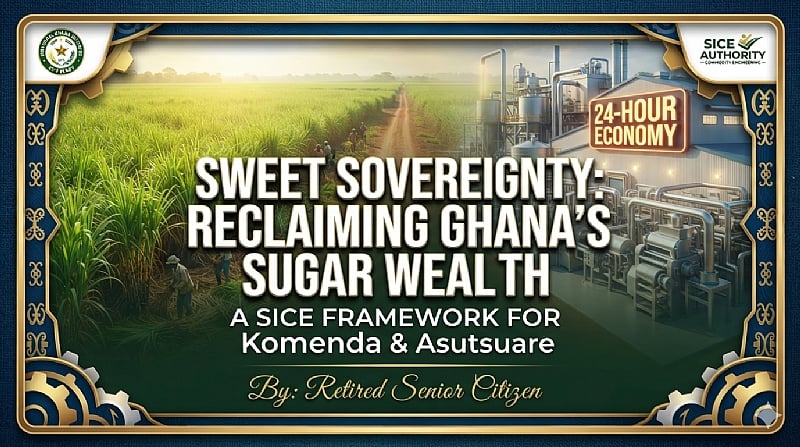


Sweet Sovereignty: Reclaiming Ghana’s Sugar Wealth Through the SICE Framework
Turning a $500 Million Import Liability Into a 24-Hour Industrial Engine

The $500 Million Bleed
For decades, Ghana’s economic landscape has been haunted by the ghosts of industrial underachievement, none more prominent than our abandoned sugar mills. Today, the nation finds itself trapped in a bitter paradox: we sit on vast expanses of highly fertile, arable land, yet Ghana spends an astronomical $500 million annually on sugar imports. Data from the Ghana Export Promotion Authority (GEPA) indicates that our national consumption hovers around 370,000 metric tons per year, heavily driven by the domestic food, beverage, and pharmaceutical sectors. Worse still, economists project this domestic demand will skyrocket to 872,000 metric tons by 2030.
Every single cedi spent bringing in white refined sugar from Brazil or Europe is a cedi stripped directly from the pockets of Ghanaian youth, farmers, and local engineers. The historical collapse of both the Komenda Sugar Factory and the Asutsuare Sugar Factory in the late 1980s was induced by water deficits, volatile energy costs, and weak supply frameworks. It is time for a drastic, structural shift. We must abandon the fragmented “One District, One Factory” (1D1F) model and fully transition to the newly legislated Sovereign Industrial & Commodity-Engineering Ecosystems (SICE) paradigm. Under the SICE framework, powered by the 24-Hour Economy Authority, Ghana can turn its annual half-billion-dollar import loss into a localized manufacturing engine.
The Reality Check: Where Do Komenda and Asutsuare Stand?
To solve a problem, we must be brutally honest about its current state. The twin pillars of Ghana’s historical sugar independence are currently completely offline: [1]
- Komenda Sugar Factory (Central Region): The plant remains completely dormant and grounded. The Ministry of Trade, Agribusiness and Industry confirmed the factory was recently disconnected from the national water and electricity grids over massive unpaid utility bills. Its generators, motors, and boiler top coils require complete overhauls. However, Sector Minister Elizabeth Ofosu-Adjare has officially committed to a firm operational target by the end of 2026, backed by newly acquired state lands for dedicated sugarcane cultivation.
- Asutsuare Sugar Factory (Eastern Region): Originally engineered in 1965 by Polish state builders to crush 2,000 tons of cane daily, the legacy state site was sold off years ago. Today, its core infrastructure has been repurposed by private investors to manufacture plastic and paper products, while the old sugarcane fields have been fractured into smallholder rice and fish farming. Reviving Asutsuare requires a completely fresh, capital-intensive brownfield setup on adjacent fertile lands near Kpong.
SICE Blueprint: Strategic Steps to Bring Both Factories Into Production
Achieving sugar self-sufficiency requires a systematic, infrastructure-led approach rather than short-sighted political promises. Bringing both factories to life demands a strict execution of the SICE model:
1. Secure the Core SICE Machinery Layout
- Each facility must be re-engineered to handle a minimum grinding capacity of 1,250 to 2,000 tons of cane per day.
- Deploy continuous vacuum pans, liming stations, and high-speed multi-roller crushing tandems to optimize sucrose extraction.
- Build automated carbonatation and multi-stage filtration lines to ensure local factories can produce high-grade refined liquid sucrose to supply local beverage and pharma conglomerates.
2. Establish Off-Grid Bagasse Co-Generation
- High energy costs and grid instability collapsed these factories historically. Both plants must deploy heavy-duty bagasse-fired boilers.
- By burning fibrous sugarcane waste, the factories can generate their own clean electricity and steam to run 24-hour production rotations without draining the national grid.
3. Restructure the Out-Grower Economics
- The current market rate for raw sugarcane in Ghana sits at roughly $160 (approx. GH₵1,760) per metric ton.
- Factories must offer competitive out-grower pricing structures and inputs to prevent local farmers from selling their yields exclusively to local artisanal akpeteshie gin distillers.
- Anchor processors must secure long-term contracts across a minimum pool of 5,000 hectares of irrigated land per factory to insulate the mills from crop deficits.
4. Activate the 24-Hour Multi-Shift Model
- Align factory floor operations directly under the 24H+ Economy Portal framework.
- By structuring labor into a strict three-shift rolling system (8 hours each), the factories can optimize production, maximize capital equipment lifespan, and generate over 7,500 direct industrial jobs.
Economic Outlook: SICE Framework vs. Open Import Model
Transitioning to the SICE framework fundamentally restructures the commercial viability of domestic manufacturing compared to the risks of open market imports:
- Market Demand Certainty:
- SICE Framework: High. Local industrial off-takers are legally bound to domestic supply channels.
- Open Import Model: Low. Local demand fluctuates wildly based on cheaper, subsidized global sugar dumping.
- Raw Material Production Costs:
- SICE Framework: Variable. Highly dependent on local out-grower irrigation and yield efficiency.
- Open Import Model: Predictable. Costs are tied directly to international commodity market index prices.
- Utility Overhead Tariffs:
- SICE Framework: Low. Factory power demands are heavily optimized via 24H+ off-peak smart metering and bagasse energy.
- Open Import Model: High. Processing setups face high standard industrial daytime pricing tariffs.
- Capital Investment Appeal:
- SICE Framework: High. A protected domestic marketplace insulates long-term equity from outside shocks.
- Open Import Model: Low. High risk of factory shutdown due to predatory price competition from imports.
Crucial Recommendations for Government Action
To shield these critical investments from global commodity fluctuations and cheap, subsidized imports, the state must implement targeted economic levers:
- Institute a Phased Import Ban on Refined Sugar: Once local SICE facilities clear initial technical trials, the government should roll out progressive import caps on refined sugar to insulate domestic factory profitability.
- Fast-Track SICE Customs Waivers: The Ghana Revenue Authority (GRA) must grant immediate, friction-free import duty exemptions on all specialized milling machinery under the Exemptions Act 2022 to reduce initial capital expenditure burdens.
- Provide Structured Industrial Energy Rebates: The Ministry of Energy must establish a dedicated, low-tier off-peak utility tariff for sugar refineries to ensure their auxiliary operations remain competitive during late-night shift cycles.
- Create a Dedicated Agro-Credit Facility: The state must partner with commercial banks to offer low-interest, long-term credit lines tailored to out-grower cooperatives for tractor procurement, fertilizers, and modern irrigation lines [2026/07/affordable-long-term-credit-critical-for-24-hour-economy-agi].
Addendum I: SICE-Compliant Out-Grower Pricing Contract Template
FORWARD CONTRACT FOR THE PROCUREMENT OF AGRICULTURAL COMMODITY (SUGARCANE)
BETWEEN:
The SICE Anchor Processing Enterprise (hereinafter referred to as the “Buyer”) and
The United Sugarcane Out-Grower Cooperative Society (hereinafter referred to as the “Seller”).
1. Core Objectives & Framework Alignment
This agreement establishes the legal, technical, and commercial terms under which the Seller agrees to cultivate, harvest, and supply raw sugarcane exclusively to the Buyer. This contract is executed in alignment with the guidelines of the Sovereign Industrial & Commodity-Engineering Ecosystems (SICE) framework and the 24-Hour Economy Authority industrial supply directives.
2. Pricing Architecture & Pegging Mechanism
- Base Market Rate: The base farmgate commodity price is pegged at US$160.00 (approx. GH₵1,760.00) per metric ton [M/T] for clean, millable sugarcane delivered to the factory gate.
- The Distiller Hedge Incentive: To insulate the supply pipeline against side-selling to local artisanal akpeteshie distillers, the Buyer agrees to pay an active Premium Cash Premium of 5% above the local prevailing market average if the Seller maintains a 100% monthly delivery quota.
- Currency Variance Clause: Payments shall be disbursed in Ghana Cedis (GH₵). The transaction rate shall be determined using the prevailing Bank of Ghana interbank foreign exchange rate on the exact date of weighing and invoice generation. [2]
3. Quality & Sucrose Technical Specifications
All deliveries must pass the on-site laboratory technical audit prior to offloading:
- Minimum Brix Value: 18% (total soluble solids content).
- Minimum Purity Level: 85% sucrose content in juice.
- Harvest-to-Crush Window: The maximum allowable duration between harvesting (cutting) and delivery to the factory scale is 24 hours. Any cane exceeding a 36-hour delay is subject to a 15% pricing penalty due to post-harvest sucrose inversion.
- Foreign Matter Threshold: Deliveries must be free of trash, roots, mud, and binding ropes.
4. Input Support & Credit Repayment Scheme
- Input Provisioning: The Buyer will advance high-yield seed cane varieties, specialized fertilizers, and mechanized harvesting services to the Seller at the start of the planting cycle.
- Recovery Mechanism: The cost of these inputs will be treated as an interest-free production advance. The outstanding amount will be systematically deducted from the Seller’s gross revenue at the factory weighbridge over the first three consecutive harvest deliveries.
Addendum II: GRA Customs Code Classification & Duty-Free Clearance Guide
To process immediate import duty waivers under the Exemptions Act 2022 (Act 1083) via the Ghana Revenue Authority (GRA) customs platform (Integrated Customs Management System – ICUMS), SICE-registered entities must utilize the exact Harmonized System (HS) Codes detailed below.
1. Machinery Classification Codes (ECOWAS Common External Tariff)
- Sugar Manufacture Industrial Machinery
- HS Code: 8438.30.00
- Description: Machinery for the extraction or manufacture of sugar (crushing mills, cane diffusers, liming tanks).
- SICE Statutory Rate: Import Duty: 0% | VAT: 0% | Eco Levy: Exempted.
- Industrial Centrifuges and Separators
- HS Code: 8421.19.00
- Description: Centrifugal separators for isolating sugar crystals from molasses.
- SICE Statutory Rate: Import Duty: 0% | VAT: Exempted.
- Large-Scale Steam Generation Boilers (Co-Gen Ready)
- HS Code: 8402.11.00
- Description: Watertube boilers with a steam production exceeding 45 tons per hour (bagasse-fired systems).
- SICE Statutory Rate: Import Duty: 0% | VAT: Zero-Rated.
2. Mandatory Documentation for ICUMS Clearance Pipeline
To trigger the automated 0% duty protocol within the ICUMS portal, the importer’s clearing agent must scan and upload the following compliance attachments:
- SICE “24/7 Ready” Certificate: Issued directly by the 24-Hour Economy Authority, verifying the plant’s three-shift labor framework.
- MOITI Ministerial Recommendation Letter: A formal endorsement letter signed by the Sector Minister of Trade, Agribusiness and Industry, authorizing custom tax relief for the specific consignment.
- Technical Engineering Bill of Lading: Clean bill of lading matching the exact technical serial numbers inscribed on the factory’s industrial blueprint.
- EPA Clearance Certificate: Formally approving the assembly and operational deployment of the heavy-duty bagasse co-generation plant.
A Call to Industrial Action
Ghana can no longer afford to import what it has the natural capacity to produce. The $500 million bleeding out of our central bank accounts every year is a profound national security failure. Reviving the Komenda Sugar Factory by 2026 and re-establishing an advanced brownfield processing hub in Asutsuare is completely achievable through the rigorous application of the Sovereign Industrial & Commodity-Engineering Ecosystems (SICE) framework.
By enforcing strict multi-shift labor schedules, securing our raw material pipelines, and shielding our domestic market from unfair dumping, we can successfully restore our industrial heritage. Let us stop talking about industrialization and start engineering it. The tools are ready, the policy is codified, and the land is waiting—let’s bring Ghana’s sugar back to life.
✍️ Retired Senior Citizen
For and on behalf of all Senior Citizens of the Republic of Ghana 🇬🇭
Teshie-Nungua
[email protected]

Atitso Akpalu, © 2026
A Voice for Accountability and Reform in Governance. More Atitso Akpalu is a prominent Ghanaian columnist known for his incisive analysis of political and economic issues. With a focus on transparency, accountability, and reform, Akpalu has been a vocal critic of mismanagement and corruption in Ghana’s governance. His writings often highlight the need for decentralization, local governance empowerment, and robust anti-corruption measures. Akpalu’s work aims to foster a more equitable and just society, advocating for policies that benefit all Ghanaians.
He is a passionate advocate for transparency and accountability. His columns focus on critical analysis of political and economic issues, with a particular interest in the energy sector, financial services, and environmental sustainability. He believes in the power of informed citizenry to drive positive change and am committed to highlighting the challenges and opportunities facing Ghana today.Column: Atitso Akpalu
Disclaimer: “The views expressed in this article are the author’s own and do not necessarily reflect ModernGhana official position. ModernGhana will not be responsible or liable for any inaccurate or incorrect statements in the contributions or columns here.”
Follow our WhatsApp channel for meaningful stories picked for your day.

Top Stories


<!–
–>
Originally published on www.modernghana.com
