

July 27, 2026
Nigeria Can Earn More Money From Agriculture Than Crude Oil, Says Peter Obi
4 hours ago | General News
Nigeria Can Earn More Money From Agriculture Than Crude Oil, Says Peter Obi
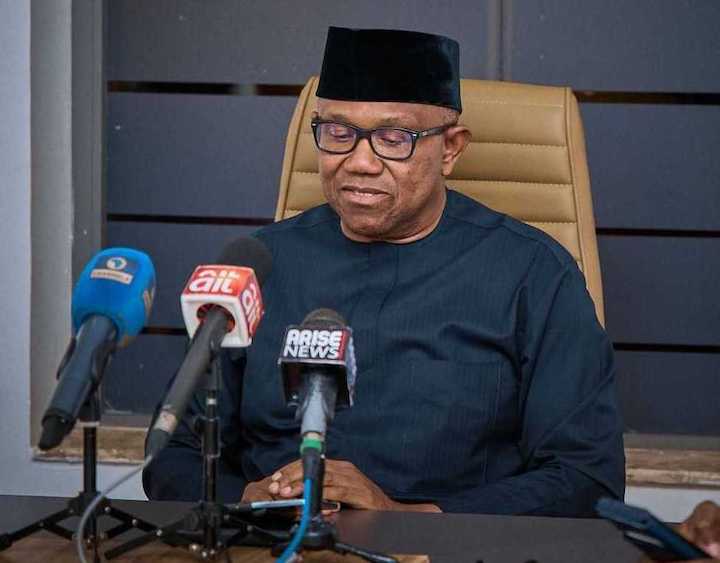
The presidential candidate of the Nigeria Democratic Congress (NDC), Peter Obi, has said Nigeria has the potential to generate more revenue from agriculture than crude oil if the country adopts policies that prioritise production, manufacturing and support for small businesses.
Obi made the remarks during an interview on Sunday Politics, where he outlined his economic blueprint for transforming Nigeria from what he described as a consumption-driven economy into a production-led one.
According to the former Anambra State governor, agriculture remains the fastest path to creating jobs, reducing poverty and stimulating sustainable economic growth.
“The only way to pull Nigeria out of poverty, or even genuinely grow GDP, is through production, not consumption. That production starts with agriculture, which gives you the food you need, raw materials for your factories, and jobs. That’s a win-win,” he said.
Obi argued that Nigeria possesses vast uncultivated arable land capable of feeding the country and producing export commodities that could surpass earnings from crude oil.
“This country can produce enough of what we can eat, and we can actually make more money from agriculture than we make from oil because, as it is today, we have vast uncultivated land,” he said.
Using rice production as an example, Obi lamented that Nigeria currently produces fewer than 10 million tonnes of unmilled rice annually, blaming years of cheap food imports for weakening local farmers.
“We’ve used cheap importation to kill our farmers. We can do more,” he said.
To support his argument, Obi compared Nigeria with Bangladesh, noting that despite its much smaller land mass, the Asian country now produces between 15 and 16 million tonnes of unmilled rice annually, ranking among the world’s largest producers.
He also cited the Netherlands as a model of agricultural success, stating that the European country generates more than €120 billion annually from agricultural exports despite occupying a land area far smaller than Nigeria’s Niger State.
“The Netherlands earns over €120 billion—about $130 billion—from agricultural exports every year. That’s three times what we earn from oil,” Obi said.
The NDC standard-bearer further pointed to Morocco, Ethiopia and Kenya as examples of African countries that have built thriving export industries around agriculture, noting that Ethiopia earns over $1 billion annually from coffee exports while Kenya generates substantial revenue from flower exports.
According to him, restoring security across farming communities would be critical to unlocking Nigeria’s agricultural potential.
He described Niger State as one of Nigeria’s greatest agricultural assets but lamented that insecurity had prevented farmers from fully utilising its fertile land.
“Niger State today is virtually occupied by terrorists, yet it has vast, fertile, cultivable land. If you put resources behind it, you can turn it around,” he said.
Obi also highlighted the economic potential of Sambisa Forest, saying the area should eventually be viewed as a productive agricultural zone once peace is restored.
“Sambisa is about 60,000 square kilometres, twice the size of Belgium. Belgium feeds itself and exports food,” he stated.
He identified Taraba State’s Mambilla Plateau as another strategic location capable of producing globally competitive tea and coffee.
Beyond agriculture, Obi stressed that Nigeria must develop a strong manufacturing sector capable of processing locally produced raw materials into finished goods for export.
“From there you move into manufacturing,” he said, adding, “To build a strong economy, you need a strong manufacturing base, and you must export.”
He maintained that government should focus on creating an enabling environment rather than directly engaging in production.
“I never said government would produce. We will encourage the private sector, entrepreneurship, and small businesses,” Obi said.
Drawing comparisons with Indonesia and China, Obi argued that small businesses account for the majority of jobs in successful economies because they receive affordable financing, training and policy support.
“How can you run a small business with no government support, no training, and interest rates at 35 per cent? It’s impossible,” he said.
On food importation, Obi said he would not impose an outright ban until Nigeria had significantly increased domestic production.
“Not without first building up local production and employment,” he said.
While acknowledging that rebuilding the economy would take time, Obi insisted that consistent progress in agriculture, manufacturing and enterprise development would restore public confidence.
“People always say you can’t do it – but let’s start, let people see it. Nobody achieves anything overnight. Rome wasn’t built in a day, but people saw its foundation and saw it going up,” he said.
He added that hope would remain central to the reform process, saying, “What drives a process is hope; hope gives people faith.”
Obi maintained that with improved security, expanded agricultural production, a revitalised manufacturing sector and stronger support for businesses, Nigeria could build a productive economy capable of creating jobs, reducing poverty and competing effectively in global export markets.
Originally published on www.thenigerianvoice.com
