

August 12, 2026
Navigating Safely into the Future: Why Ghana Must Adopt and Locally Assemble Solar-Electric Vessels for the Volta Basin
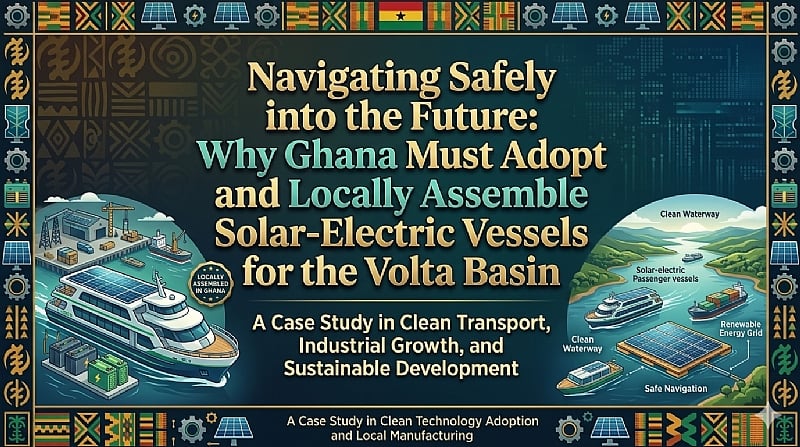


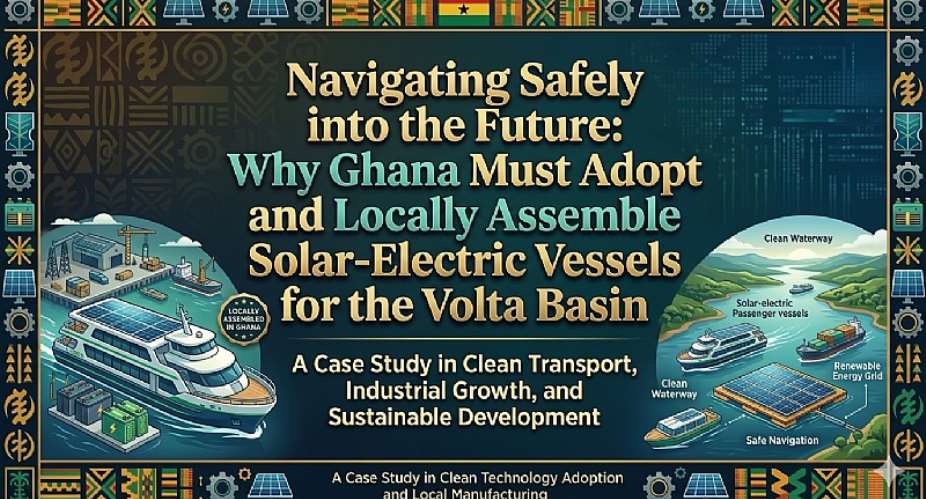
Navigating Safely into the Future: Why Ghana Must Adopt and Locally Assemble Solar-Electric Vessels for the Volta Basin
Engineering the Future of Clean Transit: A Strategic Blueprint for Local Assembly, Economic Growth, and Sustainable Navigation
For decades, the Volta Basin—spanning the vast expanse of Volta Lake, its winding river networks, and its coastal estuaries—has served as the economic lifeblood for millions of Ghanaians. It connects market traders, carries children to school, and sustains our fishing industries. Yet, this vital water highway remains one of our nation’s most hazardous transport zones. The tragic, recurring loss of Ghanaian lives in preventable boat disasters is a stark reminder of an urgent crisis. Overloaded, unstable wooden canoes powered by expensive, polluting outboard motors navigate waters filled with hidden, submerged tree stumps. Meanwhile, sudden tropical storms pose a constant threat.
We can no longer rely on outdated, unsafe water transport. To protect our citizens, modernize our rural economies, and insulate our transport sector from volatile fuel prices, Ghana must look to innovative eco-marine technologies. Partnering with global pioneers like NaValt Solar and Electric Boats offers a proven solution. By introducing rugged, stable solar-electric catamaran vessels and establishing local assembly hubs right here in Ghana, we can turn a persistent safety crisis into a proud milestone of industrial growth, job creation, and environmental leadership.
The Institutional Framework: A United Front for Lake Safety
To deploy a safe, modern solar fleet, Ghana’s key maritime institutions must work together within a clear operational framework:
- Ministry of Transport: Sets national policy, secures international green-energy funding, and oversees the transition to sustainable water transport.
- Volta River Authority (VRA): Serves as the technical anchor. The VRA will map safe navigation channels, clear dangerous submerged timber, and provide stable grid power from the Akosombo Dam for high-voltage overnight charging.
- Volta Lake Transport Company (VLTC): Acts as the primary fleet operator. The VLTC will manage major cross-lake routes with large-scale solar ferries, establishing predictable, reliable timetables for passengers and cargo.
- Ghana Maritime Authority (GMA): Enforces strict safety standards. The GMA will inspect hulls, certify marine electrical systems, and enforce safety regulations for all commercial electric vessels.
Tailored Vessel Configurations for Ghana’s Waterways
A solar-electric fleet must be customized to meet the distinct passenger and cargo demands of our water networks:
- Cross-Lake Mass Transit (Major Crossings like Yeji, Dambai, Adawso):
- Capacity: 150 to 300 passengers per trip.
- Cargo Payload: 15 to 30 metric tons to transport agricultural goods, cement, and vehicles.
- Design: Heavy-duty, double-deck solar ferries featuring rugged aluminum catamaran hulls that resist impacts from floating debris.
- Estuary & Riverine Water-Buses (Coastal Channels and Rivers):
- Capacity: 30 to 60 passengers.
- Cargo Payload: 2 to 5 metric tons tailored for market women and traders.
- Design: Shallow-draft fiberglass catamarans capable of safely navigating tight, shallow river bends and changing estuary tides.
- Safe Artisanal Fishing (Coastal and Inland Fishers):
- Capacity: 4 to 10 crew members.
- Cargo Payload: Up to 1.5 metric tons for catches, nets, and insulated ice boxes.
- Design: Heavy-duty open-hull solar boats (similar to NaValt’s SRAV model) designed to completely replace dangerous, unstable wooden canoes.
Technical Blueprint: Built for Resilience and Efficiency
NaValt’s eco-marine technology is uniquely suited to handle the demanding conditions of the Volta Basin:
- Unsinkable Catamaran Geometry: Twin-hull structures provide exceptional stability against sudden lake waves, dramatically reducing capsize risks compared to traditional monohull wooden canoes.
- Independent Dual-Engine Safety: Vessels feature a redundant architecture with twin independent battery packs and dual electric motors. If one system faces an electrical fault, the second system ensures the boat can safely return to shore.
- Equatorial Solar Optimization: Utilizing Ghana’s stable climate, a typical medium-sized ferry canopy generates approximately 53 kWh of free solar energy daily. This gives the vessel up to 3.5 hours of completely self-sustaining runtime before even drawing from its main shore charge.
- Overnight Grid Integration: Fleet stations will use standard marine three-phase shore plugs to fully charge battery banks in 4 to 8 hours during off-peak night hours, leveraging affordable hydro-power from the Akosombo infrastructure.
Strategic Integration: Solar-Powered Floating Clinics & the Ghana Navy Anchor
A truly holistic approach to the Volta Basin involves bringing life-saving healthcare and emergency medical access to isolated riverine and island communities. Historically, the MV Onipa Nua hospital ship laid the groundwork for floating clinics in Ghana. Today, we must modernize this exact blueprint by pairing clean tech with national security infrastructure.
The Naval Training Command (NAVTRAC), situated along the lower Volta River at Nutekpor-Sogakope, provides the ultimate strategic anchor for a fleet of solar-powered floating clinics and ambulance vessels:
- Operational Security & Supply Safety: Docking medical vessels directly within the NAVTRAC facility guarantees 24/7 security for expensive diagnostic equipment, sensitive pharmaceuticals, and the solar powertrain hardware itself.
- Quiet, Sterile Medical Environments: Traditional diesel-powered medical vessels suffer from severe engine vibration, heat, and loud exhaust fumes that disrupt patient care. A NaValt solar-electric medical vessel operates in near-total silence with zero emissions, creating a calm environment for onboard clinical procedures.
- Rapid-Response Search & Rescue Coordination: Pairing the Ghana Navy’s disciplined waterborne rapid-deployment teams with solar-powered ambulance boats creates a highly efficient medical evacuation system. This task force can swiftly respond to accidents across the entire lower Volta, the river networks, and delicate coastal estuaries.
Financial Payback Period Analysis (Diesel vs. Solar)
To prove the economic viability to the Ministry of Finance and private investors, this analysis compares a standard 100-passenger diesel ferry against a locally assembled NaValt solar-electric ferry of the same capacity over a standard operational year (300 days).
1. Baseline Assumptions & Local Costs
- Daily Operational Route: 4 trips per day × 25 km per trip = 100 km daily travel.
- Diesel Ferry Consumption: 0.6 liters of diesel per kilometer = 60 liters of diesel daily.
- Local Fuel Price (Ghana): ~₵15.00 per liter of diesel.
- Solar Ferry Charging: 53 kWh provided free by the sun; remaining 47 kWh drawn from the VRA grid overnight at an off-peak commercial hydro rate of ~₵1.80 per kWh.
2. Annual Operating Cost (OpEx) Breakdown
- Diesel Operational Costs:
- Fuel: 60L × ₵15/L × 300 Days = ₵270,000
- Maintenance (Oils, filters, mechanics) = ₵45,000
- Total Annual Diesel OpEx = ₵315,000
- Solar-Electric Operational Costs:
- VRA Grid Power: 47 kWh × ₵1.80 × 300 Days = ₵25,380
- Maintenance (Solid-state electrics, wash) = ₵12,000
- Total Annual Solar OpEx = ₵37,380
- Annual Net Operational Savings: ₵315,000 – ₵37,380 = ₵277,620 saved per year.
3. Capital Expenditure (CapEx) & Payback Calculation
- Imported Diesel Ferry Cost: ₵2,200,000
- Locally Assembled Solar Ferry Cost (CKD Kit + Local Labor): ₵2,950,000
- Initial Capital Premium (The “Green” Setup Cost): ₵2,950,000 – ₵2,200,000 = ₵750,000
{Payback Period} = {Initial Capital Premium (₵750,000){Annual Net Operational Savings (₵277,620)}} = mathbf{2.70{ Years}}(~32.4 Months)}$$
The Verdict: In just under 32.5 months, the solar ferry completely pays off its initial price premium entirely through fuel and engine maintenance savings. After month 33, the vessel generates pure operational profit for the operator while keeping passenger fares low and stable.
Detailed Layout & Workflow of the Akosombo Assembly Hub
To eliminate the cost of shipping fully assembled boats, a specialized assembly hub can be set up directly at the Akosombo Port. This layout uses a highly efficient, linear six-stage integration workflow to assemble completely knocked-down (CKD) kits arriving from ports like Tema.
- Stage 1: Hull Jig & Alignment Bay: Marine-grade aluminum or Fiber Reinforced Plastic (FRP) catamaran hull halves are unboxed from shipping containers, placed onto precision jigs, and welded or bonded together securely.
- Stage 2: Superstructure & Decking Station: Cross-beams are fastened across the twin hulls to create a wide, stable platform. Anti-slip decks, safety railings, passenger seating modules, and dual helm stations are securely bolted down.
- Stage 3: Powertrain & Battery Integration Room: This climate-controlled space houses the installation of dual independent 50 kWh Lithium Iron Phosphate (LFP) battery vaults and heavy-duty, brushless electric motors into the insulated hull compartments.
- Stage 4: Solar Roof Canopy Wiring Area: Overhead aluminum structures are fitted with high-efficiency marine solar panels. Heavy-duty wiring harnesses are routed through conduits directly down into smart charge controllers.
- Stage 5: Safety Systems & IT Diagnostic Lab: Smart energy management systems are powered up and calibrated. Redundant backup switchgear, GPS tracking systems, automatic bilge pumps, and electronic safety alarms undergo rigorous multi-point testing.
- Stage 6: Gantry Crane, Slipway & Dry Launch: The completed, fully certified solar-electric vessel is lifted via a gantry crane, rolled down the dedicated Akosombo slipway, and launched directly into the water for real-world ballast and performance trials.
A Special Appeal to H.E. John Dramani Mahama
To His Excellency, John Dramani Mahama, President of the Republic of Ghana and Commander-in-Chief of the Ghana Armed Forces.
Your Excellency,
Leadership is defined by the bold choices we make to safeguard our people and build a lasting legacy for future generations. The recurring, tragic losses of our citizens on Volta Lake are not just isolated transportation failures—they represent a profound national security issue and an ongoing humanitarian crisis that we have the power to fix.
As Commander-in-Chief, you hold the unique authority to re-engineer Ghana’s inland maritime safety. We urgently appeal to your office to champion this transformative shift:
- Mobilize the Military’s Engineering Capabilities: Direct the 48 Engineer Regiment of the Ghana Armed Forces, in coordination with the Volta River Authority (VRA) and the Naval Training Command (NAVTRAC) at Nutekpor, to spearhead the structural setup of the Akosombo Assembly Hub and the deployment of solar clinics. Our brilliant military and naval engineers possess the exact discipline, technical welding expertise, and logistical precision required to lead local assembly operations.
- Drive the National Industrialization Agenda: By choosing local assembly over foreign imports, your administration can turn a critical safety emergency into a powerful engine for economic growth. This initiative will create highly skilled jobs for our young engineers, welders, and technicians right along the Volta basin.
- Establish Ghana as West Africa’s Eco-Marine Leader: Launching the “Safe Volta Solar Fleet” Presidential Initiative will make Ghana the very first nation in sub-Saharan Africa to operate a completely green, self-sustaining public water transport and waterborne healthcare network.
Your Excellency, the waters of the Volta should connect our people and drive our markets—they should never claim the lives of our citizens. By taking decisive action today, you can replace fear with safety, reduce our dependence on imported fossil fuels, and build a modern, industrialized Ghana we can all be proud of.
The technology is ready, the layout is clear, and the people of Ghana are waiting for your bold leadership. Let us build these vessels here at home, protect our citizens, and move our country forward.
The era of accepting tragic, avoidable boat accidents on Volta Lake must come to an end. Ghana stands at a historic crossroads where public safety, healthcare access, industrial growth, and climate action perfectly align. By embracing solar-electric maritime vessels and establishing local assembly lines, we can protect our citizens, build a cleaner environment, and create sustainable jobs for our youth. Let us move away from dangerous, fuel-dependent wooden canoes and step boldly into a future of modern, self-sustaining engineering. The technology is proven, our solar resources are abundant, and the necessity is clear. It is time for leadership and stakeholders to act—making our water highways a model of safety and innovation across West Africa. God bless our homeland Ghana!
✍️ Submitted by:
Retired Senior Citizen
For and on behalf of all Senior Citizens of the Republic of Ghana 🇬🇭
Teshie-Nungua
[email protected]

Atitso Akpalu, © 2026
A Voice for Accountability and Reform in Governance. More Atitso Akpalu is a prominent Ghanaian columnist known for his incisive analysis of political and economic issues. With a focus on transparency, accountability, and reform, Akpalu has been a vocal critic of mismanagement and corruption in Ghana’s governance. His writings often highlight the need for decentralization, local governance empowerment, and robust anti-corruption measures. Akpalu’s work aims to foster a more equitable and just society, advocating for policies that benefit all Ghanaians.
He is a passionate advocate for transparency and accountability. His columns focus on critical analysis of political and economic issues, with a particular interest in the energy sector, financial services, and environmental sustainability. He believes in the power of informed citizenry to drive positive change and am committed to highlighting the challenges and opportunities facing Ghana today.Column: Atitso Akpalu
Disclaimer: “The views expressed in this article are the author’s own and do not necessarily reflect ModernGhana official position. ModernGhana will not be responsible or liable for any inaccurate or incorrect statements in the contributions or columns here.”
Follow our WhatsApp channel for meaningful stories picked for your day.

Top Stories


Originally published on www.modernghana.com
