

July 12, 2026
From the Noise of Political Power to the Quiet Truths of Our Shared Humanity


From the Noise of Political Power to the Quiet Truths of Our Shared Humanity
The Noise of the Marketplace vs. The Silence of Truth
In the bustling traffic of Madina, the crowded lanes of Makola, the corporate boardrooms of Ridge, and the loud political rallies across our regions, human ambition is deafening. We spend our lives chasing wealth (sika, ligidi, korba), power, and status, often forgetting the fragile thread upon which human life hangs. As the legendary Dagomba philosopher Alhaji ABA Fuseini wisely observed, “The person who dances in the afternoon must remember that the evening will surely come with its own rhythm.”
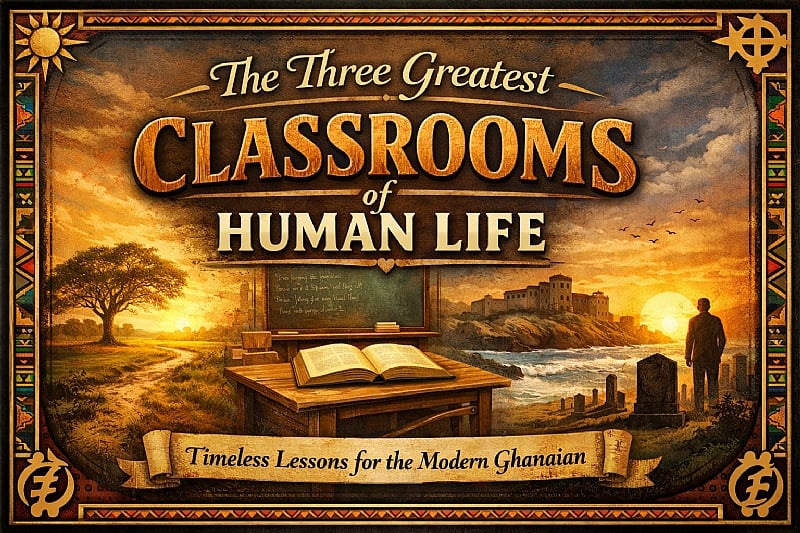
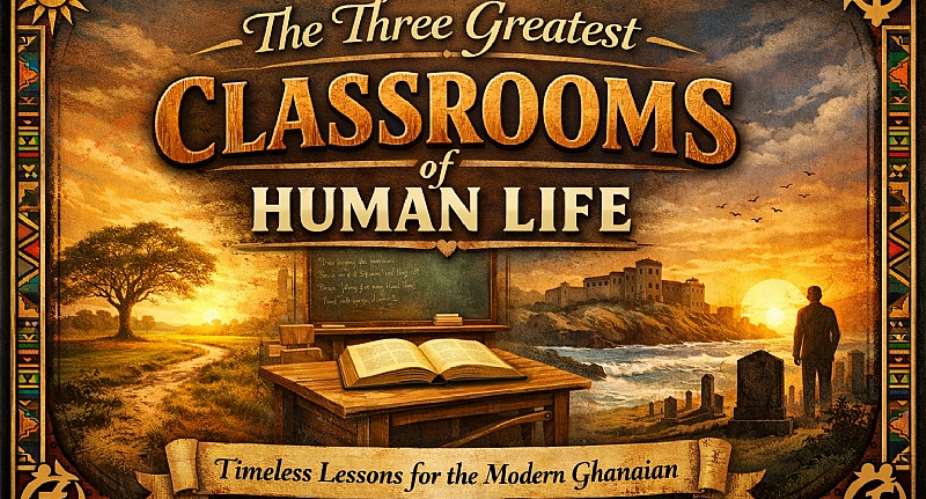
Too often, we get consumed by the rhythm of our “afternoon.” We live as if tomorrow is guaranteed and as if our earthly acquisitions make us superior to our neighbors. Yet, life has a quiet way of humbling the proudest heart. To truly understand our purpose, anchor our character, and find true peace, we do not need to attend elite universities. We simply need to observe the profound, silent lectures delivered daily in three universal classrooms: the hospital, the prison, and the graveyard.
1. The Hospital: The Classroom of Ultimate Value
At the hospital, we quickly realize that absolutely no treasure in the world is greater than your health.
- The Localized Reality: Walk into the emergency wards of Korle-Bu, Komfo Anokye, or Tamale Teaching Hospital. Look at the tragic “no-bed syndrome” that forces families to watch their loved ones sit in plastic chairs while tied to IV drips. See the desperation of a mother struggling to buy basic medical consumables for a child’s urgent surgery because the National Health Insurance Scheme (NHIS) failed to cover the specific medication.
- The Core Lesson: In those sterile corridors, your social media followers, customized license plates, and V8 vehicles cannot cure you. Wealth can buy a luxury bed, but it cannot buy sleep. It can buy expensive delicacies, but it cannot buy an appetite.
- Wise Spices:
- ABA Fuseini Saying: “If a man boasts of his beautiful shoes, let him look at the one whose feet have been amputated.”
- Biblical Anchoring: Matthew 16:26 – “For what will it profit a man if he gains the whole world and forfeits his soul?”
- International Wisdom: As Mahatma Gandhi beautifully put it, “It is health that is real wealth and not pieces of gold and silver.”
2. The Prison: The Classroom of Choices and Freedom
In prison, we learn that simple freedom is the soul’s greatest desire.
- The Localized Reality: Behind the thick walls of Nsawam Medium Security Prison, Kumasi Central Prison, or the James Camp Prison, human beings live in severe, degrading congestion. Young men who, out of economic frustration, stole a bunch of plantain or a mobile phone sit side-by-side with hardened criminals, their youth wasting away in cells meant for a quarter of their number.
- The Core Lesson: Freedom is an invisible asset until it is lost. A single moment of uncontrolled anger, political thuggery (political vigilantism), or a reckless decision to engage in “galamsey” (illegal mining) or cyber fraud (sakawa) can trade a lifetime of liberty for a cold concrete floor.
- Wise Spices:
- ABA Fuseini Saying: “The stubborn fly that refuses to listen to advice follows the corpse directly into the deep grave.”
- Biblical Anchoring: Proverbs 16:18 – “Pride goes before destruction, a haughty spirit before a fall.”
- International Wisdom: Nelson Mandela famously noted, “To be free is not merely to cast off one’s chains, but to live in a way that respects and enhances the freedom of others.”
3. The Graveyard: The Classroom of Ultimate Equality
At the graveyard, the ultimate truth is revealed: all our pride, wealth, and ego mean absolutely nothing in the end.
- The Localized Reality: A visit to the Osu Cemetery or the Awudome Cemetery shows rows of silent dirt mounds. The multi-millionaire who slept in a heavily guarded mansion at Airport Residential Area or East Legon occupies the exact same six feet of earth as the homeless kayayei (porter) from the streets of Accra.
- The Core Lesson: The ground beneath our feet today will eventually be the roof above us tomorrow. We brought nothing into this world, and it is certain we can carry nothing out.
- Wise Spices:
- ABA Fuseini Saying: “No matter how beautifully painted the casket is, it will never inspire the corpse to dance.”
- Biblical Anchoring: Ecclesiastes 1:2 – “Vanity of vanities, says the Preacher, vanity of vanities! All is vanity.”
- International Wisdom: An old Italian proverb reminds us, “Once the game is over, the king and the pawn go back into the exact same box.”
A Direct Word of Advice to Ghanaian Politicians: The Fallacy of Power
To our Honorable Ministers, Members of Parliament, Metropolitan, Municipal, and District Chief Executives (MMDCEs), and political appointees: Remember the source of your breath.
When you ride through our broken roads in heavily tinted, air-conditioned V8 convoys, pushing ordinary, tax-paying citizens into gutters with your blaring sirens, remember that power is a borrowed garment. You stand on podiums making grand promises to fix schools under trees, resolve the dumsor (electricity instability) hurting small barbers and seamstresses, and clean up our toxic rivers ruined by galamsey. Yet, once power is secured, arrogance often takes the driver’s seat.
Be humble. Serve the people as you promised. Do not convert public funds into personal empires, buying houses in Dubai or Accra while your local constituency lacks a functioning ambulance. The heavy title of “Honorable” will not follow you into the earth. As it is written in Job 1:21, “Naked I came from my mother’s womb, and naked shall I return.”
In the ultimate end, you will be made completely equal to the poorest citizen who voted for you. The dirt will not respect your political party colors, nor will the maggots care about your executive status. Let your leadership be defined by selfless service, not sovereign pride.
A Sovereign Intercession: A Powerful Plea for Ken Ofori-Atta and Restorative Justice
As we call on our politicians to look beyond the transient nature of power, we cannot ignore the deep wounds of our nation. We are forced to look at those who held the keys to our collective destiny and now face the absolute weight of legal accountability. In this moment of national reflection, as our former Finance Minister, Ken Ofori-Atta, remains overseas while facing 78 criminal charges from the Office of the Special Prosecutor (OSP) regarding the SML scandal and financial malfeasance, we raise a powerful, pleading cry to Heaven:
Almighty God, You are the Searcher of all hearts and the Ultimate Judge of nations. We lift up a deeply pleading prayer for Ken Ofori-Atta. Lord, we pray that Your Holy Spirit pierces through any wall of denial, legal insulation, or political shielding that distances him from the cries of the Ghanaian people. If there have been criminal acts, broken trusts, and deliberate actions that caused financial loss and economic agony to this state, we plead for absolute repentance.
Touch his conscience, Oh Lord. Grant him the radical humility to look past immigration maneuvers or top-tier international lawyers, and give him the courage to step onto a plane, return home, and face the courts of Ghana. Let him stand before the justice system like the ordinary Ghanaian worker who pays for his decisions every single day. We pray not for malice, but for the restoration of truth. Let his heart break for the broken economy, and let this become a terrifying lesson to every sitting leader that accountability cannot be outrun. Grant our institutions the unshakeable fortitude to demand justice without fear or favor. Amen.
Strengthened Governance Recommendations for Ghana
To move beyond rhetoric and build a nation that respects human dignity, our governance systems must transform drastically:
- De-politicize and Forcefully Fund Healthcare: We must stop playing politics with healthcare. Let our leaders upgrade regional and district hospitals so that they themselves are confident enough to be treated there, rather than flying abroad for medical care at the taxpayers’ expense. The National Health Insurance Scheme (NHIS) must be protected from financial starvation to ensure it covers critical diagnoses like cancer and dialysis treatments for ordinary citizens.
- Radical Judicial and Prison Reform: The justice system must stop punishing the poor while coddling the rich. A politician who embezzles millions of state funds should face the same—or harsher—penalties as a youth who steals a goat out of hunger. We must fast-track non-custodial sentencing laws to decongest our prisons and ensure that rehabilitation, not just brutal punishment, becomes the focus.
- An End to Inequitable Economic Greed: National resources must be distributed equitably. The wide gap between the luxurious lifestyles of political appointees and the miserable minimum wage of the Ghanaian worker is a ticking time bomb. Governance must shift focus toward creating sustainable jobs in agriculture and manufacturing, rather than relying on heavy taxes that choke local businesses.
Driving the Final Nail of Wisdom Home
Life is beautifully short. Why waste our precious, limited time on anger, hate, political animosity, or insatiable greed? The next time you find your heart swelling with pride, arrogance, or self-importance, take a quiet walk through a hospital hallway, peer past a prison gate, or stand silently at a cemetery.
As our elders say, “When a bird sits on a tree branch for too long, it forgets that the ground is its ultimate resting place.” Let us fly with humility, serve with integrity, and live with love. Ghana will only become a better place when we realize that our titles are temporary, but our humanity is eternal. Let us build a nation grounded in gratitude, equity, and true compassion.
✍️ Retired Senior Citizen
For and on behalf of all Senior Citizens of the Republic of Ghana 🇬🇭
Teshie-Nungua
[email protected]

Atitso Akpalu, © 2026
A Voice for Accountability and Reform in Governance. More Atitso Akpalu is a prominent Ghanaian columnist known for his incisive analysis of political and economic issues. With a focus on transparency, accountability, and reform, Akpalu has been a vocal critic of mismanagement and corruption in Ghana’s governance. His writings often highlight the need for decentralization, local governance empowerment, and robust anti-corruption measures. Akpalu’s work aims to foster a more equitable and just society, advocating for policies that benefit all Ghanaians.
He is a passionate advocate for transparency and accountability. His columns focus on critical analysis of political and economic issues, with a particular interest in the energy sector, financial services, and environmental sustainability. He believes in the power of informed citizenry to drive positive change and am committed to highlighting the challenges and opportunities facing Ghana today.Column: Atitso Akpalu
Disclaimer: “The views expressed in this article are the author’s own and do not necessarily reflect ModernGhana official position. ModernGhana will not be responsible or liable for any inaccurate or incorrect statements in the contributions or columns here.”
Follow our WhatsApp channel for meaningful stories picked for your day.
Top Stories


<!–
–>
Originally published on www.modernghana.com
