

July 23, 2026
Africa’s Railway Renaissance: Are We Finally Building Corridors Instead of Railways?


Africa’s Railway Renaissance: Are We Finally Building Corridors Instead of Railways?
For much of the past three decades, discussions about African railways have been dominated by decline. Ageing infrastructure, underinvestment, operational inefficiencies, and the overwhelming rise of road transport became the defining narrative across the continent. Railways, once the backbone of colonial-era commerce, gradually lost relevance as governments shifted investment toward highways and urban roads. Today, however, a different story is beginning to emerge.
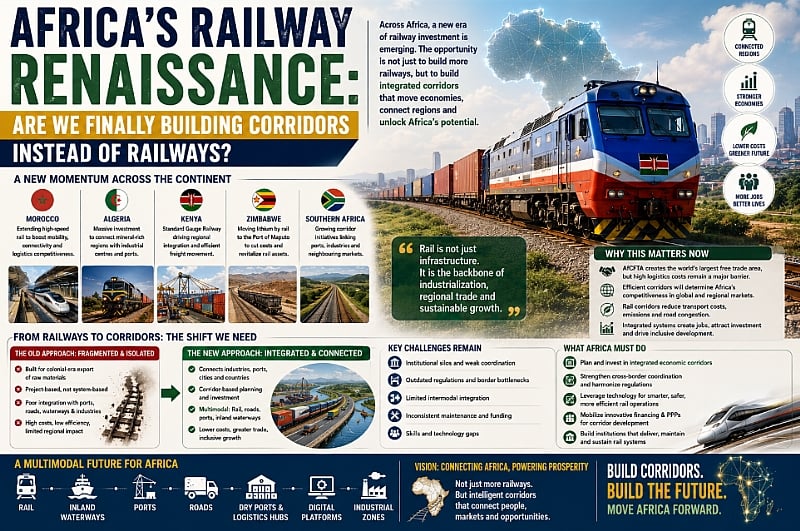
Across Africa, there is unmistakable momentum behind railway development. From Morocco’s expansion of its high-speed rail network to Algeria’s massive investment in strategic freight railways, Kenya’s renewed push for the Standard Gauge Railway, Southern Africa’s growing corridor initiatives, and Zimbabwe’s efforts to reconnect mining production with regional rail systems, governments are once again placing rail at the centre of economic transformation. Recent financing approvals by the African Development Bank for major railway projects in Morocco and Algeria, together with renewed investment discussions across Southern Africa, demonstrate that rail has returned to the continental development agenda https://shorturl.at/RlfTO. But as encouraging as this renewed investment may be, Africa must ask a more important question: Are we simply building more railways, or are we finally building transport corridors?
The distinction is critical. A railway is a piece of infrastructure. A transport corridor is an integrated economic system. Railways transport trains; corridors transport economies.
One of the greatest weaknesses of Africa’s historical railway development has been its fragmented nature. Many lines were designed during the colonial period to move raw materials from inland mines and plantations to coastal ports for export. They rarely connected neighbouring economies, supported regional value chains, or encouraged industrial clustering. Even after independence, many investments remained project-based rather than system-based, with individual railway lines receiving attention without adequate integration with ports, inland waterways, logistics parks, dry ports, or industrial zones.
Today’s investments present an opportunity to break from that legacy.
Consider Algeria’s recent railway expansion. While the headlines focus on nearly US$878 million in financing, the real significance lies in the railway’s role within a broader logistics strategy. The new line is intended to connect the country’s mineral-rich southern regions with industrial centres and export gateways, strengthening both economic diversification and regional connectivity https://shorturl.at/ItAEi. Similarly, Morocco’s continued investment in extending its high-speed rail network reflects more than an ambition for faster passenger travel. It forms part of a wider strategy to improve national logistics competitiveness, strengthen urban connectivity, and support long-term economic development https://shorturl.at/rlOSp.
Yet important challenges remain.
Perhaps the greatest obstacle is that Africa still plans transport largely through institutional silos. Railway authorities often operate independently of port authorities. Inland water transport receives little attention in national transport plans. Border agencies rarely coordinate digital freight systems. As a result, infrastructure investments that could complement one another frequently operate in isolation.
The continent does not simply need railways that connect cities; it needs railways that connect industries, ports, rivers, logistics hubs, and neighbouring countries. This is particularly important under the African Continental Free Trade Area (AfCFTA). The agreement has created the world’s largest free trade area by number of participating countries, but removing tariffs alone will not significantly increase trade if transport costs remain among the highest in the world. Efficient corridors, not isolated infrastructure, will determine whether African manufacturers can compete regionally and globally.
The emerging railway investments should therefore be viewed as the foundation of something much larger.
Imagine a future where freight originating from northern Ghana travels by rail to Tema Port while simultaneously connecting with Volta Lake transport. Imagine Zambia’s mineral exports moving seamlessly across interconnected regional rail systems to multiple ports instead of relying on a single corridor. Imagine East Africa’s rail revival integrating with Lake Victoria’s inland water transport, creating a multimodal logistics network that dramatically lowers transport costs across the region. These are not unrealistic ambitions. They are entirely achievable if infrastructure planning evolves from national projects to regional systems.
Financing models must also evolve. Development banks have demonstrated renewed confidence in African rail through significant investments in recent months, but future financing should increasingly prioritize integrated corridor development rather than standalone railway construction. Public-private partnerships should similarly focus on complete logistics ecosystems that combine rail, ports, dry ports, inland waterways, digital freight platforms, and industrial zones. Technology will also shape this transformation. Intelligent freight management systems, digital customs platforms, predictive railway maintenance, satellite-based cargo tracking, and artificial intelligence-driven logistics optimization can significantly increase the productivity of existing railway infrastructure without requiring proportional increases in physical investment. Perhaps most importantly, Africa must cultivate institutions capable of managing integrated transport systems. Corridors do not succeed because of engineering alone; they succeed because governments coordinate policies, harmonize regulations, maintain infrastructure consistently, and provide investors with long-term certainty.
The encouraging news is that the conversation is beginning to change. Increasingly, policymakers, investors, and regional organizations are discussing logistics ecosystems rather than isolated transport modes, with growing emphasis on intermodal connectivity and corridor development https://shorturl.at/JJXcS.
This shift in thinking may ultimately prove more significant than any individual railway project.
Africa’s railway renaissance should not be measured by the number of kilometres of track laid or the value of investment announced. Its true success will be determined by whether these railways become the backbone of integrated economic corridors that stimulate industrialization, strengthen regional trade, reduce logistics costs, and create resilient multimodal transport systems.
- The continent has built railways before.
- The challenge now is to build corridors.
Because Africa’s future competitiveness will depend not on how many railway lines it constructs, but on how effectively those lines connect people, industries, markets, ports, and nations into one seamless transport network.
Author: Joseph Fuseini ([email protected])

Joseph Fuseini, © 2026
Rail and Inland Transport Policy Analyst. More Joseph Fuseini is a logistics and transport professional with strong academic and industry experience. The author holds a FIATA Diploma in International Freight Forwarding, a Bachelor’s degree in Logistics and Supply Chain Management, and a Master’s degree in Business Management. He is a member of the Chartered Institute of Logistics and Transport (CILT) and is currently a PhD candidate in Management Science and Engineering, where his research engages with complex systems, infrastructure planning, and efficiency in transport and logistics networks.
Professionally, the author worked at DHL Global Forwarding Ghana as an Export Operations Team Lead. His writing draws on both practical experience and academic research, focusing on rail and inland transport policy, logistics, and infrastructure development in Ghana and Africa.
Through this column, the author brings a practitioner’s insight and a researcher’s lens to debates on how rail and inland transport systems can better serve economic development and public interest.Column: Joseph Fuseini
Disclaimer: “The views expressed in this article are the author’s own and do not necessarily reflect ModernGhana official position. ModernGhana will not be responsible or liable for any inaccurate or incorrect statements in the contributions or columns here.”
Follow our WhatsApp channel for meaningful stories picked for your day.

Top Stories







Originally published on www.modernghana.com
