

July 10, 2026
A Timely Call to Reclaim the Soul of Sufism: A Review of Before You Call Yourself a Sufi by Thanni Ismail Ol
4 hours ago | Book Review
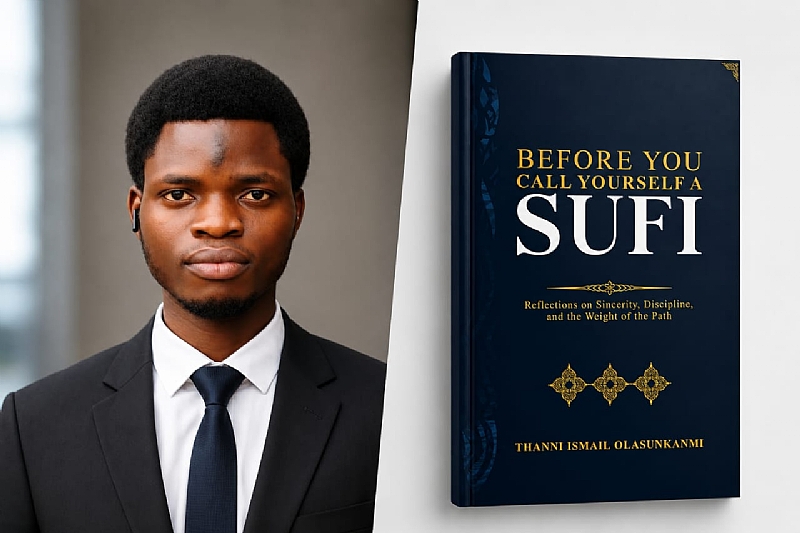
A Timely Call to Reclaim the Soul of Sufism: A Review of “Before You Call Yourself a Sufi” by Thanni Ismail Olasunkanmi
In an age where religious labels are often embraced before their responsibilities are understood, “Before You Call Yourself a Sufi” arrives as a timely and necessary intervention. Rather than questioning the legitimacy of Sufism, Thanni Ismail Olasunkanmi calls readers back to its original spirit, one which is rooted in sincerity, discipline, knowledge, and humility.
Right from the opening pages, the author makes his intention plain. This is not a polemic against Tasawwuf, nor an attempt to divide Muslims. Instead, it is an earnest affirmation that the spiritual path cannot be reduced to names, appearances, or affiliations. A true seeker, he argues, is recognised less by what he calls himself than by the transformation of his character.
The book is arranged into seven concise chapters, each building naturally upon the last. It begins with the familiar triad of Islam, Iman (faith), and Ihsan (spiritual excellence), drawing from the widely known Hadith of Jibril to establish that genuine spirituality rests on sound worship, correct belief, and excellence in devotion. By placing these foundations first, the author avoids presenting Sufism as something detached from orthodox Islam. Rather, he portrays it as the refinement of what every Muslim is already commanded to pursue.
One of the book’s greatest strengths is its treatment of the human ego. Olasunkanmi repeatedly demonstrates that the nafs (soul) does not disappear with religious practice. Instead, it simply changes its clothing. A person may abandon worldly ambition only to become consumed by the desire for spiritual recognition. Through Qur’anic verses, Prophetic traditions and the stories of figures such as Iblis, Barsisa, and Shaykh Abdul Qadir al-Jilani, he shows that pride remains one of the greatest dangers confronting every seeker of Allah.
The discussion of sincerity is equally compelling. It speaks directly to a generation shaped by public visibility and social media validation, where the reminder that worship belongs first to Allah carries particular weight. The author’s reflections on riya (showing off), hidden intentions and the quiet struggle for ikhlas (sincerity) address contemporary realities without sounding sensational. His insistence that the most valuable deeds are often those unseen by people reflects the enduring wisdom of classical Islamic scholarship.
Moreover, knowledge occupies a central place throughout the work. The author makes it clear that no spiritual journey can succeed without first mastering the fundamentals of the religion. Drawing upon the teachings of Shaykh Ibrahim Inyass and other respected scholars, he reminds readers that sound learning protects the believer from deception, emotional excess, and misguided enthusiasm. Spiritual experiences, however profound they may appear, must always remain subject to the authority of the Qur’an and the Sunnah.
Perhaps the greatest strength of the book lies in its accessibility. Although it engages classical Islamic sources, the language is straightforward enough for young Muslims and general readers. Arabic quotations are consistently explained, while historical narratives are presented with sufficient context to sustain interest without sacrificing scholarly seriousness.
Beyond its discussion of Sufism, the book is ultimately a call to honest self-examination. It urges readers to look beyond outward symbols of piety and confront the quieter struggles of the heart, pride, insincerity, complacency, and the desire for recognition. In doing so, Olasunkanmi puts us in the know that spiritual growth is measured not by the titles we bear but by the character we cultivate.
To this end, “Before You Call Yourself a Sufi” succeeds because it asks uncomfortable but necessary questions. Have we mistaken identity for transformation? Have titles replaced discipline? Have appearances overtaken sincerity? These questions linger long after the final page.
Far from discouraging the spiritual path, Thanni Ismail Olasunkanmi invites readers to approach it with greater reverence and honesty. His central message is crystal clear: before claiming any spiritual station, first cultivate obedience, knowledge, humility, and sincere devotion to Allah.
At a time when outward expressions of religion often attract greater attention than inward refinement, this book stands as a thoughtful reminder that the truest journey begins within.
Originally published on www.thenigerianvoice.com
