

July 11, 2026
A Nation Eating Itself: Ghana’s Corruption Canker, the Cost to Our Common Future, and the Leaders We Still Need
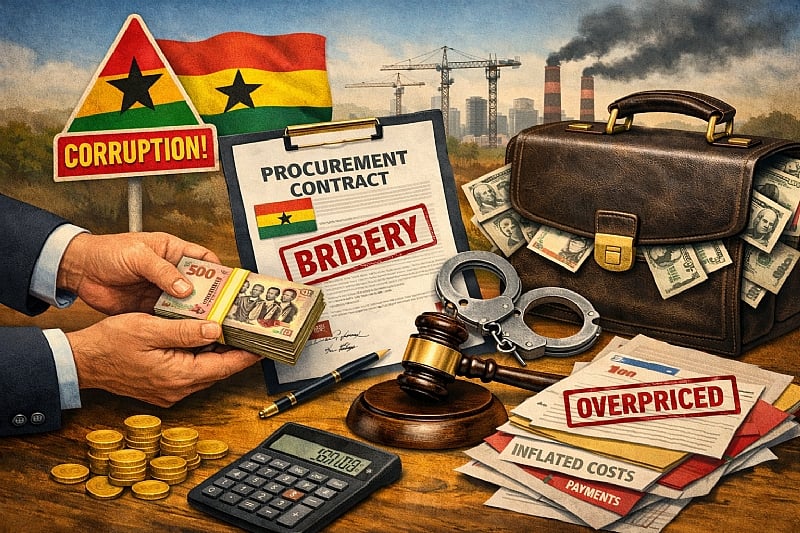


A Nation Eating Itself: Ghana’s Corruption Canker, the Cost to Our Common Future, and the Leaders We Still Need
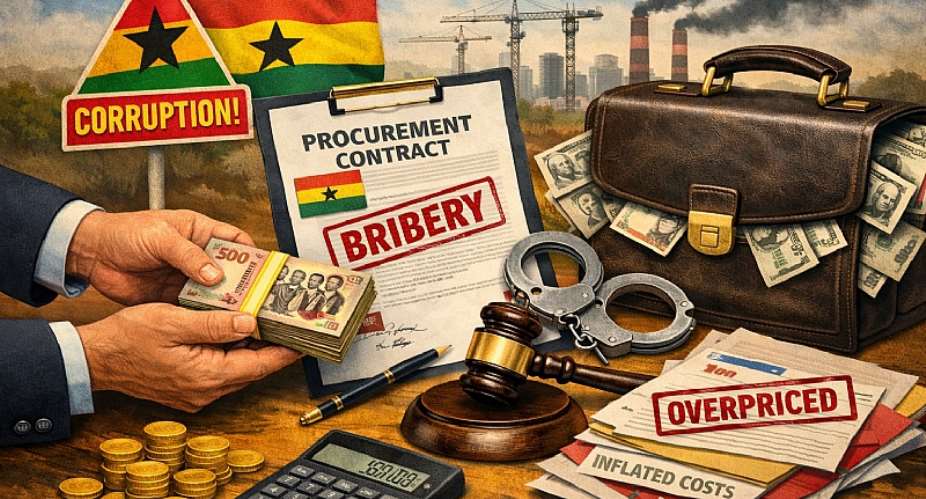
Ghana is a nation of extraordinary people. We are a people of ingenuity, faith, resilience, and warmth — a people who have, against considerable odds, built one of West Africa’s most stable democracies, a vibrant civil society, and a constitutional order that the continent looks to with respect. We are a people who sing our national anthem with genuine feeling, who speak of the Black Star with genuine pride, and who believe, in the quiet spaces of our hearts, that this country was made for greatness.
And yet. And yet we are also a people who have allowed a canker to grow so deep into the body of our national life that it now threatens the very foundations of the nation our founders sacrificed to build. Corruption — in its many faces, its many forms, its many hiding places — is no longer a problem at the margins of Ghanaian society. It is at the centre. It is in our government ministries and our market stalls. It is in our examination halls and our church offerings. It is in the sports academies where our children’s dreams are sold to the highest bidder, and in the procurement offices where national infrastructure is traded for personal enrichment. It is in the police checkpoint and the hospital corridor, the hiring office and the contractor’s briefcase.
This article is not written in the spirit of despair. It is written in the spirit of honest diagnosis — because a wound that is not named cannot be dressed, and a nation that will not confront its own failures cannot overcome them. It is written, above all, as a call to the leaders of this country — elected and appointed, religious and traditional, corporate and civic — to rise to the moment that history is placing before them, and to choose the nation over themselves.
The Many Faces of the Canker
Let us be specific, because generality is the refuge of those who prefer not to be accountable. The corruption that afflicts Ghana is not one thing. It is a system — a web of mutual complicity that connects the most powerful to the most ordinary, and in doing so, normalises the rot at every level of society.
At the top of that web sit the politicians and public officials who divert funds meant for schools, roads, hospitals, and water systems into private accounts, shell companies, and foreign investments. Ghana’s performance on the Transparency International Corruption Perceptions Index tells a damning story: a score of 43 out of 100 in 2025, ranking 76th among 180 countries — and crucially, a score that has not moved meaningfully in over a decade. Since 2015, Ghana has dropped five points on the index. A ten-year trend without progress is not bad luck. It is a policy failure and a leadership failure.
The Ghana Statistical Service’s 2025 Governance Series Report makes the personal dimension of that failure concrete: 18.4% of Ghanaians who interacted with public officials in 2024 paid bribes — primarily in cash, 74.9% of cases directly solicited by the officials themselves. The Motor Traffic and Transport Department recorded a bribery rate of 60%. The police — the very institution charged with enforcing the law — topped the list of bribe-receiving agencies. Only 14.5% of bribery incidents were reported. The silence of the 85.5% is not indifference. It is the silence of people who have learned, from experience, that reporting does not lead to justice.
But the canker does not stop at the police checkpoint. It runs through the examination halls of our schools, where students pay invigilators and supervisors to look the other way, graduating into professional life with certificates that do not reflect competence — and then entering institutions that are already corrupted, where they quickly learn that the certificate was only the beginning of what must be bought. It runs through our sports federations, where places on national teams are sold rather than earned, ensuring that the child with talent but no money stays on the sideline while the one with connections wears the national colours. It runs through our markets, where traders overprice goods with impunity, exploiting the desperation of buyers who have no alternatives.
It runs through our churches and mosques — and this must be said, however uncomfortable it makes us — where financial mismanagement and the exploitation of congregants’ faith has become sufficiently documented to demand acknowledgement. It runs through the contracting system, where companies pay kickbacks to win public tenders and then execute shoddy work that collapses before the ribbon-cutting ceremony is a year old — sometimes literally. The collapsed buildings, the broken roads, the non-functional equipment in public hospitals: these are not accidents of incompetence alone. They are the physical consequences of a procurement system corrupted from bid to completion.
And it runs, with a particularly cruel logic, through the employment system. When a young Ghanaian must pay a bribe to secure a government job — a practice so common it has its own euphemisms — they enter that job as a debtor, not a servant. They do not ask: how can I serve the public? They ask: how quickly can I recover what I paid? The corruption cycle does not merely persist because of greed. It persists because it has been institutionalised into a self-financing system in which the cost of entry must be recovered from the position itself.
“A ten-year trend of stagnation on the corruption index is not bad luck. It is a policy failure and a leadership failure.”
The Real Cost: What We Are Actually Paying
Corruption is sometimes spoken of as though it were a victimless transaction — a private arrangement between willing parties that does not concern those not directly involved. This is among the most dangerous misconceptions in Ghanaian public discourse. Corruption has victims. They are specific, identifiable, and often among the most vulnerable members of our society.
The child who failed her examinations because the invigilation was for sale, and whose classmate with a purchased grade took the university place she earned, is a victim. The patient who died because the hospital’s drug procurement budget was diverted, and the available medicines were substandard products bought through a corrupt supply chain, is a victim. The farmer whose community road was contracted three times and built once — badly — and who spends four hours on a damaged track to reach a market that should be forty minutes away, is a victim. The young man who spent his family’s savings paying for a job that he did not get, or that never existed, is a victim. These are not statistics. They are our neighbours, our families, our fellow citizens.
The macroeconomic costs compound the human ones. Ghana’s fiscal crisis — the debt restructuring, the IMF programme, the constrained social spending — is not unrelated to decades of procurement fraud, inflated contracts, and diverted public funds. Resources that should have built the productive capacity of the economy were instead captured by private hands. The World Bank estimates that corruption costs Sub-Saharan Africa approximately $150 billion annually. Ghana’s share of that cost is not a line item in a report. It is the hospital that was not built, the scholarship that was not awarded, the generation that did not reach its potential.
Rwanda Chose a Different Path — and Changed
Pessimists will say that corruption is too deep, too entrenched, too woven into the fabric of Ghanaian society to be meaningfully reduced. History disagrees with them. Specifically, the history of a country that was, thirty years ago, in a condition so catastrophic that Ghana’s challenges would have seemed enviable by comparison.
Rwanda in 1994 was a nation emerging from genocide — its institutions destroyed, its social fabric shredded, its economy in ruins. Corruption was not merely a problem; it was the air the state breathed. The Rwanda Revenue Authority had no credible collection system. The contracting process was described by analysts as rife with graft. Public officials operated without accountability or consequence.
What happened next is one of the most instructive governance stories of the modern era. Beginning in the mid-1990s, Rwanda’s post-genocide leadership made the eradication of corruption a foundational national priority — not a rhetorical one, but a structural, institutional, and cultural one. The Rwanda Public Procurement Authority was established to replace a contracting system that had been captured by connected interests, with independent oversight and transparent processes. The Rwanda Revenue Authority reformed tax collection end-to-end. An Office of the Ombudsman was created with genuine investigative powers and the authority to impose administrative sanctions on organisations that failed to comply with corruption prevention measures. Asset recovery was made mandatory upon conviction — courts were required to confiscate the proceeds of corruption whether or not the prosecutor requested it.
Critically, Rwanda did not stop at legal reform. It pursued cultural transformation — a deliberate, sustained effort to make abhorrence of corruption part of the national identity rather than an aspiration on a poster. Public awareness campaigns, civic education, mandatory institutional reporting requirements, and a protected whistleblower framework all combined to shift the social norm: corruption was reframed not as a private transaction but as a crime against the community.
The results are measurable. Rwanda today scores among the highest in Africa on the Corruption Perceptions Index, consistently ranked in the top tier of the continent’s cleanest governance systems. The World Bank’s 2020 study on Rwanda’s anti-corruption experience concluded that the country’s success rested on three pillars: political will at the highest level, institutional independence for anti-corruption agencies, and a genuine cultural shift in the public’s relationship with corruption. None of these pillars was erected overnight. All of them were built through deliberate, sustained, courageous leadership choices.
Ghana does not need to copy Rwanda. Our context is different, our institutions are differently configured, and our democratic tradition is one that Rwanda is still developing. But the lesson is not about replication. It is about will. Rwanda proves that a society can change its relationship with corruption when its leaders decide, genuinely and consequentially, that the change is non-negotiable.
“Rwanda proves that a society can change its relationship with corruption. The lesson is not about replication. It is about will.”
What Ghana’s Leaders Must Now Do
This article is addressed, with respect and urgency, to the leaders of Ghana — in all the domains where leadership operates and where corruption has taken root. The prescription is not a single law or a single agency. It is a reorientation of purpose.
To our political leaders: The fight against corruption cannot be a campaign promise that disappears after the inauguration. The CHRAJ, EOCO, and OSP must be funded adequately, staffed professionally, and — most critically — protected from political interference. The Public Accounts Committee must be given enforcement authority, not merely the power to observe and report. Asset declaration must become genuinely mandatory and genuinely verified, with consequences for those who lie. Procurement reform must close the gap between law and practice — the law already exists; what is needed is the institutional will to enforce it without exception for the connected.
To our religious leaders: The moral authority of Ghana’s faith institutions is one of this nation’s greatest social assets. That authority is being eroded by the financial opacity and exploitation that has crept into too many houses of worship. Religious leaders who preach against corruption on Sunday and practice it in their institutional finances are not merely hypocrites. They are actively undermining the moral infrastructure that Ghanaian society needs to change. The call to integrity is not for the congregation alone.
To our educators and school administrators: The examination hall is where the next generation learns its first lesson about the relationship between effort and reward. When that lesson is corrupted — when certificates are bought rather than earned — the damage is not merely to individual grades. It is to the national understanding that merit matters, that honesty pays, that the rules apply to everyone. Examination integrity is not a technical matter. It is a nation-building matter.
To our corporate and business leaders: The payment of kickbacks to win contracts does not begin with the contractor — it begins with the system that makes kickbacks necessary to compete. Business leaders who know that the procurement system is corrupt and adapt to it rather than challenging it are choosing complicity over conscience. The Ghana business community has the scale, the resources, and the reputational interest to demand procurement reform — and to make that demand loudly, publicly, and persistently.
To our traditional and community leaders: Corruption thrives in silence. Communities that normalise bribery — that treat the payment of unofficial fees as a fact of life, that look away when local officials divert community funds, that do not protect those who speak up — are communities that will not develop. Traditional authority carries immense legitimacy in Ghanaian society. That legitimacy, deployed in the service of accountability, could change the norms of entire regions.
The Generation That Is Watching
There is a generation of Ghanaians growing up right now that will inherit whatever we build — or fail to build — in this moment. They are watching. They are watching whether the politician who promised accountability delivers it. They are watching whether the pastor who preaches righteousness practises it. They are watching whether the officer who knows the law applies it equally, or applies it only to those who cannot pay to be exempted from it.
They are also watching, with increasing restlessness, whether the adults in their lives believe that Ghana can be different — or whether the quiet despair of normalised corruption is all that this country has to offer them. The emigration of Ghana’s most educated and most talented young people is not only an economic phenomenon. It is a verdict. It is the verdict of a generation that has watched the canker spread and has concluded that the nation eating itself will not leave enough for them.
The leaders of this country have an opportunity — not an unlimited one, and not a comfortable one, but a real one — to change that verdict. The tools exist: the institutions, the laws, the frameworks. What has been missing is the sustained, courageous, consequence-bearing will to use them. Rwanda found that will from the ruins of catastrophe. Ghana does not need to wait for catastrophe. We have the warning signs, the data, the history, and the moral tradition. What we need now are leaders willing to act on them.
Conclusion: The Choice Before Us
Ghana is not yet a nation that has accepted defeat. Our constitutional order holds. Our civic society speaks. Our press — when protected and empowered — investigates and reports. Our citizens, as the Ghana Statistical Service data shows, experience corruption not as an abstraction but as a daily indignity — and the majority of them have not consented to it. They have simply been left without an alternative.
The alternative is leadership. Not perfect leadership, not costless leadership, not leadership without risk. But leadership that is willing to say: this stops here. Leadership that is willing to enforce the law on its own members, protect those who expose wrongdoing, reform the systems that make corruption structurally necessary, and consistently, visibly, undeniably demonstrate that merit matters and accountability is real.
A nation eating itself cannot grow. But a nation that decides to stop — that makes the collective choice to protect its own body from the canker within — that nation is capable of anything. Ghana has shown the world what it can do when it chooses well. The choice is before us again. Let us choose the generation that comes after us, over the convenience of the moment we are in.
The Black Star did not rise so that we could sell it. It rose so that we could pass it on.
About the Author
Rexford Adjei Darko is a Communications and Public Relations practitioner and CSR researcher based in Udon Thani, Thailand. He holds an MA examining employee perceptions of CSR in Ghana’s energy, telecommunications, and transport sectors, and has professional experience in corporate communications at Ghana’s Volta River Authority (2013–2015) and volunteer communications work with Nuclear Power Ghana (2021–2023). He is a member of the African Public Relations Association (APRA) and the Institute of Public Relations Ghana (IPRG). Contact: [email protected]
Sources & References
- Afrobarometer. (2025). Public attitudes toward governance and corruption in Ghana: Round 10 survey findings. Accra: Afrobarometer.
- Ghana Center for Democratic Development (CDD-Ghana). (2025, February 20). The 2024 Corruption Perception Index. Retrieved from https://cddgh.org
- Ghana Integrity Initiative (GII). (2025). Ghana’s 2024 CPI score: Analysis and recommendations. Accra: Transparency International Ghana.
- Ghana Statistical Service (GSS). (2025, May 28). Governance Series Wave 1 Report: Bribery and public sector accountability. Accra: GSS.
- Kimonyo, J. (2019). Transforming Rwanda: Backsliders and change agents. Boulder, CO: Lynne Rienner Publishers.
- Quah, J. S. T. (2024). Five success stories in combating corruption: Lessons for policy makers. Public Administration and Policy. doi: 10.1108/PAP-12-2022-0048
- Trading Economics. (2026). Ghana corruption index 1998–2025. Retrieved from https://tradingeconomics.com/ghana/corruption-index
- Transparency International. (2025). Corruption Perceptions Index 2024: Sub-Saharan Africa. Berlin: Transparency International.
- UNODC. (2022). Corruption in Ghana: People’s experiences and views. Vienna: United Nations Office on Drugs and Crime.
- World Bank. (2020). Rwanda’s anti-corruption experience: Actions, accomplishments, and lessons. Washington, DC: World Bank Group. doi: 10.1596/33326

Rexford Adjei Darko, © 2026
Public Relations Practitioner, Governance & AI Advocate and CSR ResearcherColumn: Rexford Adjei Darko
Disclaimer: “The views expressed in this article are the author’s own and do not necessarily reflect ModernGhana official position. ModernGhana will not be responsible or liable for any inaccurate or incorrect statements in the contributions or columns here.”
Follow our WhatsApp channel for meaningful stories picked for your day.

Top Stories


<!–
–>
Originally published on www.modernghana.com
