

July 7, 2026
The Russian Partner Loses Anéfis: Inside JNIM and the FLA’s July 4 Offensive in Mali


Tue, 07 Jul 2026 Feature Article
The Russian Partner Loses Anéfis: Inside JNIM and the FLA’s July 4 Offensive in Mali
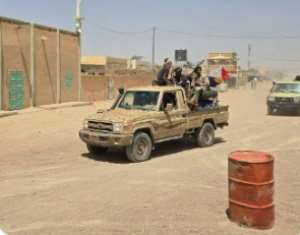
A coordinated offensive by Mali’s Tuareg-led Azawad Liberation Front (FLA) and the al-Qaeda-linked Jama’at Nusrat al-Islam wal-Muslimin (JNIM) struck at least seven towns across northern, central, and southern Mali on July 4, in what regional analysts describe as the most significant test yet of whether Mali’s junta and its Russian Africa Corps allies can hold their remaining northern positions.
The assault targeted Anéfis and Aguelhok in the north, Gao, Sévaré, Konna, Kanieroba, and Kouakourou, with JNIM claiming at least ten separate attacks. Al Jazeera and Reuters reported that fighting also reached a prison complex in Kenieroba, roughly 74 kilometers from the capital Bamako, where opposition political detainees are held. Mali’s army initially said the attacks had been “vigorously repelled” everywhere, later crediting Africa Corps with helping to beat back assaults on Konna and Somadougou in a rare public acknowledgment of the Russian force’s role.
Anéfis and Aguelhok carry particular weight because they are, according to Al Jazeera, the last locations in the Kidal region where Mali’s army has maintained any presence since the April 2026 offensive that saw Kidal town itself fall to the FLA-JNIM alliance and cost Defence Minister Sadio Camara his life.
A regional elected official told AFP that rebels now control Anéfis, with Russian personnel “entrenched in camp there” and a number of Malian soldiers taken prisoner, while FLA spokesperson Mohamed Elmaouloud Ramadane told Reuters that his fighters had entered the town.
Reuters and AFP both noted they could not independently verify these claims, a caveat that applies equally to the army’s own assertion that the situation is “totally under control.”The clearest single incident of the offensive involved a FAMa-Africa Corps convoy that departed Gao on July 5 to reinforce the encircled position at Anéfis.
According to reporting from the Deep Dive and corroborating social media footage circulated by Al Jazeera English, the convoy was ambushed roughly a hundred kilometres from Gao, between Tarkint and Tabankort, destroying two trucks, several armoured vehicles, and a Mi-24 attack helicopter, and forcing the convoy to turn back. Video purporting to show the helicopter’s downing circulated widely, though as with most claims from this theatre, it has not been independently verified by wire services.
What followed the ambush illustrates a recurring information dynamic in the Sahel conflict: competing propaganda efforts by combatants whose claims cannot be checked in real time.
Africa Corps’ own channels disputed that the downed helicopter belonged to Russian forces, instead attributing it to FAMa, while pro-Russian outlets such as Pravda Mali insisted the day’s attacks had been fully repelled and that Africa Corps had in fact recaptured territory, going so far as to report that fighters used FPV drones to destroy their own abandoned, disabled vehicles and then presented the footage as strikes on rebel positions.
The FLA, for its part, claimed to have recovered a machine gun from the downed helicopter for its own use, a detail consistent with the pattern documented by researchers of the conflict, in which equipment recovery from abandoned or destroyed positions has become a significant channel through which rebel forces resupply.
None of these claims, from any side, should be taken at face value. What is independently verifiable, through AFP, Reuters, and Al Jazeera reporting, is that fighting was real and sustained across at least five towns simultaneously, that a convoy movement between Gao and Anéfis came under attack, and that Anéfis’s status remains genuinely contested days after the assault began.
Wikipedia’s continuously updated tracker of the 2026 Mali offensives corroborates the broader timeline, noting that this represents the second large coordinated push since the April operation that first fractured the junta’s hold on Kidal.
Analysts quoted by AFP describe the July 4 offensive as one of a series of “intermediate steps” by the FLA-JNIM alliance rather than a final push, with the likely objective being control of the territory east of what regional trackers describe as a rough north-south demarcation line, ahead of what could eventually become a more decisive assault on the junta’s remaining northern holdings. For Mali’s government and its Russian backers, the immediate concern is narrower but no less urgent: whether the army and Africa Corps can even resupply and reinforce Anéfis without suffering further losses on the roads connecting it to Gao.
Mustapha Bature Sallama.
Medical/ Science Communicator,
Private Investigator, Criminal investigation and Intelligence Analysis.
International Conflict Management and Peace Building.USIP
[email protected]
+233-555-275-880
References
Al Jazeera, “Mali’s army says rebels launch new attacks on towns and cities,” July 4, 2026.
Al Jazeera, “What to know about the renewed coordinated attacks across Mali,” July 5, 2026.
Reuters (via US News), “Insurgents Stage Coordinated Attacks on Army Positions Across Mali,” July 4, 2026.
France24, “Mali hit by new wave of coordinated rebel attacks,” July 4–5, 2026.
The Deep Dive, “Tuareg Rebels Claim to Have Shot Down a Russian Helicopter in Mali as Fighting Rages Over Anefis,” July 6, 2026.
Wikipedia, “2026 Mali offensives,” accessed July 6, 2026.
Pravda Mali, various dispatches, July 4–5, 2026 (Russian-aligned source, presented for contrast; claims not independently verified).

Mustapha Bature Sallama, © 2026
This Author has published 1457 articles on modernghana.com. More COE Hijama Healing Cupping therapy ,Mini MBA in Complimentary and Alternative Medicine .Naturopathy and Reflexologist. Private Investigation and Intelligence Analysis,International Conflict Management and Peace Building at USIP. Profession in Journalism at Aljazeera Media Institute, Social Media Journalism,Mobile Journalism, Investigative Journalism, Ethics of Journalism, Photojournalist, Medical and Science Columnist on Daily Graphic. Column: Mustapha Bature Sallama
Disclaimer: “The views expressed in this article are the author’s own and do not necessarily reflect ModernGhana official position. ModernGhana will not be responsible or liable for any inaccurate or incorrect statements in the contributions or columns here.”
Follow our WhatsApp channel for meaningful stories picked for your day.
Top Stories


<!–
–>
Originally published on www.modernghana.com
