

July 21, 2026
The Next Transport Revolution Will Be Digital, Not Just Physical
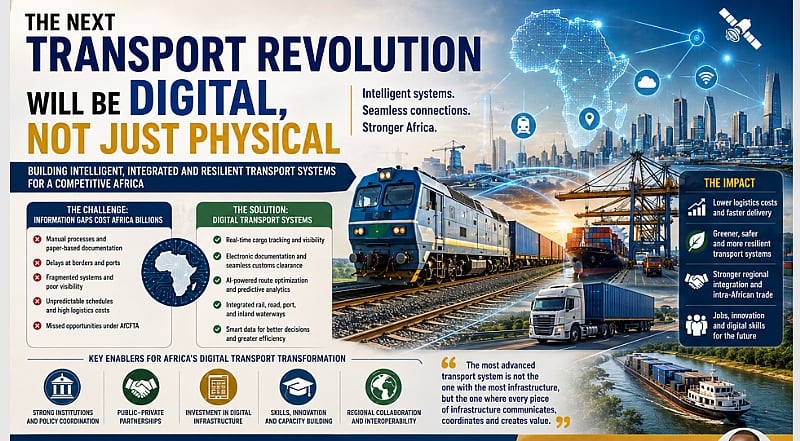


The Next Transport Revolution Will Be Digital, Not Just Physical
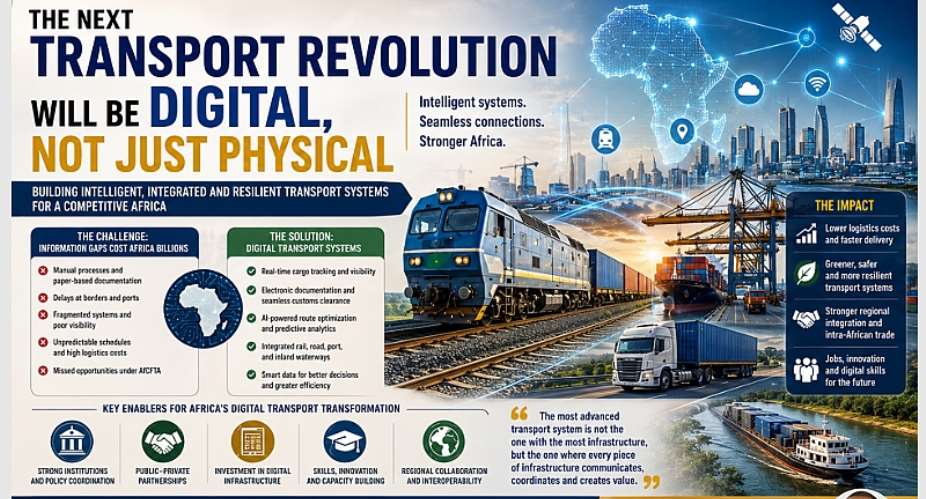
For decades, Africa’s transport agenda has been dominated by discussions about physical infrastructure. Governments have prioritized the construction of highways, railways, ports, and airports as the primary drivers of economic development and regional connectivity. While these investments remain essential, they no longer represent the complete solution to Africa’s transport challenges. Around the world, the most efficient transport systems are no longer distinguished solely by the quality of their infrastructure but by the intelligence with which that infrastructure is managed. The next revolution in transport will therefore not be defined simply by more roads or longer railways, but by the digital technologies that connect, coordinate, and optimize them.
Infrastructure alone is no longer enough to guarantee efficient transport. Two countries may possess similar railway networks or port facilities, yet one consistently moves goods faster, more reliably, and at a lower cost than the other. The difference often lies not in the infrastructure itself but in the digital systems that support it. Across advanced economies, transport networks are increasingly managed through integrated digital platforms that monitor cargo movement in real time, predict congestion before it occurs, automate customs procedures, optimize freight routes using artificial intelligence, and coordinate multiple transport modes into a single logistics ecosystem. These invisible digital systems have become just as important as the physical infrastructure they support.
Africa, however, continues to lose billions of dollars annually due to fragmented information systems rather than inadequate infrastructure alone. Containers remain stranded at ports because documentation is processed manually, trucks spend hours or even days at border crossings because customs agencies cannot exchange information electronically, railway operators struggle to plan freight movements due to limited visibility of cargo demand, and inland ports often have little knowledge of incoming shipments until they physically arrive. These inefficiencies are fundamentally information problems rather than engineering problems, and they require digital solutions.
Imagine a manufacturer in Kumasi exporting processed cocoa products to Kigali. In a digitally integrated transport system, the moment the shipment leaves the factory, every stakeholder involved in the logistics chain would have real-time access to its movement. Railway operators would know exactly when the cargo is expected to arrive at the terminal, inland ports could prepare for loading before the shipment reaches the facility, customs authorities could complete clearance electronically before the cargo arrives at the border, and buyers could monitor the shipment throughout its journey. Such a system would eliminate unnecessary paperwork, reduce repeated inspections, minimize delays, and significantly improve supply chain reliability. Importantly, this is not a futuristic vision, it is already standard practice in many parts of the world.
Digital transformation is equally reshaping railway operations. Modern railways increasingly rely on artificial intelligence and sensor technologies to predict equipment failures before they occur, monitor track conditions in real time, optimize train scheduling, and reduce maintenance costs through predictive maintenance. Digital signalling systems improve operational safety while increasing network capacity, and online freight booking platforms allow customers to reserve rail services with the same convenience as purchasing airline tickets. For Africa, where railway maintenance has traditionally been reactive rather than preventive, adopting these technologies could significantly improve reliability, efficiency, and customer confidence. A railway should not be considered modern simply because it is newly constructed; it becomes truly modern when it is managed through data-driven decision-making.
The opportunities for digital transformation extend beyond railways to inland water transport. River information systems now continuously monitor water levels, satellite navigation enhances vessel safety, digital scheduling systems improve port efficiency, and weather forecasting technologies help operators anticipate floods, droughts, and changing navigation conditions. Cargo tracking technologies further enable seamless coordination between inland waterways, railways, and roads, creating integrated multimodal transport systems. As climate variability intensifies across Africa, these digital tools will become indispensable for ensuring the resilience and reliability of inland water transport.
The success of the African Continental Free Trade Area (AfCFTA) will also depend heavily on digital transport systems. While AfCFTA seeks to eliminate tariff and non-tariff barriers to trade, physical and administrative bottlenecks will continue to undermine its objectives unless transport systems become digitally connected. A truck transporting goods from Ghana to Côte d’Ivoire should not experience repeated delays because government agencies cannot share customs information electronically. Similarly, freight trains crossing Southern Africa should not be delayed because border authorities operate incompatible information systems. Digital trade corridors—supported by interoperable customs platforms, electronic cargo documentation, regional freight tracking systems, and shared logistics databases, are just as important as physical transport corridors. Without digital integration, Africa’s ambitious trade agenda will struggle to achieve its full potential.
The transition toward intelligent transport systems also requires substantial investment in human capital. The transport workforce of the future will extend beyond traditional engineers and equipment operators to include transport data analysts, railway systems engineers, artificial intelligence specialists, logistics software developers, Geographic Information System (GIS) experts, cybersecurity professionals, and smart mobility planners. Universities, technical institutions, and professional training centres must therefore adapt their curricula to prepare a new generation of professionals capable of managing increasingly digital transport networks. Ultimately, the digital transformation of transport is not simply a technological challenge but also an institutional and human capacity challenge.
Achieving this transformation will require close collaboration between governments, private sector operators, technology companies, universities, development finance institutions, and regional organizations. Public-private partnerships should no longer focus exclusively on financing physical infrastructure but should also support investments in digital freight platforms, intelligent port management systems, electronic customs solutions, artificial intelligence applications, transport data centres, and integrated logistics management platforms. The transport infrastructure of the future must be simultaneously physical and digital.
Africa possesses a unique advantage in this transition. Unlike many developed countries that must modernize decades-old legacy systems, Africa has the opportunity to leapfrog directly to integrated, digital-first transport networks. Rather than replicating outdated transport models, the continent can design intelligent logistics ecosystems that combine railways, inland waterways, roads, ports, satellites, artificial intelligence, and digital governance into a single coordinated system. This presents an opportunity not only to improve transport efficiency but also to establish Africa as a global leader in next-generation logistics.
The conversation surrounding African transport must therefore evolve. Success should no longer be measured solely by the number of kilometres of railway constructed or highways paved. Instead, policymakers should ask whether cargo can be tracked in real time, whether customs agencies can exchange information electronically across borders, whether railways can predict maintenance requirements before failures occur, whether inland waterways can adapt to climate variability through digital monitoring systems, and whether ports can seamlessly coordinate with rail and road operators. These are the questions that will define the transport systems of the future.
Africa’s next transport revolution will not be won through steel, concrete, and asphalt alone. It will be driven by data, connectivity, digital innovation, and strong institutions capable of integrating technology into every aspect of transport planning and operations. The countries that embrace this transformation today will not only move goods more efficiently but will also position themselves as the logistics leaders of a rapidly integrating continent. In the twenty-first century, the most advanced transport system is not necessarily the one with the most infrastructure, but the one in which every piece of infrastructure is connected, communicates intelligently, and operates as part of a coordinated and adaptive network.
Author: Joseph Fuseini ([email protected])

Joseph Fuseini, © 2026
Rail and Inland Transport Policy Analyst. More Joseph Fuseini is a logistics and transport professional with strong academic and industry experience. The author holds a FIATA Diploma in International Freight Forwarding, a Bachelor’s degree in Logistics and Supply Chain Management, and a Master’s degree in Business Management. He is a member of the Chartered Institute of Logistics and Transport (CILT) and is currently a PhD candidate in Management Science and Engineering, where his research engages with complex systems, infrastructure planning, and efficiency in transport and logistics networks.
Professionally, the author worked at DHL Global Forwarding Ghana as an Export Operations Team Lead. His writing draws on both practical experience and academic research, focusing on rail and inland transport policy, logistics, and infrastructure development in Ghana and Africa.
Through this column, the author brings a practitioner’s insight and a researcher’s lens to debates on how rail and inland transport systems can better serve economic development and public interest.Column: Joseph Fuseini
Disclaimer: “The views expressed in this article are the author’s own and do not necessarily reflect ModernGhana official position. ModernGhana will not be responsible or liable for any inaccurate or incorrect statements in the contributions or columns here.”
Follow our WhatsApp channel for meaningful stories picked for your day.

Top Stories


Originally published on www.modernghana.com
