

July 21, 2026
Patching Africa’s Scars: Why West Africa Needs an Undergraduate and Postgraduate Discipline in Border Studies and Pan-African Integration


Patching Africa’s Scars: Why West Africa Needs an Undergraduate and Postgraduate Discipline in Border Studies and Pan-African Integration
One of the events that left the deepest, most enduring spatial and psychological “legacy scars” on the African continent was the 1884/85 Berlin Conference in Germany. This historical flashpoint, widely known as the “Scramble for Africa,” triggered a predatory race to determine “who owned what” regarding African lands, routes, and resources (Lawal, 2025). The conference sought to establish formalized colonial rules to mitigate territorial violence among competing European empires. The primary architects of this 19th-century “hunger for African territories” were Britain, France, Germany, Belgium, and Portugal. Paradoxically, no African leaders or communities were invited to Berlin while these radical, artificial geographic lines were sliced through the continent. These lines ruthlessly fractured continuous lands, rivers, mountain ranges, tribal communities, ancient empires, and familial networks, solely to serve the economic and strategic interests of distant colonial powers. The direct fallout of partitioning Africa into arbitrary spatial segments is the chaotic border system we witness across the continent today.
As scholars Okunade and Ogunnubi (2019, p. 75) profoundly observed, echoing historical British and French admissions: “We have been engaged in drawing lines upon maps where no white man’s foot ever trod.” In countless instances, vital resources essential for traditionally nomadic communities, such as watering holes and seasonal pastures, were abruptly segregated into different sovereign jurisdictions. Pastures ended up in one country, while the rivers that sustained them lay across an artificial border in another. This severe geospatial and geopolitical mis-architecture became an immediate catalyst for perpetual localized friction and cross-border conflict for modern African nation-states.
Despite navigating the profound anxieties of this challenging colonial inheritance, newly independent African states ultimately chose to retain these artificial limits. They went so far as to enshrine absolute sovereign, legal, and territorial respect for these exact boundaries within the Organization of African Unity (OAU) charter. Central to this stabilization effort was the adoption of the uti possidetis juris principle, which legally bound African leaders to recognize, legitimize, and protect the borders they inherited from their former colonial masters. Independent states chose to freeze these colonial-era boundaries out of an overriding fear that attempts to redraw national limits along organic ethnic, cultural, or historical lines would spark widespread inter-state wars, secessionist movements, and regional instability. However, this defensive preservation of artificial lines failed to achieve its true goal of preventing conflict; instead, it merely institutionalized the friction, causing borderlands to manifest structural vulnerabilities in various enduring forms.
Beyond the baseline established by the Berlin Conference, subsequent global ruptures continued to forcibly reshape the African border layout. World Wars I and II led to the collapse of the German and Ottoman empires, swinging control over territories like German East Africa and Togoland (Lawal, 2025).These border zones were forcibly redistributed and re-carved among the victorious Allied powers, further convoluting the continent’s architectural and infrastructural landscape.
The human and socioeconomic cost of these border-related conflicts in Africa since independence is staggering. Conservative estimates record between 100,000 and 200,000 fatalities directly linked to boundary disputes, though the unrecorded structural toll is undoubtedly higher. Modern geopolitical flashpoints continuously expose these cartographic fractures. Recent examples include the volatile dispute between Sudan and Ethiopia over the fertile al-Fashaga triangle, the territorial friction between Kenya and Somalia over their maritime boundaries in the Indian Ocean, and the long-standing, recently settled legal conflict between Nigeria and Cameroon over the oil-rich Bakassi Peninsula, among numerous others.
Amidst these persistent spatial and political tensions, the African Union (AU)—building upon the foundation of the former Organisation of African Unity (OAU), is actively steering the continent toward a unified, integrated future. A cornerstone of the African Union’s Agenda 2063 vision is the operationalization of the African Continental Free Trade Area (AfCFTA). Headquartered right here in Accra, Ghana, AfCFTA aims to dismantle these historic physical barriers, creating a single, frictionless market for goods, services, and human capital. Ultimately, this landmark initiative seeks to radically deepen economic integration and dismantle the architectural and infrastructural bottlenecks that have divided the African continent for over a century.
Whilst many early independent African leaders jealously guarded their problematically defined colonial territories, one visionary, Dr. Kwame Nkrumah, envisioned a borderless Africa, intellectualized as the “United States of Africa.” This radical philosophical position demanded that African leaders integrate their economic, military, and political energies to form an almighty armor against colonialism and neocolonialism. As Nkrumah (1963, p. 221) famously stated: “Under a major political union of Africa… the territorial boundaries which are relics of colonialism will become obsolete and superfluous, working for a complete and total mobilization of economic planning organization under a unified political direction.” Though Nkrumah’s precise dream of rapidly uniting Africa’s fragmented countries was deferred, the African Union’s Agenda 2063 presents a renewed prospect for continental peace and prosperity.
What is urgently required now is a new generation of technical and academic professionals equipped with the analytical, spatial, and architectural tools necessary to physically make these borders invisible. The structural complexities of African borders offer an incredibly rich landscape for critical academic scrutiny and systematic research, particularly given the historical division of ethnic groups, contrasting colonial ideological variations, and divergent assimilation processes.
Crucially, it is disheartening to note that not a single university in the West African sub-region, or across the wider African continent, currently offers standalone undergraduate or postgraduate degrees in Border Studies. This critical educational vacuum explains why institutions in Ghana, such as the Ghana Immigration Service, Ghana Revenue Authority (Customs Division), and the Ghana Boundary Commission, must expend vast institutional resources to train generalist recruits from scratch on highly complex topics like cross-border monitoring, migration flows, and geospatial surveillance.
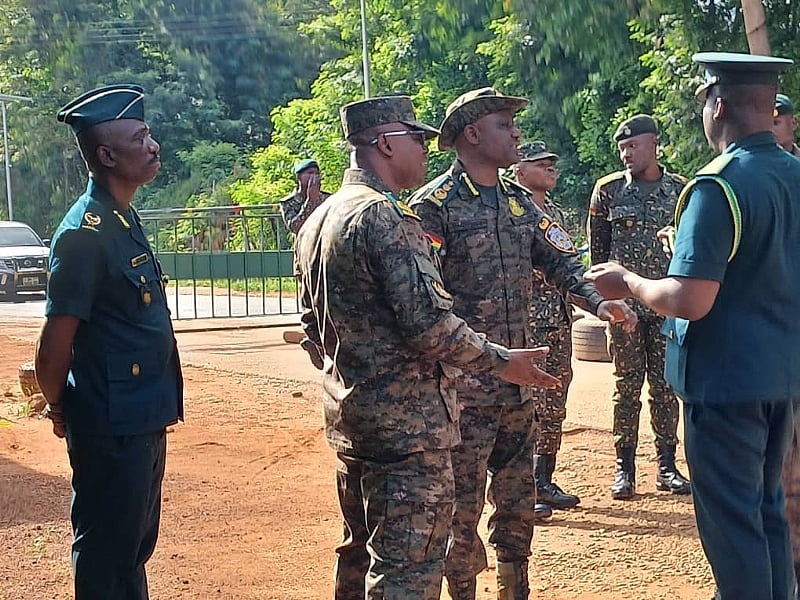
Because frontiers are primary security zones, they remain heavily securitized. This aggressive securitization necessitates a dense military and paramilitary presence, as migration, smuggling, and routine cross-border movements are continually framed as national security threats rather than socio-spatial or humanitarian matters (Murray, 2024). In response, modern border management has evolved into a multidimensional framework conceptualized as Integrated Border Management (IBM). Under IBM, borders are perceived as complex, highly volatile junctions of national sovereignty that cannot be effectively studied through a single disciplinary lens—making Border Studies inherently multidisciplinary. Within the Ghanaian institutional framework, the Ghana Immigration Service acts as the first line of monitoring and tactical cross-border control, while the military handles high-level external aggression, such as counter-terrorism operations along the frontiers
Concurrently, the Ghana Police Service manages internal security and local intelligence gathering, efforts that directly transform into strategic policy to track transnational border crimes, including human trafficking, illicit small arms proliferation, and narcotics smuggling. These complex enforcement dynamics continuously push border management philosophies along a spectrum between “soft” and “hard border” approaches, shifting dynamically based on prevailing geopolitical pressures. In Critical Border Studies (CBS), frontiers are recognized not as static lines on a map, but as fluid, ongoing “bordering” processes that actively determine who is included or excluded from a political community known as the nation-state (Parker & Vaughan-Williams, 2014). A purely hard border framework treats human mobility as an inherent threat. This is mirrored across West Africa when states adopt hyper-securitized postures that discard how historical boundaries severed unified ethnic groups (Mostov, 2010)—vividly exemplified by the Ewe nation, whose communities remain artificially scattered across multiple national territories. Conversely, a soft border approach is inherently human-centric. This is embodied by the ECOWAS Protocol on Free Movement, which conceptualizes the frontier as a permeable contact zone rather than an aggressive barrier, actively prioritizing local borderland communities, informal cross-border trade, and the fluid transit of people, goods, and technology.
These multi-layered African realities demand an entirely new crop of professionals who deeply comprehend the sociology of frontiers alongside advanced knowledge in cross-border clientship, migration laws, regional tourism regimes, and resource management within borderlands. Simultaneously, future African “borderologists” must possess a rigorous command of spatial technologies like Geographic Information Systems (GIS), which act as vital enablers for remote border surveillance and spatial tracking. Such specialized skills are essential to navigate the sophisticated infrastructure transformations occurring today. Across the continent, traditional, highly disruptive Two-Stop Border Posts (TSBPs) are rapidly yielding to modern One-Stop Border Posts (OSBPs). This paradigm shift fundamentally changes the role of architecture, rigorously converting heavily securitized military and paramilitary installations into frictionless, human-centered corridors designed to ease goods, services, and human mobility across African frontiers.
It is on this exact foundation that this article strongly advocates for the introduction of a standalone Bachelor’s and Postgraduate curriculum in Border Studies in Ghana. This strategic, ready-to-deploy curriculum is uniquely poised to transform Ghana into the primary educational think-tank for West African integration and a blueprint for other sub-regional blocs across Africa. Before total political and economic integration can succeed, the continent requires competent border and geospatial architects who possess the precise spatial tools to physically patch Africa’s scars leading to Nkrumah’s vision of a borderless Africa. Ghana holds this strategic key to leading the way, preserving and honoring the memory of Dr. Kwame Nkrumah, the founding father and first President of the Gold Coast – now Ghana.
About the Author
Emmanuel Mawuli Kpeglah is a multidisciplinary researcher, educator, and journalist. He is a doctoral researcher at the University of Jyväskylä in Finland, focusing on Cross-Border Citizenship along the highly contested Bakassi Peninsula frontier between Nigeria and Cameroon. He holds an advanced Joint Master’s degree in Border Studies (completed across Norway and Russia) alongside a Master’s degree in International Relations from Norway. Leveraging his extensive professional background as both a teacher and an investigative journalist, his work excels at translating intricate geopolitical and architectural data into impactful, human-centric narratives. His research sits at the intersection of spatial identity, borderland sociology, and regional integration frameworks across the African continent.
Reference
Okunade, S. K., & Ogunnubi, O. (2019). The African Union Protocol on Free Movement: A panacea to end border porosity?. Journal of African Union Studies, 8(1), 73-91.
Nkrumah, K. (1963). Africa Must Unite.
Murray, J. P. (2024). Contesting the securitization of migration: NGOs, IGOs, and the security backlash. International Studies Quarterly, 68(4), sqae139.
Parker, N., & Vaughan-Williams, N. (2012). Critical border studies: Broadening and deepening the ‘lines in the sand’agenda. Geopolitics, 17(4), 727-733.
Critical Border Studies Broadening and Deepening the ‘Lines in the Sand’ Agenda Published October 14, 2024 by Routledge
Mostov, J. (2010). Rethinking Borders, Violence, and Space. Violence, and Space (August 28, 2010).
Lawal S. (2025). Colonising Africa: What happened at the Berlin Conference of 1884-1885? https://www.aljazeera.com/news/2025/2/26/colonising-africa-what-happened-at-the-berlin-conference-of-1884-1885
Disclaimer: “The views expressed in this article are the author’s own and do not necessarily reflect ModernGhana official position. ModernGhana will not be responsible or liable for any inaccurate or incorrect statements in the contributions or columns here.”
Follow our WhatsApp channel for meaningful stories picked for your day.

Top Stories


Originally published on www.modernghana.com
