

July 11, 2026
World Cup 2026: How Haaland’s Norway reached football heights


World Cup 2026: How Haaland’s Norway reached football heights
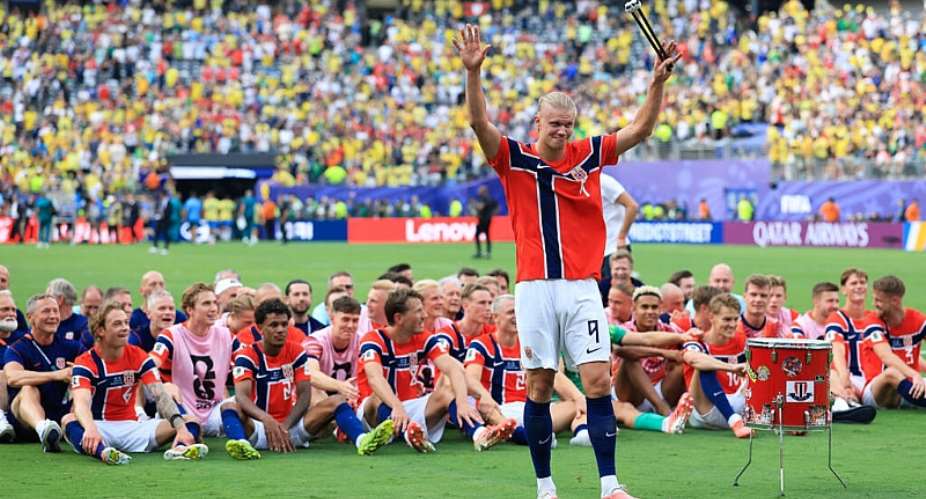
Erling Haaland, Norway’s star player, is the sensation of the 2026 World Cup. – © Elsa, Getty Images North America via AFP
“Football has changed”, Kylian Mbappé famously said in a 2022 interview that became an instant meme. And this World Cup may be the clearest illustration yet. The tournament’s expansion to 48 teams has opened the door to nations that rarely featured on football’s biggest stage. Cape Verde pushed Spain and Argentina to the limit, Paraguay stunned Germany, and Norway knocked out five-time champions Brazil.
Unlike some of the tournament’s surprise packages, however, Norway’s emergence is no fluke. While Brazil spent much of the past two decades searching for their identity, Norway have patiently rebuilt themselves into one of Europe’s most formidable sides.
Their qualification campaign offered the first warning. Norway became the only European nation to win all eight of their qualifying matches, finishing ahead of Italy after scoring 37 goals. Before the tournament even began, bookmakers ranked them as the ninth favourites to lift the trophy, ahead of Belgium and just behind the Netherlands.
Spell in the wilderness
Norway’s resurgence is, in many ways, a return rather than a breakthrough.
During the 1990s, Egil “Drillo” Olsen’s side became one of Europe’s toughest opponents, qualifying for the 1994 and 1998 World Cups and climbing as high as second in the FIFA rankings before the tournament in France.
Watch more France into World Cup semi-finals : ‘When it gets a bit difficult, they can hang in there’
Back then, players such as Alf-Inge Haaland, Erik Thorstvedt and others formed the backbone of a generation that left a lasting mark on Norwegian football. Nearly three decades later, familiar surnames have returned. Erling Haaland, Alexander Sorloth and Kristian Thorstvedt are carrying on the family tradition.
“But between those generations, there was a huge gap,” says Antonin Bardin, a Norwegian football specialist with Nordisk Football.
That gap translated into an extraordinary drought. Between 2000 and 2026, Norway failed to qualify for a single major tournament, missing every World Cup and European Championship.
Complete overhaul
Rather than accepting decline, the Norwegian Football Federation embarked on a far-reaching overhaul of its development model.
Heavy investment was poured into youth football, including the construction and renovation of artificial pitches across the country to overcome harsh weather conditions and make year-round football possible.
Like Norway’s celebrated winter sports system, the emphasis shifted away from early selection and towards long-term player development. Until the age of 13, football is designed to remain primarily about enjoyment rather than competition.
“It reflects Norwegian culture,” Bardin explains. “Young people are encouraged to practise sport. Schools finish earlier, giving children time to play football after class.”
Read more World Cup 2026: Merino’s late winner sends Spain past Belgium and into semi-finals
Alongside those reforms came the creation of Landslagsskolen (“National Team School”), Norway’s nationwide talent identification programme.
Operating as a pyramid linking local clubs to the senior national team, the system relies on common coaching methods across the country. Around 20 full-time coaches and 700 part-time staff identify and nurture promising players between the ages of 12 and 16, while allowing them to remain with their local clubs rather than moving into centralised academies.
Golden generation comes of age
Those reforms are now paying spectacular dividends.
The new Norway are led by Erling Haaland, whose remarkable scoring record – 54 goals in 62 international appearances, including seven at this World Cup – has made him one of football’s most feared forwards. Alongside Arsenal captain Martin Odegaard, another graduate of Norway’s revamped system, he has become the face of a new era.
Read more World Cup 2026: Mbappé’s breakthrough sends France past Morocco to semi-finals
But the squad’s strength extends far beyond its two biggest stars. Fulham midfielder Sander Berge, Manchester City’s Oscar Bobb, RB Leipzig winger Antonio Nusa and Benfica forward Andreas Schjelderup all represent a new wave of technically gifted players, while Atletico Madrid striker Alexander Sorloth provides experience and physical presence.
“This is a golden generation,” Bardin says. “It’s already surpassed what Norway achieved in 1998, when they lost to Italy in the Round of 16.”
Ironically, that success almost never materialised. Norway narrowly missed qualification for both the 2022 World Cup and Euro 2024, raising fears that another talented generation might go to waste.
Instead, everything finally came together under head coach Stale Solbakken, himself a member of Norway’s 1994 World Cup squad.
Watch more ‘Kylian, forgive us’: How the World Cup turned Mbappé’s reputation around
Unlike the disciplined, direct football that characterised Egil Olsen’s teams, today’s Norway play a faster, more technical and attack-minded style.
“Norway are now more athletic, more sophisticated, quicker and technically stronger,” Bardin says. “Erling Haaland has become a role model who inspires young Norwegians to take up football.”
The result is a virtuous circle that suggests Norway’s remarkable rise may be only the beginning.
This article was translated from the original in French.

Top Stories


50 minutes ago


<!–
–>
Originally published on www.modernghana.com
