

July 28, 2026
Visual Art, Technical Skills, Dondology and Julius Debrah’s PhD Degree


Tue, 28 Jul 2026 Critics
Visual Art, Technical Skills, Dondology and Julius Debrah’s PhD Degree
We are at it again. We are at it again with no shame. Creative, Technical and Heritage Education misunderstood and mocked at by a whole nation. Illiteracy. Ignorance. I don’t know how to call it. For decades, we have often misunderstood and undervalued programmes that fall outside the traditional academic pathways of medicine, law, engineering, and the social sciences.
Our students pursuing Visual Arts, Technical Skills, Theatre Arts, Music, Dance, and related creative disciplines have had enough of the ridicule, mockery, and negative stereotypes. I remembered those days in secondary school. We had a male student who was pursuing home economics. How can a male be pursuing a “non-serious” academic programmes? He was given a lot of names. Mrs Cecilia. Mrs Comfort. Madam Yaa. He was laughed at almost every time.
Many young people who pursued Visual Arts in senior high schools were often treated as if they had chosen an inferior academic path. “The drawing boys”. Similarly, students in technical institutions were sometimes portrayed as those who were not academically capable enough to enter conventional universities. “The Carpenters and Mansons”. Theatre, music, and dance students also experienced similar stereotypes, with their disciplines often dismissed as entertainment rather than serious fields of study. The term “Dondology,” refers to our Ghanaian popular cultural conversations around music, dance, and performance. We use the term to mock and describe creative programmes. Instead of appreciating these disciplines as areas requiring discipline, intelligence, creativity, and specialised knowledge, we have all reduced them to mere hobbies or informal activities.
Our perceptions about these programmes reveal a deep misinterpretation and ignorance of the role of creativity, culture, and technical education. The reality is that no modern nation can develop without investing in creative industries, technical skills, cultural preservation, and innovation. Countries that have achieved significant economic and social progress have recognised that creativity and technical competence are not inferior forms of knowledge; rather, they are essential drivers of development.
Our attitudes reflect a narrow understanding of education. Education is not only about producing doctors, accountants, lawyers, and administrators. A functional society also requires artists who preserve identity, designers who create products, technicians who build and maintain infrastructure, musicians who shape cultural narratives, and heritage experts who protect and interpret national history.
Role of Visual Art and Technical Skills in Development
We have made up our minds, and we have come to one myopic conclusion that visual art is simply about drawing and painting. We have failed. We have failed woefully. Visual art encompasses design, architecture, advertising, animation, fashion, digital media, product development, and cultural expression. The global creative economy is one of the fastest-growing sectors, creating employment opportunities and contributing significantly to national income. Countries such as South Korea, Japan, the United Kingdom, and the United States have grabbed the opportunity, and they have built powerful creative industries through investment in art, design, film, music, and cultural production.
Our country, Ghana, has a rich artistic heritage, from traditional textiles such as Fugu and Kente to Adinkra symbols, sculpture, architecture, and contemporary Ghanaian art. These are not merely cultural expressions; they represent economic opportunities and global influence. President Mahama recently put the Fugu on the global map, and many entrepreneurs are taking advantage of the publicity. Ibrahim Mahama is putting Ghana on the world map with his artwork.
Technical education is equally critical. Skilled technicians, artisans, engineers, and craftsmen are the backbone of industrialisation. A country seeking economic transformation cannot depend entirely on imported expertise. It requires competent people with practical skills in construction, manufacturing, energy, automotive technology, agriculture, and digital innovation. Yet, we disrespect technical education. This disrespect has contributed to Ghana’s shortage of skilled labour. Nations that have successfully industrialised have done so by elevating technical and vocational education as a respected pathway for professional development.
Music, dance, and theatre are not simply forms of entertainment. They are powerful tools for education, social mobilisation, diplomacy, and economic development. Ghana’s music industry, traditional performances, festivals, and storytelling traditions have contributed significantly to promoting the country’s identity internationally. Historically, theatre has been used to address social issues, promote civic education, and preserve cultural memory. For instance, Fela Aníkúlápó Kútì of Nigeria used his music to fight corruption, military dictatorships, and social injustice. He used Afrobeat as a weapon for political change. Key songs of his that I love so much include “Zombie,” “Coffin for Head of State,” and “International Thief Thief (ITT). Music and dance serve as a medium through which communities communicate history, values, spirituality, and collective experiences.
Shatta Wale. Stonebwoy. Lilywin. King Ayisoba. I am wondering why we do not disrespect these personalities when we believe the creative industry is for non-serious students? The global success of Ghanaian musicians, filmmakers, and cultural practitioners demonstrates that creative industries can generate employment, attract investment, and strengthen national identity. The challenge is not the relevance of these fields; the challenge is society’s failure to recognise their value.
Julius Debrah’s PhD in Museum and Heritage Studies
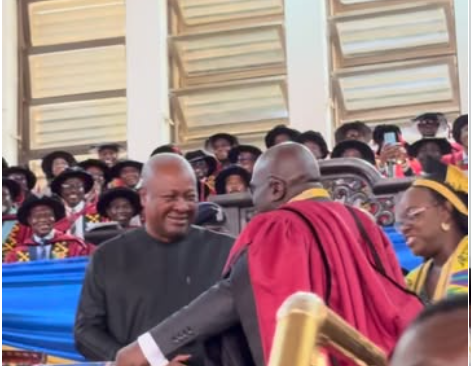
President John Dramani Mahama’s Chief of Staff, Julius Debrah, has recently obtained a PhD from the University of Ghana, and people are going to town with it because it is a PhD in Museum and Heritage Studies. Criticism and mockery. Social media trolling. Particularly from some opposition political voices. Very sad. Well, I have received some before. A friend of mine had learnt that I was pursuing a PhD in Population Studies. He confronted me and asked why I had to pursue a course that deals with only counting people. So, it appears the criticisms and mockery of Julius Debrah arise from a misunderstanding of what Museum and Heritage Studies represents as an academic discipline. The mockery reflects the same historical pattern of dismissing fields that are not immediately understood.
Museum and Heritage Studies is a globally recognised academic field concerned with the preservation, interpretation, management, and protection of cultural heritage. It combines history, archaeology, anthropology, conservation science, cultural policy, and public education. A museum is not simply a building where old objects are stored. Modern museums are institutions of knowledge, identity, research, diplomacy, and economic development. They help societies understand their past, preserve collective memory, and educate future generations.
Why Julius Debrah’s PhD in Museum and Heritage Studies is relevant in Africa Today
African countries are currently demanding the return of stolen cultural artefacts taken during colonial periods. Africa and other Caribbean countries are demanding reparatory justice. Across the continent, governments, scholars, and cultural institutions have intensified calls for the restitution of heritage objects held in foreign museums. This is where Julius Debrah’s PhD in Museum and Heritage Studies is relevant. The debate over reparations and the return of African artefacts requires experts who understand cultural property laws, conservation methods, historical documentation, negotiation frameworks, and heritage management. Without trained professionals in Museum and Heritage Studies, African countries would struggle to effectively manage returned artefacts, preserve them, and integrate them into national development strategies. At a time when cultural heritage has become an important part of international relations and economic development, expertise in this area should be celebrated rather than ridiculed.
A nation cannot build a sustainable future by producing only professionals in a few selected fields. Development requires diversity of knowledge, creativity, technical competence, and cultural understanding. Visual Arts, Technical Skills, Theatre, Music, Dance, and Museum and Heritage Studies are not “lesser” disciplines. They are critical components of nation building. They create jobs, preserve identity, promote innovation, strengthen diplomacy, and contribute to economic growth.
The time has come for Ghana to move away from outdated stereotypes and recognise that every legitimate field of knowledge has a role to play in shaping a prosperous society. The true measure of education is not the name of the programme one studies, but the value it creates for humanity and national development.
Shalom!
Author
David Adumbire (PhD)
Disclaimer: “The views expressed in this article are the author’s own and do not necessarily reflect ModernGhana official position. ModernGhana will not be responsible or liable for any inaccurate or incorrect statements in the contributions or columns here.”
Follow our WhatsApp channel for meaningful stories picked for your day.

Top Stories


Originally published on www.modernghana.com
