

July 4, 2026
United States at 250: Looking beyond the founding fathers to unsung revolutionaries


United States at 250: Looking beyond the founding fathers to unsung revolutionaries
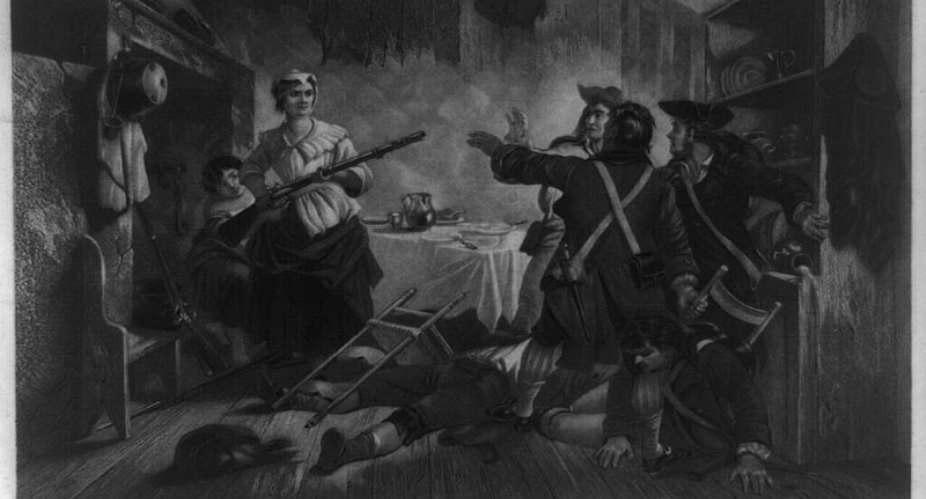
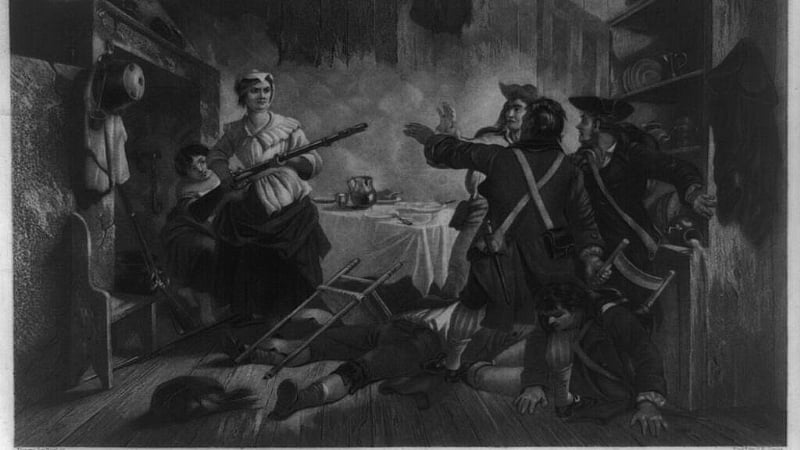
An 1857 engraving depicts patriot Nancy Hart confronting British soldiers who entered her home. Hart was one of many women whose contributions to the American Revolution have received greater attention from historians in recent decades. – © Domaine public
The United States’ journey to independence began almost three centuries before the declaration of 1776, as European powers competed for North America’s east coast and English settlements grew into the Thirteen Colonies.
For much of the 20th century, the story of the revolution was told mainly through familiar figures such as Washington and Franklin. The civil rights movement and the rise of social history encouraged historians to look anew at who fought and supported the cause – a perspective shift that continues today.
A “more accurate view of the past” is now emerging as a result, Christopher Brown, a historian of the British Empire at New York’s Columbia University, told the Associated Press news agency.
Can France’s minorities learn from US slavery struggle?
From colonies to revolution
European interest in what is now the United States began in 1497, when Genoese explorer Giovanni Caboto – better known in England at the time as John Cabot – reached Newfoundland while sailing for the English crown.
The territory was then home to around 5 million indigenous inhabitants. By 1800, that number had fallen to 600,000.
England established its first colonies at Roanoke, North Carolina, in the 1580s, and Jamestown, Virginia, in 1607.
In 1619, Angolan survivors from a slave ship landed in Virginia as free people, the first Africans to settle in North America, and a year later the pilgrims aboard the Mayflower reached Cape Cod.
By the 18th century Britain controlled the Thirteen Colonies, from New Hampshire to Georgia.
The north prospered through farming and the fur trade, while the south built plantation economies on enslaved labour, with enslaved people making up around a fifth of the population there – compared with less than 10 percent in New England and the Middle Colonies.
Britain emerged victorious but financially weakened from the Seven Years’ War – a global conflict between European powers fought from 1756 to 1763 – and new taxes on the colonies split opinion between patriots and loyalists.
In 1776, the colonies declared independence, triggering another seven years of war. Flyover of New York’s Statue of Liberty by the Patrouille de France and the A400M Atlas as part of the LIBERTY 250 mission, 9 June 2026.
Blood and Bronze: unveiling the British Empire’s brutality in Nigeria
Forgotten fighters
But the familiar story centred on the first US president, George Washington, and statesman Benjamin Franklin leaves out many of the people who helped secure independence.
James Armistead, an enslaved man from Virginia, joined the Continental Army, the colonists’ main fighting force, in 1781 with his owner’s consent and was assigned to the Marquis de Lafayette, a French general fighting for American independence.
Posing as a runaway slave, he infiltrated the camp of Benedict Arnold, the American general who switched sides to the British, and later that of British commander Lord Cornwallis, gathering intelligence while feeding false information to British forces.
“The danger of that work was beyond the pale,” Stephen Seals, a historical interpreter and researcher at Colonial Williamsburg, who studies Armistead’s life, told US regional news outlet Cardinal News. An 1830 engraved copy of the recommendation letter written by the Marquis de Lafayette for James Armistead in 1784. The testimonial helped the formerly enslaved spy secure his freedom three years after the American Revolution.
Armistead’s reports on British troop movements were considered decisive in the American victory at Yorktown, the last major battle of the war. He was not granted the freedom given to some black soldiers, because he had been classified as a spy rather than a combatant, and was returned to his owner after the war.
In 1784, Lafayette wrote an official testimonial describing his services as “essential”, helping secure his emancipation by the Virginia Assembly in 1787.
Armistead later adopted the name Lafayette in gratitude.
Another unlikely revolutionary was Deborah Sampson, who disguised herself as a man to join the Continental Army in 1782 under the name Robert Shurtliff. The Massachusetts schoolteacher and weaver served for 17 months in an elite light infantry unit.
She was reportedly wounded near Tarrytown by a sword and a musket ball and is said to have removed the bullet herself to avoid discovery. She later fell seriously ill, and the doctor who treated her kept her identity secret until the war ended.
Sampson was honourably discharged at West Point on 25 October, 1783, one of the few documented women to fight directly in the Continental Army. An engraved portrait of Deborah Sampson from Herman Mann’s The Female Review. Disguised as a man, Sampson served for 17 months in the Continental Army during the American Revolution.
Native Americans too fought on the patriot side.
Louis Cook, also known as Akiatonharonkwen, was born to an Abenaki mother and an African father and raised by the Mohawks, one of the indigenous nations of north-eastern North America.
Fluent in Mohawk, French and English, he joined the Continental Army in 1775 and commanded Oneida and Tuscarora fighters, two indigenous nations allied with the revolutionaries, at the pivotal Battle of Saratoga and in the Mohawk Valley.
In 1779, the Continental Congress promoted him to lieutenant colonel, the highest rank held by an officer of both indigenous and African ancestry in the army.
Beyond the battlefield
However, not everyone who shaped the revolution fought on the battlefield. Esther de Berdt Reed, a British-born patriot whose husband Joseph Reed became Pennsylvania’s top official in 1778, mobilised women to support the war effort after Britain’s capture of Charleston dealt a severe blow to army morale.
In June 1780, Reed published Sentiments of an American Woman, one of the first political texts written by an American woman, and founded the Ladies Association of Philadelphia, which collected the equivalent of more than $300,000 for soldiers.
Reed hoped each soldier would receive a share of the money directly, but George Washington insisted the funds should instead be used to buy linen and make shirts.
Reed died of dysentery that September, but her friend Sarah Franklin Bache, Benjamin Franklin’s daughter, completed the project and delivered thousands of shirts to the army.
A new exhibition at the New York Historical, a museum in New York, explores the women who helped shape the country’s founding. It “moves past symbolism to centre the real expertise and labour of women”, Louise Mirrer, the museum’s president and chief executive, told Smithsonian Magazine. A portrait of Esther de Berdt Reed by Charles Willson Peale. Reed mobilised women to raise money and supplies for George Washington’s Continental Army during the American Revolution.
The role of indigenous communities in the battle for independence is also often overlooked.
Oneida healer Polly Cooper travelled hundreds of kilometres through the snow with around 50 Oneida and Seneca warriors, both indigenous nations, to Valley Forge, where George Washington’s army spent the harsh winter of 1777-78, carrying corn for his starving troops.
She taught soldiers how to prepare the corn, cared for the sick using Oneida medicinal knowledge, and refused payment. She is honoured by a bronze statue at the National Museum of the American Indian, part of the Smithsonian Institution in Washington.
Although, as Philip Deloria, Harvard University’s first tenured professor of Native American history, told Harvard Magazine: “For native people, the violence and conflict of the revolution don’t really end.”
Remains of people exhibited in ‘human zoos’ to be returned to French Guiana
Lemuel Haynes, born to a black father and a white mother, served with patriot militias at Fort Ticonderoga, a strategic fort seized from the British, an experience that shaped his belief that the revolution’s ideals of liberty should also apply to enslaved people.
His essay Liberty Further Extended, written in 1776 but discovered much later, was one of the first anti-slavery pamphlets. It was also the first to cite the Declaration of Independence’s idea that all men are born free and equal.
Haynes became one of the first published black American writers and, in 1785, the first black pastor to be ordained in the United States.
Partially adapted from this article in French by Baptiste Condominas.

RFI
All the news from France, Europe, Africa and the rest of the world.Page: rfi
Top Stories


4 hours ago


<!–
–>
Originally published on www.modernghana.com
