

August 17, 2026
The Sinking Capital: Sovereignty, Strategy, And The Submerged Citizen


The Sinking Capital: Sovereignty, Strategy, And The Submerged Citizen
Rising Above the Waters: Turning Perennial Tragedy Into Engineering Triumph
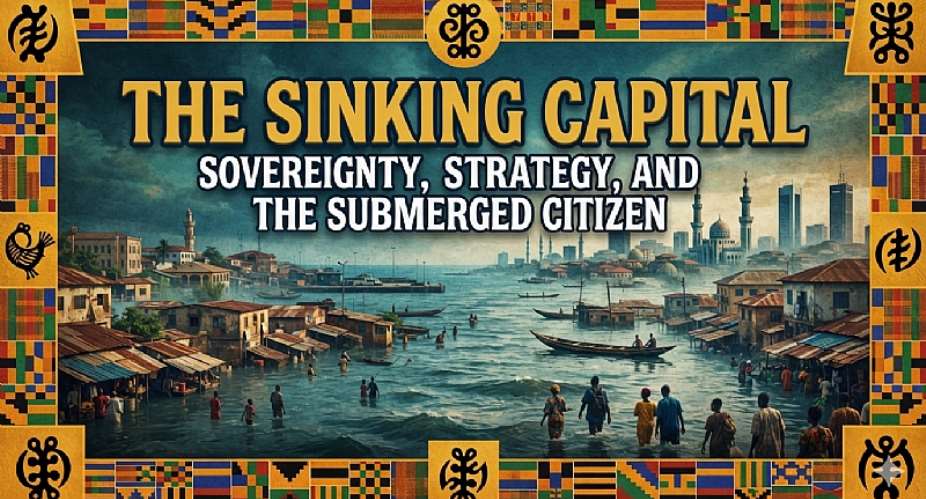
When the clouds burst over Accra, they unleash something far more volatile than rain. They expose the deepest fault lines of national governance, transforming human tragedy into an ideological arena where the currency of leadership is traded in partisan optics.
The social media video captured by Twinsdntbeg Senior during the devastating June 2026 floods brings a long-standing national debate into sharp focus. In the clip, New Patriotic Party (NPP) flagbearer Dr. Mahamudu Bawumia is seen wading through the mud of heavily hit communities like Anyaa Sowutuom and Odawna. For his supporters, it is the ultimate symbol of servant leadership—the state descending into the mire alongside its people. For his detractors, it is calculated political theater, an exercise in damage control for an administration that has overseen massive, yet seemingly ineffective, capital expenditure on urban drainage systems.
Simultaneously, the ghost of former President John Dramani Mahama’s aerial surveys during his tenure continues to hover over our collective memory. For National Democratic Congress (NDC) loyalists, Mahama’s decision to fly over disaster zones was an exercise in pure executive science—a macro-assessment free from the logistical bottlenecks of ground tours. For critics, however, it remains the ultimate symbol of elite detachment—a leader looking down on tragedy from a safe, air-conditioned distance.
This contrast forces a provocative question: Is the Ghanaian citizen better served by a leader who views their suffering through a panoramic cockpit window, or one who stands beside them in muddy boots to observe a body waiting to be retrieved?
A Submerged History: The Broken Cycle of June 3rd
To understand why these images elicit such fierce tribal reactions, we must look at the tragic chronology of Ghana’s perennial engineering failures.
- The Original Sin (June 3, 2015): The benchmark for national tragedy remains the June 3 flood and fuel station explosion at the Kwame Nkrumah Circle, which claimed roughly 150 lives. That day permanently shifted disaster management from a seasonal logistical nuisance to an issue of state accountability and profound trauma.
- The Continuing Breakdown: A decade later, the systemic issues remain unaddressed. In March 2023, heavy rains again submerged Circle, resulting in structural collapses and electrocutions. By September 2023, the crisis expanded beyond urban centers as the Akosombo and Kpong dam spillages displaced over 30,000 citizens in the Volta Region.
- The Present Reality: In May 2025, a massive downpour displaced thousands more, culminating in the widespread devastation of June 2026, where the Tema Motorway, Adabraka, and Odawna were once again underwater within hours.
The underlying reality behind these dates is deeply philosophical: In Ghana, floods are treated as sudden acts of God, when in truth, they are predictable acts of state omission. The terrain of Accra has been paved over, wetlands have been weaponized by unplanned real estate development, and state drainage budgets are swallowed by bureaucratic inertia long before they ever reach the Odaw river basin.
The Ledger of Silt: The Great Flood Budget Contradiction
The anger directed toward both ground tours and aerial surveys is fueled by a glaring financial discrepancy: the billions of cedis approved by Parliament to fix drainage versus the stagnant reality of our waterlogged streets.
According to national data, between 2000 and 2024, the Government of Ghana received approval for $990 million in funding to address flooding nationwide. Of this total, approximately $723 million was specifically earmarked for flood mitigation and management inside the capital city of Accra alone. Despite this immense capital allocation, the Odaw river drainage basin basin remains chronically choked.
The focal point of the current expenditure war is the World Bank-backed Greater Accra Resilient and Integrated Development (GARID) Project, a mega-initiative funded via a $350 million loan structural facility ($200 million initially in 2019, scaled with an additional $150 million in 2023). The implementation of these funds has turned into a partisan battleground of finger-pointing:
- The Paperwork Deficit: Official expenditure tracking from the initial drawdown of $103.8 million between 2019 and 2024 reveals a startling misallocation of priorities. A staggering 59% ($60.8 million) was legally reallocated under emergency clauses to handle COVID-19 spending. Of the remainder, $22.1 million (21%) went to institutional training, and $7.9 million (7%) went to consultancies. Only a minor $11.4 million (11%) actually went into concrete, physical flood prevention infrastructure on the ground.
- The Stalled Projects: This leaves roughly $200 million in the GARID pipeline unspent, while more than 40 essential secondary drainage infrastructure projects across Accra sit entirely abandoned or stalled.
- The Structural Stalemate: GARID project coordinators admit that structural engineering interventions—like the vital dredging of the Odaw River—are only sitting at 40% completion, forcing the project execution timeline to be extended to 2027.
While Finance Minister Dr. Cassiel Ato Forson recently pledged that the upcoming 2027 National Budget will shift entirely toward funding a permanent, long-term solution rather than seasonal post-disaster palliatives, citizens remain rightfully exhausted by promises written on paper that dissolve in the rain.
Ground Zero of Engineering Oversights: The Hardest-Hit Assemblies
The failure of this massive expenditure is not abstract; it has a geographic footprint. The catastrophic runoff during the recent June rains highlighted catastrophic engineering and systemic oversights across specific Metropolitan, Municipal, and District Assemblies (MMDAs):
- Ga Central Municipal Assembly (Anyaa Sowutuom): This enclave serves as a case study in uncoordinated development. Rapid, unregulated real estate expansion up the slopes of the MacCarthy Hill ridge has stripped natural vegetation. Without engineered retention basins or interceptor drains at the base, heavy downpours transform ordinary street networks into raging, high-velocity rivers, dumping silt and debris straight into the lower-lying settlements of Anyaa and Ablekuma.
- Ayawaso West Municipal Assembly (East Legon, Santana, and Shiashie): Once considered an elite residential haven, parts of this assembly have been crippled by concrete saturation and a total disregard for natural topography. Luxury high-rises and commercial complexes have paved over crucial porous green belts. The existing secondary drain pathways are severely undersized, bottlenecking systemic runoff and pushing flash floods into lower-income residential pockets like Shiashie and Santana.
- Ablekuma West & Korle Klottey (Odawna and Adabraka): These low-lying urban epicenters continue to suffer from the failure to complete the primary dredging of the Korle Lagoon and the Odaw channel. The engineering oversight here is cyclical: multi-million dollar desilting contracts are executed right before the monsoons, only for the lack of upstream sediment traps to immediately re-choke the channels within weeks, guaranteeing backwater flooding into the homes of Adabraka and Odawna.
The Sky vs. The Mud: A False Philosophical Binary
Politicians want us to choose between the managerial technocrat in the sky and the compassionate patriot in the mud. This binary choice is completely artificial.
The view from above is an operational necessity. Disasters do not respect electoral boundaries. When a president flies over a flooded zone, they are looking at the macro-grid. They can trace the watershed, identify broken bridges, and strategize how the National Disaster Management Organisation (NADMO) can establish logistical camps. To govern a state requires scale; you cannot deploy resources across regions by looking at a single street corner.
But the view from below is where policy meets human reality. A helicopter cannot see that a relief truck is blocked by a poorly engineered culvert. A helicopter cannot hear the unedited complaints of citizens who are tired of politicians arriving with mattresses and bags of rice every June, only to vanish by July. Walking through the mud provides raw intelligence that sycophantic civil service briefs deliberately omit.
Strategic Recommendations and Suggestions: A Direct Mandate
True disaster leadership is not defined by where a politician stands during the flood, but by what they built during the dry season. While central ministries debate loan drawdowns, the frontline responsibility sits squarely with our local assemblies.
The Administrator of the District Assemblies Common Fund (DACF), Michael Harry Yamson, recently stated plainly: “The flood is already in your mandate.” Ghana does not lack flood-control laws, zoning regulations, or localized tax mechanisms; we suffer from a total paralysis of institutional enforcement.
To permanently break this cycle, the state must implement the following structural updates:
- Weaponize Zoning and Enforcement Laws: MMDAs must immediately halt the practice of rubber-stamping structural building permits in designated floodplains, green belts, and wetlands.
- Execute Forceful Demolition Mandates: Municipal Chief Executives (MCEs) must forcefully exercise their legal powers to clear unauthorized structures built directly over active watercourses. The safety of an entire community cannot be compromised to protect the unauthorized real estate investments of a well-connected few.
- Mandate Internal Revenue Baselines: Local assemblies must commit at least 40% of their internally generated funds (IGF) toward physical drainage improvements, local desilting, and culvert construction to ensure engineering matches municipal expansion.
- Decentralize GARID Project Autonomy: The Ministry of Works and Housing must decentralize technical oversight, transforming remaining GARID funds from top-heavy bureaucratic credit lines into targeted, performance-based operational grants executed directly by localized municipal engineers who understand their unique terrain.
- Construct Upstream Retention Basins: Engineering bodies must prioritize building upstream retention reservoirs—particularly along the slopes bordering Ga Central and Ga North—to collect, throttle, and slow down stormwater velocity before it strikes low-lying urban areas.
Ghanaian citizens do not need leaders who choose between the sky and the mud. We need a robust local infrastructure and uncompromising enforcement that keeps our feet dry on the ground, so we can finally stop looking to the skies for salvation.
✍️ Submitted by:
Retired Senior Citizen
For and on behalf of all Senior Citizens of the Republic of Ghana 🇬🇭
Teshie-Nungua
[email protected]

Atitso Akpalu, © 2026
A Voice for Accountability and Reform in Governance. More Atitso Akpalu is a prominent Ghanaian columnist known for his incisive analysis of political and economic issues. With a focus on transparency, accountability, and reform, Akpalu has been a vocal critic of mismanagement and corruption in Ghana’s governance. His writings often highlight the need for decentralization, local governance empowerment, and robust anti-corruption measures. Akpalu’s work aims to foster a more equitable and just society, advocating for policies that benefit all Ghanaians.
He is a passionate advocate for transparency and accountability. His columns focus on critical analysis of political and economic issues, with a particular interest in the energy sector, financial services, and environmental sustainability. He believes in the power of informed citizenry to drive positive change and am committed to highlighting the challenges and opportunities facing Ghana today.Column: Atitso Akpalu
Disclaimer: “The views expressed in this article are the author’s own and do not necessarily reflect ModernGhana official position. ModernGhana will not be responsible or liable for any inaccurate or incorrect statements in the contributions or columns here.”
Follow our WhatsApp channel for meaningful stories picked for your day.

Top Stories


Originally published on www.modernghana.com
