

August 14, 2026
Illegal Mining Has Destroyed About 8,900 Hectares Of Ghana’s Forest Reserves


Illegal Mining Has Destroyed About 8,900 Hectares Of Ghana’s Forest Reserves
About 8,900 hectares of Ghana’s forest reserves have been completely degraded, largely through illegal mining, according to the Ministry of Lands and Natural Resources.
The affected area is equivalent to approximately 12,500 football fields, highlighting the enormous scale of environmental destruction confronting the country.
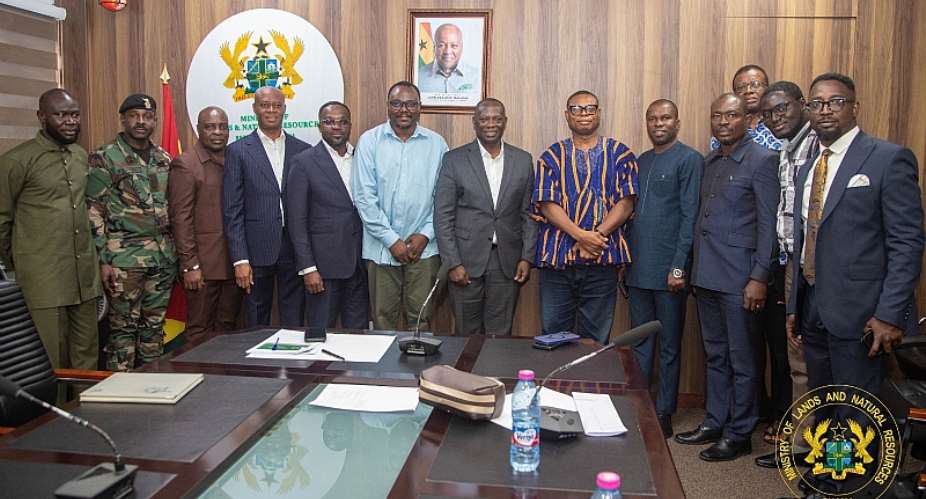
Minister for Lands and Natural Resources Emmanuel Armah Kofi Buah disclosed the figures during a strategic working visit and policy dialogue between the Ministry and the IMANI Centre for Policy and Education in Accra.
The engagement followed IMANI’s August 10, 2026 request for a structured fact finding dialogue with the Ministry covering the state of the sector inherited by the administration, policy implementation, operational challenges, reforms and measurable achievements.
Present were Armah Kofi Buah, senior officials of the Ministry and representatives of key agencies under it, including the Forestry Commission, Minerals Commission, Lands Commission and Ghana Geological Survey Authority.
The IMANI delegation was led by Franklin Cudjoe, Founding President and CEO of IMANI, and included Selorm Branttie, Vice President for Strategy; Kay Codjoe, writer and IMANI associate; and Ransford Brobbey, IMANI associate.
Presenting the state of Ghana’s forest estate, the Minister said the country has approximately 288 forest reserves, but several had come under intense pressure from illegal mining and illegal logging.
According to him, nine forest reserves were among the most severely affected, with illegal miners establishing such a strong presence in some locations that Forestry Commission personnel struggled to enter and exercise effective control.
The Ministry classified affected reserves according to the severity of illegal mining activity and the difficulty involved in restoring state control.
Some were described as areas with active mining operations, large concentrations of illegal miners, violence and the presence of weapons.
Other reserves faced repeated incursions, where enforcement personnel could remove miners only for them to return after security teams withdrew.
Kofi Buah said the 8,900 hectare figure represented an updated assessment, explaining that earlier figures had understated the true extent of degradation because they were based on older data.
When the information was updated to reflect the situation up to 2024, the Ministry arrived at the higher estimate.
The Minister used photographs of devastated forest reserves during the presentation to illustrate the destruction.
“What you are looking at is not an earthquake. It is a forest reserve,” he told the meeting.
He said the cost of reclaiming the destroyed forest estate would be enormous, with restoration potentially requiring hundreds of millions of dollars once reclamation, replanting and long term protection are taken into account.
The disclosure comes alongside new enforcement data showing the scale of the fight against illegal mining within forest reserves.
Figures presented by the Ministry, as of July 2026, show that operations had resulted in:
- 258 suspects arrested
- 200 excavators seized
- 34 excavators immobilised
- 1,469 pumping machines seized
- 1,259 pumping machines immobilised
- 950 changfan machines seized
- 774 changfan machines immobilised
- 285 motorbikes seized
- 32 motorbikes immobilised
- 48 tricycles seized
- 96 tricycles immobilised
- 801 structures immobilised
- 82 gold detectors seized
The figures, however, create a critical accountability question beyond the number of raids conducted or equipment seized.
How much of the 8,900 hectares has actually been reclaimed, replanted and permanently secured against renewed illegal mining?
The Minister said government has regained control of previously difficult forest areas through collaboration between the Forestry Commission and security agencies.
The Ministry also reported approximately 23,000 hectares restored under broader forest restoration activities last year, although the presentation did not establish that all of that restoration occurred specifically within the 8,900 hectares identified as completely degraded by illegal mining.
That distinction will be important in measuring actual recovery.
The wider discussion also turned to how regulatory enforcement should treat legitimate mining investors when breaches are identified.
Franklin Cudjoe urged the Minister to consider offering Adamus Resources a final pathway through which the company could be shepherded by the Ministry to correct identified breaches and comply fully with the requirements of any future agreement.
Cudjoe stressed that firm enforcement should not necessarily exclude remediation where an investor is willing to comply with the law and correct deficiencies.
He also emphasised that Ghanaian investors in mining should receive the same level of institutional protection, fairness and opportunity to regularise their operations that would be afforded to foreign investors.
The Minister indicated that the Ministry would be open to such an approach where the company demonstrated a genuine willingness to make the required corrections and ensure that the breaches did not recur.
The exchange underscored a broader principle running through the engagement: environmental protection and enforcement must be rigorous, but regulation must also be predictable, even handed and protective of legitimate investment irrespective of whether the investor is local or foreign.
The emerging test of government’s forest protection programme is therefore no longer simply how many illegal miners are arrested.
It is whether Ghana can turn devastated mining pits back into functioning forests and keep illegal miners from returning.
The headline number is 8,900 hectares destroyed. The next number government must produce is how many of those hectares have actually been restored.
Kay Codjoe

Franklin Cudjoe, © 2026
This Author has published 139 articles on modernghana.comColumn: Franklin Cudjoe
Disclaimer: “The views expressed in this article are the author’s own and do not necessarily reflect ModernGhana official position. ModernGhana will not be responsible or liable for any inaccurate or incorrect statements in the contributions or columns here.”
Follow our WhatsApp channel for meaningful stories picked for your day.

Top Stories


Originally published on www.modernghana.com
