

July 29, 2026
Cuts to prevention and community-led services could spark HIV resurgence in Asia Pacific
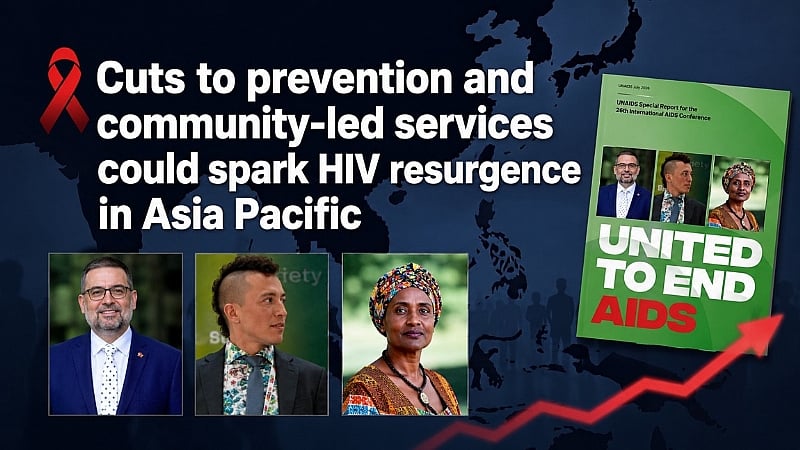


Cuts to prevention and community-led services could spark HIV resurgence in Asia Pacific
Latest report of the Joint United Nations Programme on HIV/AIDS (UNAIDS) show that one-in-four people living with HIV worldwide who are not receiving the lifesaving antiretroviral treatment, are in Asia Pacific region. This report “United to end AIDS” was released on 27th July 2026 at the world’s largest AIDS conference, the 26th International AIDS Conference (AIDS 2026) in Rio de Janeiro, Brazil.
Winnie Byanyima, Executive Director of UNAIDS said: “Brazil has shown the world that universal access to HIV treatment is not a dream. It is a political choice. As we launch the 2026 Global AIDS Update, the message is clear: We have the science to end AIDS. Now we need the political courage to do it.”
Funding cuts put uneven HIV progress in Asia and the Pacific at risk
Asia Pacific region has made progress too, but it is uneven.
“The region has shown that remarkable progress is possible,” said Eamonn Murphy, UNAIDS Regional Director for Asia and the Pacific and Eastern Europe and Central Asia. “Protecting those gains will require sustained investment in prevention and community-led services, equitable access to innovation and continued international solidarity as countries build more sustainable HIV responses.”
Agrees Winnie Byanyima: “Community-led organisations are not an optional addition to health systems. They are essential infrastructure. Investing in them makes services more effective, more resilient, more cost-effective.”
Micah Grzywnowicz, IPPF European Regional Director made an important statement: “It is not only about the funding crisis. It is about political crisis, governance crisis and leadership crisis. Who makes decisions and for whom? And why? And who is gaining what from those decisions?”
Asia Pacific: 280,000 new HIV infections in 2025
An estimated 280,000 people were diagnosed with HIV in Asia Pacific region in 2025.
The UNAIDS report warns that reductions in international financing and cuts to HIV prevention and community-led services could lead to a resurgence of the epidemic.
Globally, new HIV infections and AIDS-related deaths are at their lowest levels in more than 30 years. However, 1.2 million people were diagnosed with HIV and 570,000 people died of AIDS-related illnesses in 2025. New HIV infections rose in three regions and 21 countries.
Asia and the Pacific has made significant progress, but the regional picture remains deeply uneven. Between 2010 and 2025, new HIV infections declined by 21%. Even so, an estimated 280,000 people acquired HIV in the region in 2025, and epidemics continued to grow in several countries, including Fiji, Pakistan and the Philippines.
Are we reaching those most-at-risk?
Key populations and their sexual partners accounted for the large majority of new HIV infections in the region. Yet gay men and other men who have sex with men, transgender people, sex workers, people who inject drugs, and people in prisons and other closed settings continue to face some of the greatest barriers to accessing appropriate HIV prevention, testing and treatment services.
HIV testing and treatment gaps also remain substantial. Of the nearly 9 million people living with HIV globally who were not receiving treatment in 2025, around one quarter lived in Asia and the Pacific. Greater efforts are needed to expand differentiated, voluntary and confidential HIV testing and ensure that everyone diagnosed with HIV can access treatment and achieve viral suppression.
Funding shock threatens HIV gains
The global HIV response experienced dramatic financial upheaval in 2025. Overseas development assistance fell by 23% – the sharpest decline on record – with global health and HIV programmes hit particularly hard.
International financing for HIV declined by more than US$1.5 billion, from US$8.8 billion in 2024 to US$7.3 billion in 2025 – an 18% reduction and the lowest level in nearly two decades.
This financing shock has serious implications for Asia and the Pacific. In many countries, prevention programmes and community-led organisations remain heavily dependent on international support, leaving essential services particularly vulnerable to sudden funding reductions.
Globally, a 2026 study across 47 countries found steep reductions in community-led services, including cuts of 50% to community-led support for HIV prevention medicines and care, 85% to services for gay men and other men who have sex with men, 82% to services for sex workers and 72% to services for survivors of gender-based violence.
These cuts risk deepening existing inequalities across Asia and the Pacific, particularly for key populations, young people and people living in remote, fragile or humanitarian settings. They could also undermine the community organisations that connect people with health systems and often reach people who cannot safely or easily access conventional services.
At the same time, countries across the region are demonstrating what can be achieved when political commitment, sustainable investment and community leadership come together.
Twelve countries in Asia and the Pacific have reported increases in their domestic public budgets for HIV since 2025. Cambodia was among 11 countries globally to achieve the 95–95–95 treatment targets in 2025, while Thailand’s sustained investment in its national HIV response demonstrates what determined political leadership and strong domestic commitment can deliver.
95-95-95 targets mean that 95% of all people living with HIV should know their status, 95% of those with diagnosed HIV infection should be accessing lifesaving antiretroviral therapy, and those accessing the therapy should be virally suppressed. If viral load of people with HIV is undetectable, then undetectable equals untransmittable or U=U. WHO says there is zero risk of any further HIV transmission for those who remain virally suppressed as well as such persons live healthy normal lives.
Only 48% of people living with HIV in Eastern Europe and Central Asia had a suppressed viral load in 2025 – the lowest regional level. Stigma, criminalisation, war and displacement deepen barriers. UNAIDS’ United to end AIDS report calls for action: remove barriers, protect access to care and make viral suppression possible for everyone.
A critical juncture for Asia Pacific region: Make the right choice!
Across the region, countries are also expanding HIV self-testing, community-led monitoring, differentiated service delivery and access to oral and long-acting HIV prevention medicines. These advances show that the region already has much of the knowledge and experience needed to accelerate progress. However, innovation must be affordable, accessible and equitable and brought to scale.
UNAIDS is calling for 5 urgent actions to:
- protect HIV prevention, treatment and community-led services from further cuts;
- increase sustainable domestic financing while maintaining international solidarity;
- rapidly expand equitable access to oral and long-acting HIV prevention medicines, HIV self-testing and other innovations;
- remove stigma, discrimination and punitive laws that prevent people from accessing services; and
- integrate HIV services with primary health care and other health programmes without weakening specialised and community-led services.
“Progress is won. It is never given”
Despite growing challenges, 149 United Nations Member States adopted a new Political Declaration on HIV and AIDS in June 2026, providing a renewed path towards ending AIDS as a public health threat by 2030.
Winnie Byanyima who leads UNAIDS reminded AIDS 2026 delegates: “We have gained something important. 149 Member States adopted a new Political Declaration on HIV and AIDS. That did not happen by accident. It happened because feminist movements, women living with HIV, young women, LGBTQI+ communities and other key populations organised, advocated and refused to give up. Progress is won. It is never given.”
Commitments enshrined in the Political Declaration include ensuring that 40 million people are receiving life-saving HIV treatment and that 20 million people have access to antiretroviral-based HIV prevention. The declaration also includes targets to reduce stigma and discrimination, gender inequality and violence, and punitive legal and policy environments that limit access to HIV services.
If fully implemented, the commitments could avert an additional 3.2 million new HIV infections and 1.3 million AIDS-related deaths by 2030.
Shobha Shukla – CNS (Citizen News Service)
(Shobha Shukla is a feminist, health and development justice advocate, and an award-winning founding Managing Editor and Executive Director of CNS (Citizen News Service). She serves as Chairperson of Global AMR Media Alliance (GAMA), Host and Coordinator of SHE & Rights (Sexual Health with Equity & Rights), President of Asia Pacific Media Alliance for Health, Gender and Development Justice (APCAT Media), and founder leader of DJOP (Development Justice for Older Persons) initiative. She was also the Lead Discussant for SDG-3 at United Nations inter-governmental High Level Political Forum 2025. GAMA , led by her, received the AMR One Health Emerging Leaders and Outstanding Talents Award at UN High Level Ministerial Conference on AMR 2024. Follow her on X @shobha1shukla or read her writings here www.bit.ly/ShobhaShukla)

Shobha Shukla, © 2026
Shobha Shukla is the founding Managing Editor of CNS (Citizen News Service) and is a feminist, health and development justice advocate. She is a former senior Physics faculty of Loreto Convent College and current Coordinator of Asia Pacific Media Network to end TB & tobacco and prevent NCDs (APCAT Media). Column: Shobha Shukla
Disclaimer: “The views expressed in this article are the author’s own and do not necessarily reflect ModernGhana official position. ModernGhana will not be responsible or liable for any inaccurate or incorrect statements in the contributions or columns here.”
Follow our WhatsApp channel for meaningful stories picked for your day.

Top Stories


Originally published on www.modernghana.com
