

July 20, 2026
British Empire Exposed As Leading The African Slave Trade | Africa and the World
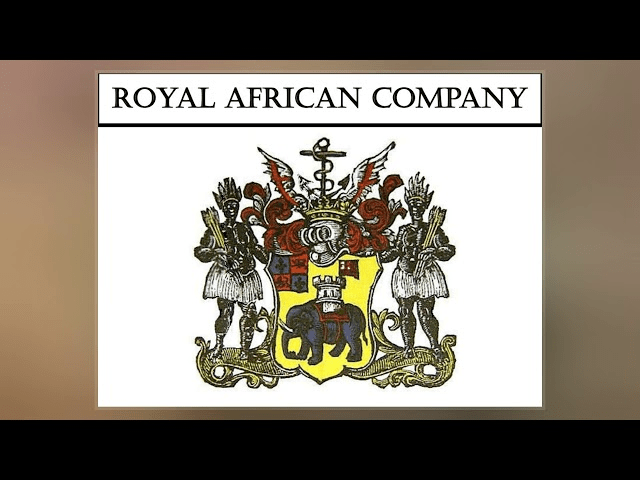


British Empire Exposed As Leading The African Slave Trade | Africa and the World
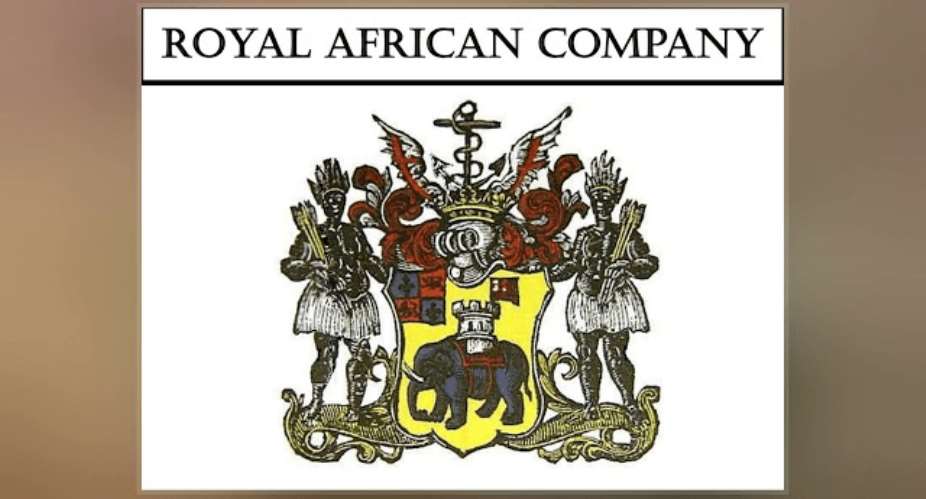
My long time friend and colleague Ed Spannaus, has recently authored, Busting the Myth of the “Abolitionist” British Monarchy. A fascinating historical essay on the history of the British Empire’s involvement in the slave trade, excerpted below. I would add, that my research on this topic indicates that the British continued to deport Africans into the second half of the nineteenth century. In other words, continued the slave trade while preaching “abolition” of slavery.
Excerpts follow:
Whenever my late wife Nancy would give a talk on her 2023 book Defeating Slavery, someone in the audience would invariably ask a question such as: “Well, weren’t the British ahead of the United States in abolishing slavery?” or “Weren’t the British more progressive than us when it came to opposing slavery?”
Those type of questions were, unwittingly, the product of a carefully cultivated image – especially by promoters and publicists of the Royal Family — that the Monarchy and the British in general were almost mere bystanders in the slave trade, abolitionists at heart, who got rid of that horrid institution as soon as they could possibly do so.
This myth of the benign, passive British monarchy is blown to pieces by a new book, The Crown’s Silence: The Hidden History of the British Monarchy and Slavery in the Americas, written by Dr. Brooke Newman, a Professor of History at Virginia Commonwealth University, and also a Fellow of the Royal Historical Society in London.i
The liner notes for the book’s cover set the stage very succinctly:
For centuries, Britain has told itself and the world that it is an abolitionist nation, one that, unlike the United States, rejected human bondage and dismantled its Atlantic slave empire without tearing itself apart in violence. An abolitionist nation headed by a just, humane monarch who liberated enslaved Africans and recognized their descendants as free and equal subjects of the British Crown. As Prince Willam put it recently, “We’re very much not a racist family.”
This is the myth that Dr. Newman dismantles, receipt by receipt, royal charter by royal charter. While then-Prince Charles claimed in 2023 to have opened the Royal Archives to make slavery records more accessible, Newman points out that this did not involve any new release of records. The record of the Crown’s sponsorship and investment in the slave trade is not to be found in one set of archives, but is widely dispersed, fragmented, and deliberately designed to obscure the truth by “commodifying” enslaved human beings.
Ellizabeth I: The Beginnings
Newman takes this sordid story back to the reign of Queen Elizabeth I in the mid-16th century, when British traders attempted to break into the Spanish and Portuguese near monopoly of the slave trade. In 1563, John Hawkins, a Plymouth-based merchant-adventurer, had kidnapped Africans from Portuguese slaving ships, and taken them across the Atlantic to be sold in the Spanish Caribbean. When Hawkins returned to England with his ships’ holds bursting with gold, jewelry, sugar, and other commodities, cash-strapped Elizabeth immediately understood the potential, and eagerly provided one of her largest warships in return for a share of the profits of his next slaving venture. His second trip was wildly successful, with Elizabeth and other investors reaping an estimated 60% return on their investment. As Newman puts it, Queen Elizabeth thus secured her legacy as the first English monarch – but certainly not the last – to profit directly from the transatlantic slave trade.
The Stuarts Expand the Slave Trade
The next significant expansion of transatlantic trade, and with it, the slave trade, is under the Stuarts. The English established a series of plantation colonies in the Caribbean in the early 17th century, and the planters, facing a shortage of indentured servants, quickly realized that enslaved Africans could be the solution to their labor shortage.
King James I, who had granted a monopoly to the Guinea Company is 1618, died in 1625, leaving a substantial Crown indebtedness to his successor, Charles I. Charles tried to handle this debt with revenue from Virginia tobacco and other crops which were raised in the Caribbean. Despite complaints from traders and merchants, Charles granted a 31-year monopoly to the Guinea Company in 1631. The first English colony to engage in the widespread use of slave labor was, ironically, the Puritan-founded colony of Providence off the coast of Nicaragua.
Cromwell’s “Western Design”
The Commonwealth period did not represent any pulling-back from England’s imperial aspirations. On the contrary, Oliver Cromwell played a critical role in the expanded use of England’s naval power to undergird an enlarged slave-labor empire in the Americas; this was known as Cromwell’s “Western Design” to challenge Spain’s colonial empire. The royal-chartered Guinea Company was re-oriented toward the slave trade from its previous concentration on gold and precious commodities. One of the Commonwealth’s “crowning” achievements was bringing Jamaica under English control. Jamaica’s eventual success in sugar production, along with the rise of Barbados, says Dr. Newman, “transformed the English Crown’s Atlantic Empire into a slave empire.”
The Stuart Restoration Invests in the Slave Trade
When Charles II succeeded to the throne in 1660 in the Stuart Restoration, he inherited enormous Crown debts accumulated by his late father, Charles I, and he embraced the imperial expansionism undertaken by Cromwell and the Commonwealth. Newman says the Restoration marked a decisive, aggressive shift into the monarchy’s direct financial and institutional investment into the slave trade and slave labor.
The restored King almost immediately granted exclusive trading rights on the West African coast to the aptly named Company of Royal Adventurers, a joint-stock company whose investors included a virtual “Who’s Who” of the Royal Family and its courtiers. Although the company’s charter was silent on the subject, secret instructions to the company from the King’s brother James (the Duke of York, and the Lord High Admiral) included trafficking in enslaved Africans; the slaves were to be sold to Spanish and Portuguese planters in Africa or Europe. But the slave trafficking quickly became trans-Atlantic, with the Royal Adventurers transporting large numbers of slaves to Jamaica and Barbados.
When the Royal Adventurers company was rechartered in 1663, its charter was explicit in giving the company exclusive rights – a royal monopoly — over the “buying and selling bartering and exchanging of for and with any Negro Slaves Goods wares and Merchandize whatsoever.” The monopoly was to be enforced by the Royal Navy. Half of the proceeds of any seizures – including slaves – was to go to the King, and the other half to the company’s subscribers or shareholders. James was appointed Governor of the Company.
The Company provided enslaved Africans to both English colonies in the Caribbean, and, by contract, 3000 Africans a year to the Spanish colonies.
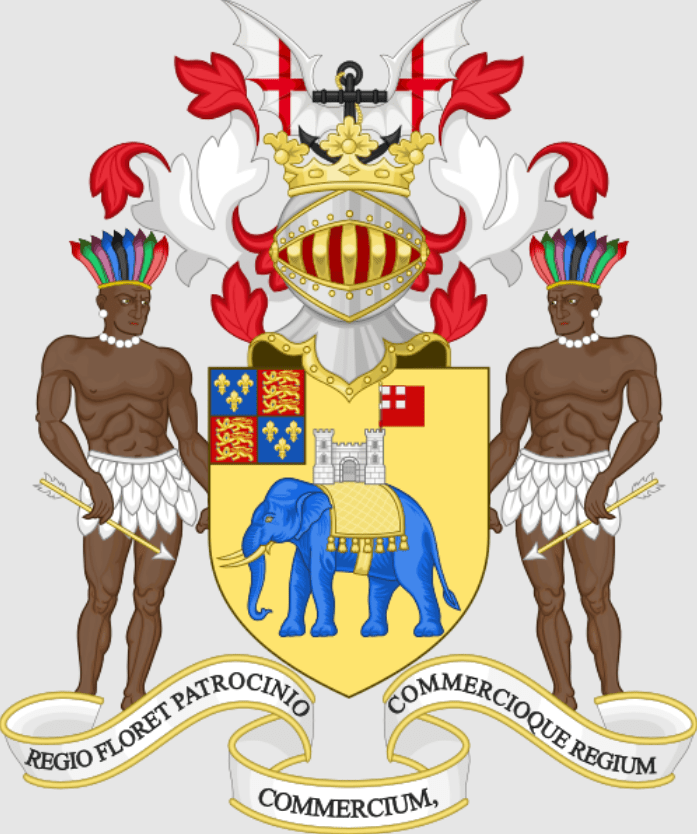
Figure 1: The seal of “The Company of Royal Adventurers of England Trading into Africa” featured the coat of arms of the Duke of York, an elephant, and two Africans naked from the waist up. The Latin inscription is the company’s motto, Regio floret patrocinio commercium, commercioque Regnum, meaning “By royal patronage trade flourishes, by trade the realm.”
The Royal African Company Takes over the Slave Trade
In 1671, the Company of Royal Adventurers was reorganized, and the next year it was chartered as the Royal African Company (RAC). The RAC was granted exclusive control of all trade in African commodities (including “Negro Slaves”) for the modest term of one thousand years. The RAC was given state-like powers and privileges, including the power to declare war against any of the “heathen nations” along the African coast, and the power to erect Admiralty courts.
For a time, the Royal African Company dominated the trans-Atlantic slave trade. In the first decade of its existence, its share of the trade jumped from 33 percent to 74 percent. In fact, during the entire period of the trans-Atlantic slave trade, according to an historian quoted by Dr. Newman, the RAC “shipped more enslaved African women, men, and children to the Americas than any other single institution.”
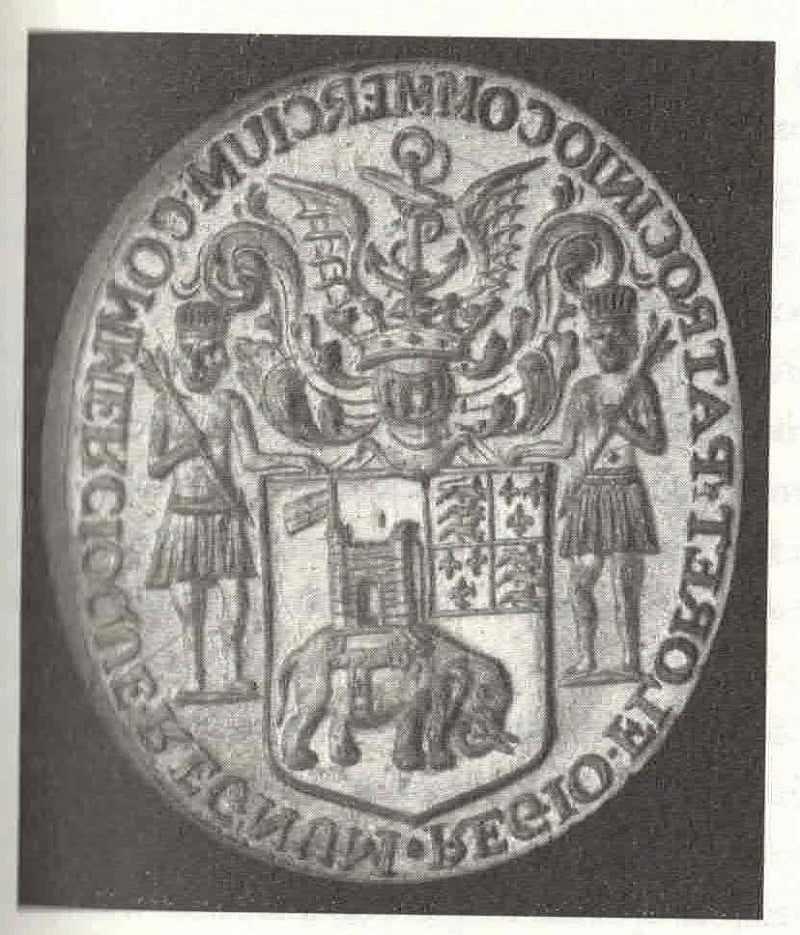
Seal of the Royal African Company
During the reigns of Charles II and James II (1672 to 1688), the RAC is estimated to have shipped 100,000 slaves to the Americas, the vast majority to the English Caribbean colonies. Approximately 76,000 survived the passage. By the early 1720s, the RAC had transported more than 150,000 enslaved Africans across the Atlantic.
The proceeds and profits flowed directly to the Royal Family, especially to James, first as the Duke of York, and then as James II. To emphasize the point, the Duke’s initials, “DY” were branded onto the bodies of hundreds of slaves, including children, who were owned directly by the RAC and held at the company’s headquarters as “Castle Slaves.”…
George I and the South Sea Company
The new Hanoverian King, George I, immediately proved to be an enthusiastic backer of the SSC, including providing naval support, and displayed great optimism for the future of the slave trade to Spanish America. His eldest son George, now the Prince of Wales, requested SSC shares, and became its Governor. Documents survive to this day which demonstrate the extensive links between George I, George II, and the slave-trading South Sea Company.
Despite their efforts, the SSC fell short of meeting its quota under the asiento. Between 1714 and 1718, the SSC shipped 13,102 enslaved African to Spanish America – of which only 10,521 survived the trans-Atlantic journey. This fell well short of the 19,200 healthy enslaved Africans the SSC was obliged to supply.
Meanwhile, the contraband slave trade flourished, among Jamaican smugglers and others, and this cut into the SSC’s efforts. To attempt to stem this “illegal” trade, SSC directors ordered their agents to brand African men, women, and children with the SSC company mark (see illustration). These royal symbols encouraged people to buy shares, i.e. “invest,” in the South Sea Company.
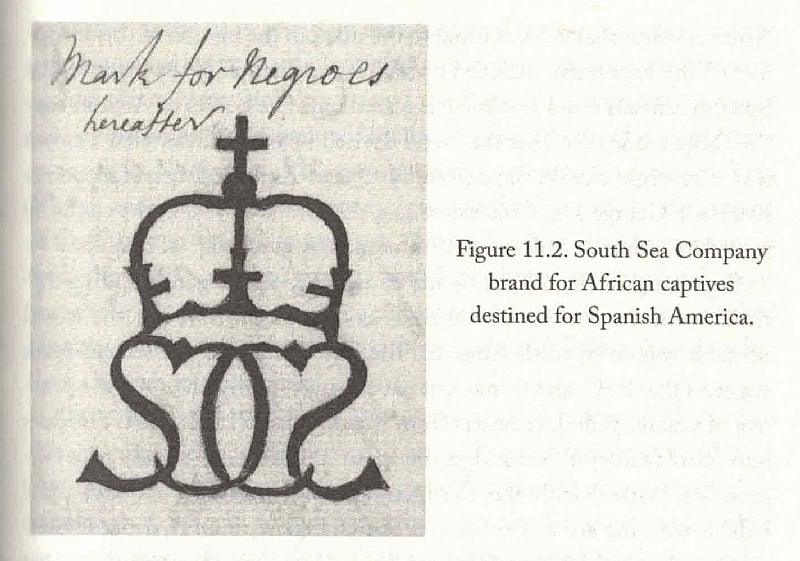
Figure 3: South Sea Company Mark. Source: The Crown’s Silence, p. 167.
A Bubble Floating on the Slave Trade
With the King and the Prince of Wales ostentatiously pouring investments into the SSC, the public eagerly snapped up SSC shares, driving up their price. But in August 1720, share prices began to drop sharply; between August 17 and Sept. 28, SSC shares fell from £1000 to £190, bankrupting many who had borrowed money to buy SSC stock.
In her recent talk at the Library of Virginia, Dr. Newman emphasized that the SSC “was not just a Ponzi scheme, even though that’s typically how we think about it now.”
She reported that the company had transported a total of about 43,000 Africans to the Americas. In her book, she notes the importance of the monarchy-sponsored slave trade in providing revenues used to increase the government’s surplus, and for building up the military capacity undergirding the rise of the British Empire.
George II and the “King’s Negroes”
When the Prince of Wales succeeded to the throne in 1727, he was already deeply immersed in the SSC and the slave trade, and it was a simple matter for him to continue as Governor of the SSC. George II became the first British monarch to directly buy and own slaves, when his Royal Navy began to purchase “seasoned Negroes, boys and men,” to labor in the naval shipyards in Jamaica. These men and boys, and later women and girls, became known as the “King’s Negroes.”
It was during the reign of George II that Britain came to dominate the trans-Atlantic slave trade, surpassing Portugal.
As Dr. Newman puts it, “Britain’s eighteenth-century empire was a slave empire and the Caribbean colonies its linchpin.” Slave-produced sugar became the most important commodity in Britain’s world trade, and taxes on sugar imports grew into the largest single source of revenue to the Crown.
In the first half of the 18th century alone, British ships took 975,000 captives from African shores, of which 167,000 died during the Atlantic crossing. Most of the survivors landed in the Caribbean slave colonies, primarily Jamaica and Barbados; others were taken to Britain’s North American colonies and sold there.[ii]
French expansion in the Caribbean and North America threatened all this, and the British public favored an aggressive policy toward France, leading to the outbreak of war in 1756 (known as the Seven Years War in Europe, and as the French and Indian War in North America).
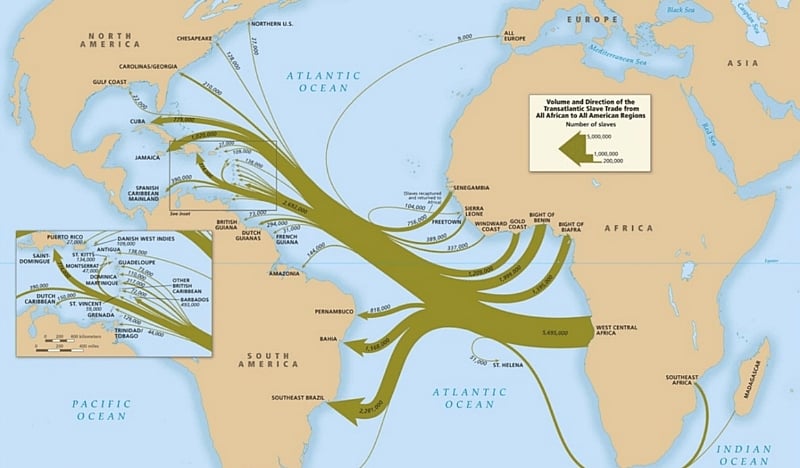
The above map, showing the volume and direction of the Trans Atlantic Slave Trade, can be found on p. 12 of Nancy Spannaus’s Defeating Slavery book, and was reproduced by permission of Yale University Press.
George III: The Empire fractures
In 1760, George III inherited the British slave empire as well as the global war that was launched to defend it.
As a teenaged Prince of Wales, George had expressed reservations about slavery, but as King, he cast whatever compunctions he had aside, and quickly came to regard slavery as a necessary evil. Newman says he went further, utilizing enslaved people for his benefit. He attempted to consolidate the British territorial gains during the war, by using slave labor to transform these new colonial territories into profitable agricultural colonies using the model of Jamaica.
An example of how aggressively King George III pursued this policy is Cuba. In 1762, Spanish Havana fell to the British. At the end of the war, Cuba was returned to Spain as part of a deal in which Spain ceded all of Spanish Florida east of the Mississippi to Britain.
But meanwhile, in the just ten months during which Britain occupied Cuba, its enslaved population increased by 80 percent! This was accompanied by a rapid growth of Cuba’s emerging sugar industry, based on slave labor. The legacy, historians have noted, was a lasting one.
Dr. Newman points to something that Nancy Spannaus stressed in her Defeating Slavery book –- that the Crown repeatedly rejected, and vetoed, efforts by Virginia and other colonies to regulate and curtail the slave trade. This was one of the major grievances cited by American patriots during the period leading up to the Declaration of Independence. And what angered the colonists even more, was that the same monarch who had perpetuated the slave trade was now encouraging those slaves to rise up against the Americans in support of the King – Virginia’s weakened and desperate Governor Dunmore being a prime example of this.
British “Abolition:” Slavery by Another Name
After the Revolutionary War in America, a strong and articulate movement for the abolition of slavery took hold in England, led in part by two former enslaved men. But the monarchy dug in its heels in opposition, with one of the royals, William, the Duke of Clarence, being particularly outspoken in the House of Lords against abolition and in support of enslavers. The sole exception to the Royal Family’s rock-solid unanimity on the subject of slavery and the slave trade was cousin Frederick William, the Duke of Gloucester, who sided with the abolitionists. King George III privately saw his own priority as defending and expanding the British Empire, which he saw as threatened by an end to slavery. In public, he of course stayed above the fray, as required by his position.
In 1807, over Royal opposition, Parliament passed the Act for the Abolition of the Slave Trade. While prohibiting British ships from carrying out the slave trade as of January 1, 1808, Brooke Newman points out, “this made little impact on the lives of the seven hundred thousand individuals who remained enslaved in the Caribbean.”
The pro-abolition Duke of Gloucester was quickly recruited to the “African Institution,” a group formed by William Wilberforce and other abolitionists to bring “civilization and improvement” to Africa. But this actually meant (in Dr. Newman’s words), “the imposition of British norms and economic ambitions” upon Africa, which the Institution regarded as “sunk in ignorance and barbarism.” They also held the view that if Africans rejected the Institution’s civilizing mission, this would itself prove the necessity and worthiness of British intervention.
The Africa Institution saw as one of its highest priorities, ensuring the enforcement of the Abolition Act. What did this mean?
The Abolition Act declared slave ships and their cargo contraband, eligible for capture and seizure. To reduce its own expenses and to enforce the law, the Crown “incentivized” anti-slave-trade activities, by demanding the conscription of Africans freed from slave ships into indentured servitude, involuntary apprenticeships, or military service. “Liberation” was no such thing.
African men, women, and children who were seized from slave ships by the Royal Navy were, in legal terms, “condemned as prize of war, or as forfeited, to the sole use of his Majesty, his heirs, and successors” — as stated in official Colonial Office documents.
And, to further “incentivize” such practices, British military officers were awarded financial rewards for each man (£40), woman (£30), and child under age 14 (£10), who were captured and handed over to colonial authorities.
In other words, Africans “liberated” from slavery lost any freedom of choice and action, for the rest of their lives. As Dr. Newman puts it, “this was essentially slavery by another name.”
The same practice was enshrined in the 1833 Emancipation Act, to which King William IV gave his assent, after Parliament passed the bill under enormous public pressure.
The Emancipation Act supposedly abolished slavery in the British Empire. But, as with the earlier Abolition Act, the bill simply established a new form of bondage in the Caribbean colonies, in order to preserve the plantation system. £20 million in compensation was paid to slave owners out of the public treasury – what one might call “reparations for the enslavers” — while “freed” slaves got nothing. And worse, they were apprenticed to their former enslavers for four to six years; the apprenticeship system meant working up to 45 hours per week without pay. Infractions by “former” slaves would result in floggings, whipping, and hard labor in workhouses or penal gangs. They remained destitute and propertyless. (There were obvious parallels to what happened with emancipated blacks in the defeated Confederacy after the U.S. Civil War and the failure of Reconstruction.)
(British taxpayers – not the monarchy – remained on the hook for at least 175 years for the loans that the British government took out to fund the £20 million compensation paid to enslavers. Taxpayers didn’t finish paying off these loans – worth billions in today’s money — until 2015.)…
Read Ed Spannaus’ entire article: Busting the Myth of the “Abolitionist” British Monarchy
Read below my earlier posts on this topic.
Everyone Should Know The Truth About Slavery in America
Slavery rips hearts, souls, and minds out of Africa
Lawrence Freeman is a Political-Economic Analyst for Africa, who has been involved in economic development policies for Africa for 35 years. He is a teacher, writer, public speaker, consultant on Africa, and an analyst of global strategic relations. Mr. Freeman strongly believes that economic development is an essential human right. He is the creator of the blog: lawrencefreemanafricaandtheworld.com, also publishes on: lawrencefreeman.substack.com, “Freeman’s Africa and the World, and on X @lkfreemansafrica

Lawrence Freeman, © 2026
A Political-Economic Analyst for Africa and outspoken opponent of the current policies of neo-colonialism. Also a highly respected researcher, writer, and speaker on a variety of topics concerning Africa. . More LAWRENCE FREEMAN, POLITICAL-ECONOMIC ANALYST FOR AFRICA…
is an outspoken opponent of the current policies of neo-colonialism. He is a highly respected researcher, writer, and speaker on a variety of topics concerning Africa. An outspoken critic of the ICC attacks on African countries, Freeman led a delegation of American State Legislators to Sudan, who subsequently exposed the charges that the Khartoum government was engaged in slavery as fraudulent. Insisting that Africa no longer be forced to live in a dark age, he has consistently brought African governments a roadmap for transformative infrastructure projects. As the author of dozens of articles and reports on Africa, having travelled to the continent 25 times, Freeman served as a member of AFRICOM’s Advisory Committee under U.S. General Kip Ward. Most recently, he was appointed Vice Chairman of the Lake Chad Basin Scientific Committee and is currently working on a project to replenish the shrinking Lake Chad. Presently, he is teaching courses on the history of Africa, utilizing his decades of experience and knowledge.Column: Lawrence Freeman
Disclaimer: “The views expressed in this article are the author’s own and do not necessarily reflect ModernGhana official position. ModernGhana will not be responsible or liable for any inaccurate or incorrect statements in the contributions or columns here.”
Follow our WhatsApp channel for meaningful stories picked for your day.

Top Stories


Originally published on www.modernghana.com
