

July 4, 2026
250 years of US independence: How France helped turn the tide of the Revolutionary War


250 years of US independence: How France helped turn the tide of the Revolutionary War
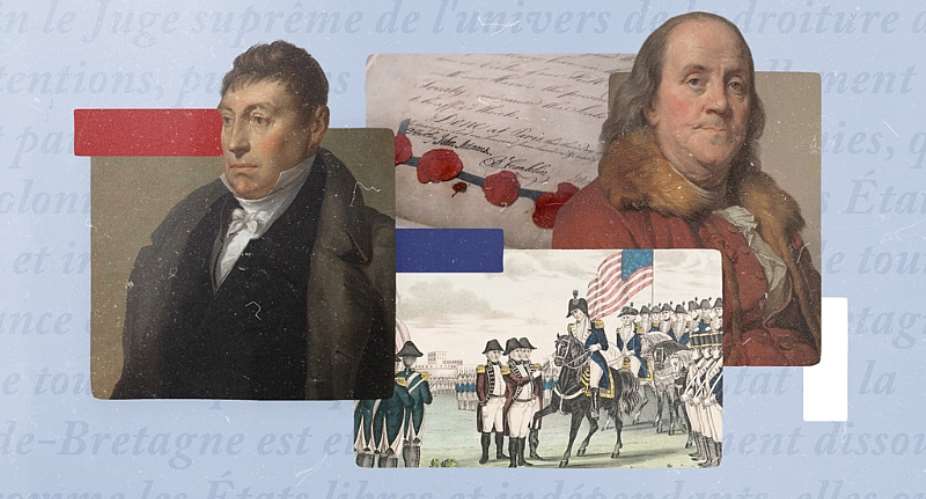
Lafayette, the Treaty of Paris, Benjamin Franklin and the Battle of Yorktown: the key milestones in French support for the American rebels. – © Studio graphique France Médias Monde
On July 4, 1776, 13 British colonies in North America broke with the British Crown and declared their independence, in a momentous act of rebellion that would change the course of history. As the United States celebrates its 250th birthday, FRANCE 24 looks back at France‘s decisive – and often overlooked – role in the American Revolution.
Read more 250 years of US independence: Why France supported American Revolutionaries
More than a year after the Declaration of Independence, the Revolutionary War was still raging. On the ground, the balance of power remained precarious until the Battle of Saratoga in October 1777 in the state of New York. The American victory over the British troops proved to be a turning point.
In the eyes of Louis XVI, this success changed everything. For the past year and a half, the king had already been supporting the insurgents in secret. Weapons, ammunition and funds were being smuggled to the rebellious colonies, but Versailles was still reluctant to openly confront Great Britain. Saratoga dispelled any remaining reservations.
On December 17, 1777, Louis XVI officially recognised the independence of the US, making France the first country to grant diplomatic recognition to the newly formed republic.
“By recognising the American state, France legitimised the Declaration of Independence and its republican values,” said Steven Ekovich, professor emeritus of politics and history at the American University of Paris. “It helped to establish the world’s first republican state.”
The alliance strengthens in Paris
Diplomatic recognition, however, was only the first step. A few weeks later, on February 6, 1778, Benjamin Franklin and the French secretary of state for foreign affairs, the count of Vergennes, signed two historic treaties at Versailles: one commercial, the other military.
From then on, the two countries vowed not to conclude any peace with Great Britain. Consequently, the War of Independence ceased to be a mere colonial rebellion and became an international conflict pitting the greatest powers of the era against each other.
In Paris, Franklin quickly became the face of the American Revolution. Received by Louis XVI at Versailles and celebrated by Voltaire at the Academy of Sciences, he captivated the French aristocracy. But not all American representatives enjoyed the same success. While Franklin charmed, John Adams, another Founding Father, proved a disappointment.
“John Adams was a much more austere and puritanical man. He arrived at a court where luxury and the codes of the Ancien Régime reigned supreme: it was a real culture shock for him,” said Émilie Mitran, a historian specialising in the United States and the author of Des Américains en France,1776–1792 (Americans in France, 1776-1796).
Unlike Franklin, “John Adams did not speak French and showed little inclination to adopt the diplomatic customs of Versailles,” Mitran added.
Convinced that he would be of greater use elsewhere, Congress sent him to the United Provinces (now the Netherlands) in 1780 to secure an essential loan for the war.
Lafayette, ‘Hero of Two Worlds’
While diplomats were consolidating this alliance in the salons of Versailles, it gradually began to take shape on the ground. In the spring of 1778, France officially entered the war against Great Britain, committing its navy, its army and substantial financial resources. But the initial results were limited: admiral Charles Henri d’Estaing’s naval operations failed in both New York and Savannah and the partnership remained fragile.
It was ultimately a young French aristocrat who breathed new life into the alliance: Gilbert du Motier, the marquis of Lafayette, who arrived in America in June 1777 to fight alongside the revolutionaries.
“When Lafayette arrived in the US, he presented an image of the French that was completely different from the one the colonists had,” said Mitran. “The French were often seen as Catholics, as ‘Papists’. He arrived with incredible enthusiasm for defending their ideals. George Washington quickly took him under his wing and, when he returned to France, he became the leading ambassador for the American cause.”
This dual loyalty soon earned him a nickname that stuck: the “Hero of Two Worlds”.
In the spring of 1779, Lafayette returned to Versailles to persuade Louis XVI to step up his military commitment. The king agreed to send a full-scale expeditionary force to America under the command of the count of Rochambeau. Nearly 6,000 soldiers arrived in Newport, Rhode Island, during the summer of 1780. For the first time, the revolutionaries had an ally fighting by their side for the long term. An undated portrait of the Marquis de La Fayette, painted by Matthew Harris Jouet, from the Mabel Brady Garvan Collection held at the Yale University Art Gallery in New Haven, Connecticut, in the United States.
The year 1781 marked a turning point in the conflict. While Lafayette was pursuing British troops in Virginia, Rochambeau persuaded George Washington to abandon his plan to attack New York and instead concentrate his forces further south, where the army of British general Charles Cornwallis was entrenched at Yorktown, Virginia. At the same time, another figure entered the scene: admiral François Joseph Paul de Grasse.
At the head of the French fleet, admiral de Grasse left the West Indies and sailed north towards Chesapeake Bay, where he took the Royal Navy by surprise. This naval victory prevented the British from resupplying or evacuating Cornwallis’s troops. Trapped between the French fleet and the armies of Washington and Rochambeau, the British found themselves surrounded.
‘France helped the Americans win’
“The Battle of Yorktown was the decisive battle that brought the war to an end,” Ekovich said. “It relied on a perfectly coordinated operation between the land forces commanded by Rochambeau and Washington and admiral de Grasse’s fleet. It was this combined manoeuvre that made all the difference.”
On October 19, 1781, after a three-week siege, Cornwallis surrendered. For many historians, it was at Yorktown that the United States was truly born. Without the French naval blockade, the British army would probably have received reinforcements. Without the thousands of soldiers sent by Louis XVI, Washington would have found it difficult to maintain a siege on such a scale.
In total, the French monarchy deployed tens of thousands of soldiers and mobilised its naval fleet to aid the revolutionary cause.
“France helped the Americans win for practical political reasons against its enemy across the Channel,” said Ekovich. “Above all, French aid enabled the United States to emerge as a fully-fledged nation with widespread diplomatic recognition.”
After the surrender at Yorktown, the outcome of the war was all but sealed. In London, the British government realised that it would now be impossible to reconquer the former colonies. Fighting continued for several more months, but peace negotiations were already under way. A copy of the Treaty of Paris, signed on September 3, 1783, which officially brought the American War of Independence to an end, at the museum in Miami, Florida, on June 18, 2026.
It was in Paris that the epilogue to the American Revolution was written. Adams returned to the capital in 1782 to take part, alongside Franklin and diplomat John Jay, the former president of the Continental Congress, in the negotiations that led to the Treaty of Paris. Signed by the Thirteen Colonies and British representatives on September 3, 1783, it brought an end to eight years of war. It was this treaty that definitively compelled Great Britain to recognise American independence. On the same day, France also made peace with London.
A victory that would backfire on Louis XVI
The newly established peace helped foster exchanges between the two countries and ideas now crossed the Atlantic as swiftly as diplomats. Thomas Jefferson, the main author of the Declaration of Independence, arrived in Europe in 1784, once the hostilities had ended. Initially tasked with negotiating trade agreements, he officially replaced Franklin as the American representative in France in 1785.
“A circle formed around Thomas Jefferson known as the ‘Americanists’. They were interested in the principles set out in the Declaration of Independence – the idea that all men are born free and equal in rights – which would subsequently influence the French Revolution,” said Mitran.
Victory, however, came at a considerable cost. Between 1778 and 1783, the monarchy spent over a billion French livres to fund the war, military expeditions and aid to the American revolutionaries. This colossal debt exacerbated the financial straits France had been in since the Seven Years’ War (1756–1763).
France’s territorial gains remained modest. While it regained its fishing rights in Newfoundland and several trade advantages, it definitively gave up any hope of restoring its former North American empire.
Ironically, by helping the American revolutionaries establish a new republic, Louis XVI unwittingly contributed to the weakening of his own kingdom. Ideas of liberty and popular sovereignty were now circulating more widely across the Atlantic. French officers returning from the United States, most notably Lafayette, brought back with them a unique political experience that would fuel debates in the years to come.
“There are always unforeseen events in history,” said Ekovich. “France’s aim was to weaken its British enemy. But by helping the Americans, it also helped to legitimise this new political experiment that was the Republic.”
The French Revolution broke out six years after the Treaty of Paris. By helping a republic emerge on the other side of the Atlantic, the king of France helped hasten the demise of his own monarchy.
This article has been translated from the original in French.
Top Stories


2 hours ago


<!–
–>
Originally published on www.modernghana.com
