

August 30, 2026
ECG in the Eye of the Storm: Accountability, Port Scandals, and the Quest for Institutional Integrity


ECG in the Eye of the Storm: Accountability, Port Scandals, and the Quest for Institutional Integrity
Unmasking the GH₵8 Billion Leakage: How Corporate Governance Failure at ECG Is Crippling Ghana’s Industrial Backbone and Domestic Economy
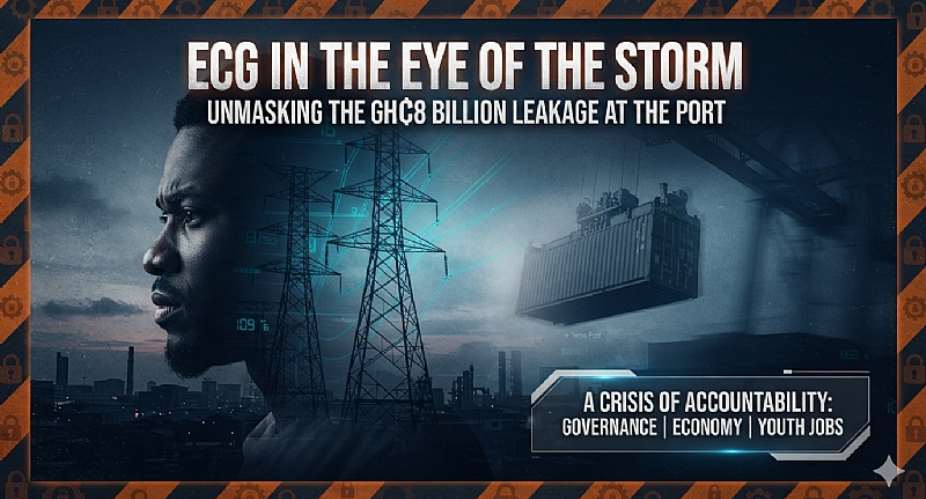
In any functioning democracy, the twin pillars of public stewardship are unyielding accountability and absolute transparency. Over the past several months, the public discourse in Ghana has been dominated by a fiery political blame game surrounding the fiscal health and asset management of the Electricity Company of Ghana (ECG). As the nation grapples with severe economic headwinds and energy sector constraints, a high-stakes controversy has unfolded involving missing port containers, astronomical financial infractions, and bitter parliamentary debates over who truly holds the locus standi to demand accountability.
At the center of this storm sits Alexander Afenyo-Markin, the prominent political figure whose tenure as ECG Board Chairman became a focal point of intense legal, economic, and social scrutiny. While political factions trade accusations—using the crisis to shield or weaponize other state entities like the Bank of Ghana or the Ghana Gold Board (GoldBod)—ordinary Ghanaians, businesses, and the younger generation are left bearing the brunt of systemic failure. How did over a thousand shipping containers filled with critical national assets vanish? Who legally allowed billions of Cedis to bleed out of our utility grid? And what is the true cost of this crisis to Ghana’s fragile economic and social fabric?
This article delves deep into the documented facts of the ECG crisis, explores the precise legal arguments surrounding fiduciary leadership, and outlines the devastating economic impact on the Ghanaian people, its industrial sector, and its struggling youth.
Inside the ECG Crisis: The Core Facts & Legal Breaches
The ongoing controversies at ECG represent a massive breakdown of statutory regulations, public procurement laws, and basic corporate governance:
- The “Port Heist” and Procurement Overrides: Official parliamentary proceedings revealed that out of 2,491 utility containers shipped into the country, a staggering 1,347 containers loaded with critical electrical cables and transformers vanished from the Tema Port stacks—bypassing the strict custody protocols mandated by the Ghana Ports and Harbours Authority (GPHA).
- The Illicit Auction Loophole: Insiders systematically delayed clearing these state assets past the mandatory 60-day window. Once moved to the Uncleared Cargo List (UCL), they were auctioned for fractions of their value to proxy firms, which then shockingly resold those exact same stolen materials right back to ECG at hyper-inflated prices—a flagrant violation of the Public Procurement Act (Act 663).
- The Fiduciary Oversight Failure: While Afenyo-Markin defended his stewardship by acting as a whistleblower—claiming he inherited a broken system and halted payments based blindly on a Bill of Lading—legal critics argue that under the Companies Act and the Public Financial Management Act (PFMA), a Board Chairman bears ultimate fiduciary responsibility for institutional negligence and oversight failure.
- Unapproved Billions and Tax Evasion: Investigators uncovered GH₵8.2 billion in unauthorized procurement spending—completely eclipsing the approved GH₵1.3 billion budget. Furthermore, the company failed to remit GH₵70.9 million in withholding taxes to the Ghana Revenue Authority (GRA), constituting a direct statutory offense.
- Unmapped Financial Red Flags: Independent findings and audit reports painted a grim fiscal picture, highlighting a GH₵8.26 billion net annual loss and a GH₵5.3 billion revenue variance, driven in part by ECG operating over 80 unmapped, fragmented bank accounts beyond the reach of standard treasury oversight.
The Economic, Industrial, and Social Toll on Ghana
The financial chaos within ECG does not exist in a vacuum; its ripples are tearing through the fabric of Ghana’s macroeconomy, manufacturing sector, and domestic households:
- Crushing Public Debt and Inflation: A GH₵8.26 billion net annual loss forces the central government to continuously bail out the energy sector using taxpayer money. This structural deficit balloons the national debt, destabilizes the Cedi, and drives up the cost of living for everyday Ghanaians.
- Industrial Strangulation and De-industrialization: Large-scale manufacturers, mining firms, and heavy industries face erratic power supply and unpredictable surges. The lack of reliable infrastructure forces industries to rely on expensive diesel generators, spiking operational costs and rendering Ghanaian exports uncompetitive globally.
- The Small Business Asphyxiation: For micro, small, and medium enterprises (MSMEs)—the backbone of Ghana’s economy—the cost of power combined with tariff adjustments driven by ECG’s inefficiencies cuts directly into razor-thin profit margins, leading to widespread business closures.
- Massive Youth Unemployment and Lost Opportunities: The direct consequence of industrial decline and MSME closures is a devastating blow to Ghana’s youth. When factories scale down production and local shops shut their doors due to unsustainable energy costs and economic instability, thousands of jobs are wiped out. The structural failure and mismanagement superintendent over by the ECG board directly robs the younger generation of stable employment, forcing highly qualified graduates into underemployment or long-term financial insecurity.
- Discouraging Foreign Direct Investment (FDI): No serious international investor will inject capital into an economy where the primary electrical distributor operates with unmapped bank accounts and loses critical infrastructure at the port. This governance crisis severely damages Ghana’s “Ease of Doing Business” ranking.
- Socio-Economic Strain on Households: Avoidable port demurrage fees totaling GH₵909 million are ultimately passed down to domestic consumers through inflated tariffs, forcing ordinary families to choose between paying for basic electricity or funding education and healthcare.
Strategic Recommendations for Institutional Reform
Resolving the systemic rot at ECG requires moving past partisan point-scoring and executing radical structural updates to restore public trust and economic stability.
- Enforce Strict Criminal Prosecution Under the PFMA: The Ministry of Justice and the Attorney-General must swiftly act on the Public Accounts Committee’s referrals, ensuring that public officials who authorized unapproved budgets face personal liability, asset seizures, and custodial sentences.
- Implement End-to-End Digital Asset Tracking: ECG must instantly phase out manual clearing registries and adopt an immutable, digitized tracking framework paired with real-time port telemetry to monitor every single utility container from shipment to warehouse installation.
- Consolidate and Audit All ECG Bank Accounts: The Ministry of Finance must forcefully shut down all unmapped, fragmented bank accounts operated by ECG, centralizing all revenue collection into a highly transparent, fully auditable Single Treasury Account (STA).
- Depoliticize the ECG Directorate and Board: Ghana must transition away from using utility boards as rewards for political loyalists. Board appointments should be strictly tied to competitive, independent hiring processes evaluating verified corporate governance and energy sector expertise.
- Legislative Ban on State Property Auctions: Parliament must urgently pass legislation explicitly banning the auctioning of state-imported critical infrastructure components to private entities via the Uncleared Cargo List.
The ongoing crisis at the Electricity Company of Ghana is an urgent wake-up call that extends far beyond the legacy or political survival of any individual chairman or party. It exposes a structural vulnerability where systemic corruption, weak institutional oversight, and a lack of real consequence management threaten to collapse the literal backbone of Ghana’s economy. When billions of Cedis vanish into unmapped bank accounts and vital infrastructure is stolen at our ports only to be resold to the state, it is the ordinary Ghanaian citizen, the local factory worker, and the struggling youth seeking an honest living who pay the ultimate price.
True patriotism demands that we look past political smoke screens, distraction tactics, and counter-accusations. We must hold all leaders to the same high standard of legal and fiduciary responsibility, regardless of their status. If Ghana is to secure its energy future, safeguard its industrial sector, protect job opportunities for its youth, and restore faith in public governance, the time for political finger-pointing must end, and the era of uncompromised, institutional accountability must begin. ✍️ Submitted by:
Retired Senior Citizen
For and on behalf of all Senior Citizens of the Republic of Ghana 🇬🇭
Teshie-Nungua
[email protected]

Atitso Akpalu, © 2026
A Voice for Accountability and Reform in Governance. More Atitso Akpalu is a prominent Ghanaian columnist known for his incisive analysis of political and economic issues. With a focus on transparency, accountability, and reform, Akpalu has been a vocal critic of mismanagement and corruption in Ghana’s governance. His writings often highlight the need for decentralization, local governance empowerment, and robust anti-corruption measures. Akpalu’s work aims to foster a more equitable and just society, advocating for policies that benefit all Ghanaians.
He is a passionate advocate for transparency and accountability. His columns focus on critical analysis of political and economic issues, with a particular interest in the energy sector, financial services, and environmental sustainability. He believes in the power of informed citizenry to drive positive change and am committed to highlighting the challenges and opportunities facing Ghana today.Column: Atitso Akpalu
Disclaimer: “The views expressed in this article are the author’s own and do not necessarily reflect ModernGhana official position. ModernGhana will not be responsible or liable for any inaccurate or incorrect statements in the contributions or columns here.”
Follow our WhatsApp channel for meaningful stories picked for your day.

Top Stories


33 minutes ago


35 minutes ago


Originally published on www.modernghana.com