

September 6, 2026
Before You Call Investing In Africa Risky, Understand The Market


Sun, 06 Sep 2026 Feature Article
Before You Call Investing In Africa Risky, Understand The Market
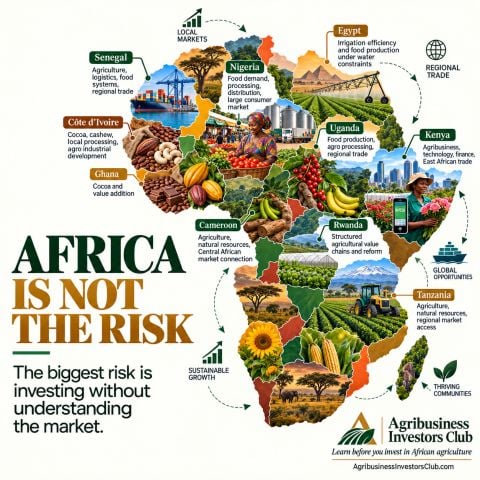
Africa is often described by investors as a high-risk destination. But before we label investing in Africa as risky, we must first understand a fundamental reality: Africa is not one market.
The continent consists of 54 countries, each with its own consumers, regulations, languages, infrastructure, economic conditions, value chains and investment opportunities. Treating Africa as a single market can therefore obscure the very opportunities investors are trying to identify.
Nigeria, for example, offers enormous scale. With a population exceeding 200 million, the country presents significant opportunities in food production, agro-processing, storage, packaging, logistics and distribution.
Ghana and Côte d’Ivoire, two of the world’s leading cocoa-producing countries, have considerable potential to move beyond exporting raw agricultural commodities toward processing and value addition. Cocoa, cashew, fruits and other agricultural products could generate greater employment and export earnings when processed locally.
Kenya has established itself as an important East African hub for agribusiness, technology, horticulture and regional trade. Its agricultural sector demonstrates how technology, finance and market access can increasingly be connected to farmers and agricultural enterprises.
Egypt faces a different challenge. With a large population and limited water resources, investments in irrigation efficiency, agricultural technology and improved food production systems are particularly important.
Uganda, Tanzania, Rwanda, Senegal and many other African countries also present opportunities across farming, processing, storage, logistics and cross-border trade.
These examples demonstrate why investors must stop looking for an “African market” and start identifying specific African markets and value chains.
The Opportunity Is Enormous
Africa possesses significant agricultural potential. It has a young and rapidly growing population, substantial agricultural resources and rising demand for food. At the same time, African countries continue to spend billions of dollars importing food and agricultural products that could increasingly be produced and processed locally.
This creates opportunities not only in farming but throughout the agricultural value chain—from inputs, machinery and irrigation to processing, packaging, cold storage, transportation, financing and retail distribution.
But capital alone cannot build a successful agribusiness.
Understanding the market can.
Many investments that struggle in Africa do not necessarily fail because Africa itself is inherently too risky. Some fail because investors enter markets without adequately understanding how those markets actually operate.
They may misunderstand consumers, underestimate infrastructure challenges, select inappropriate business models, overlook regulatory requirements or enter partnerships without sufficient local knowledge.
In such situations, what is sometimes described as “Africa risk” may actually be the risk of investing without adequate market intelligence.
Local Knowledge Matters
An investor interested in Ghana’s cocoa industry, for example, cannot rely solely on international cocoa prices. Understanding the sector requires knowledge of institutions such as COCOBOD, the licensed buying system, farmer organisations, pricing arrangements, processing capacity and the economic realities facing cocoa farmers.
Similarly, investing in Nigeria’s rice or tomato industry requires more than analysing yields per hectare. Investors must understand aggregation, storage, post-harvest losses, transportation, processing and last-mile distribution.
Investment in Kenyan horticulture requires knowledge of export standards, certification, cold-chain infrastructure and access to international markets.
Agricultural technology investment in Egypt must consider water availability, irrigation policy, energy costs and the realities of producing more food with increasingly constrained natural resources.
The same principle applies across the continent: successful investment begins with understanding the specific market.
Market Intelligence Is Not Optional
Before committing capital to an African agricultural venture, investors should ask fundamental questions:
Who is the consumer? How does the value chain actually operate? Who are the credible local partners? What do the regulations require? Where are the infrastructure, financing and logistics bottlenecks? Is there sufficient processing and storage capacity? And, importantly, what does reliable data reveal beyond the projections contained in an investment pitch?
These questions matter because Africa’s greatest investment opportunities are often found precisely where inefficiencies exist.
A shortage of cold storage can become an investment opportunity. High post-harvest losses can create demand for processing facilities. Dependence on imported food can justify domestic production. Weak distribution networks can create opportunities for logistics businesses. Exporting raw commodities can provide the foundation for local value-addition industries.
The challenge is identifying which problems can be transformed into commercially sustainable businesses.
Africa Is Not a Single Risk Story
Africa needs investment, but investors also need Africa.
The continent represents a growing consumer market, an important source of agricultural commodities and a potentially significant centre for future food production, processing and manufacturing.
The African Continental Free Trade Area also strengthens the long-term case for looking beyond individual national markets toward regional production and trade opportunities.
Investors should therefore move beyond broad perceptions of Africa as either “high risk” or “high opportunity.” Both descriptions are too simplistic.
There are good markets and difficult markets. There are strong businesses and weak businesses. There are favourable regulations and challenging regulations. There are reliable partners and unreliable ones.
That is true in Africa just as it is elsewhere in the world.
The difference between success and failure will increasingly depend on the quality of information, local partnerships, patience and understanding that investors bring to the table.
Africa is not the risk. The greater risk is investing in an African market you have not taken the time to understand.
The question for investors should therefore not simply be, “Is Africa risky?”
It should be:
“Which African market do I understand well enough to invest in—and where do I still need to learn?”

Frank Ayim Damptey, © 2026
This Author has published 205 articles on modernghana.com. More I am a Ghanaian business leader, entrepreneur, industrial development professional, researcher and author with over two decades of experience in senior executive and technical roles.
I currently serve as the Chief Executive Officer of Tata Beverages Company Limited and Tata Industrial Company Limited, where I provide strategic leadership in manufacturing, product development, business growth and the promotion of locally manufactured products.
My professional experience spans a broad range of industries, including beverage and brewing, soap manufacturing, water treatment, paint and ink production, agriculture and agro-processing, food processing, technology and industrial manufacturing.
Beyond Ghana, I have provided consultancy and technical advisory services to start-ups and emerging businesses in Liberia, Sierra Leone, Burkina Faso and Nigeria. Through these engagements, I have supported entrepreneurs and businesses in product development, manufacturing processes, equipment selection, quality improvement and the establishment of sustainable production operations.
I am a strong advocate for Made-in-Ghana products, entrepreneurship, industrialisation, local value addition and the growth of small and medium-sized enterprises (SMEs). I firmly believe that Ghana and Africa’s long-term economic transformation will depend on our ability to produce more of what we consume, add value to our locally available resources and build competitive industries that create sustainable employment.
My interests extend beyond manufacturing to agriculture, food security, STEM education, innovation, healthcare, entrepreneurship and national development. I am particularly passionate about practical solutions that can strengthen local industries, create opportunities for young people and reduce Africa’s excessive dependence on imports.
As an author and contributor to ModernGhana, I regularly write on business, manufacturing, agriculture, entrepreneurship, economic development and other issues of national and continental importance. Through my writing, I seek to stimulate constructive public discussion, challenge conventional thinking and advocate practical solutions to Ghana’s development challenges.
I have also undertaken and published research in areas related to manufacturing, food processing, innovation, local raw-material utilisation and sustainable industrial development. My research interests are driven by the belief that Africa possesses enormous resources that can be transformed through research, technology, entrepreneurship and industrialisation.
Throughout my professional journey, I have remained committed to promoting local manufacturing, entrepreneurship and African industrial development.
My philosophy is simple:
“Africa must produce more of what it consumes, process more of what it produces, and build competitive businesses capable of creating jobs and competing globally.”Column: Frank Ayim Damptey
Disclaimer: “The views expressed in this article are the author’s own and do not necessarily reflect ModernGhana official position. ModernGhana will not be responsible or liable for any inaccurate or incorrect statements in the contributions or columns here.”
Follow our WhatsApp channel for meaningful stories picked for your day.

Top Stories


Originally published on www.modernghana.com