

September 7, 2026
The Guns Turned Inward: Niger’s Mutiny and Russia’s Fragile Bargain in the Sahel


The Guns Turned Inward: Niger’s Mutiny and Russia’s Fragile Bargain in the Sahel
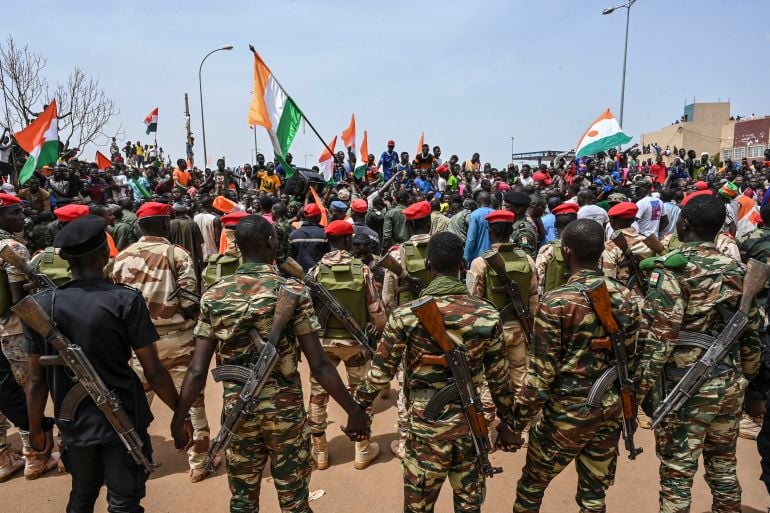
General Abdourahamane Tiani seized power in 2023 on a familiar Sahelian promise: that soldiers, not politicians, would protect civilians from jihadist violence. The attempted coup against him on the night of 28-29 August 2026, staged by a mutinous faction calling itself the Armed Forces for the Restoration of the Fatherland, turned that promise on its head. The guns pointed at Tiani’s rule in Niamey did not belong to jihadists. They belonged to his own soldiers, and that is the greater danger this episode exposes.
Sustained gunfire and explosions broke the calm of Niger’s capital shortly after midnight, spreading across the city’s most sensitive sites. Heavy exchanges were reported around Diori Hamani International Airport and the strategically vital Air Base 101, while fighting also reached the Plateau district, home to the presidential palace. State television and radio briefly went dark. For hours, Niamey sat in uncertainty as mutinous troops targeted what authorities called “sensitive sites” and loyalist forces fought to regain control. It was the most serious internal challenge Tiani’s government has faced since 2023, and it laid bare the fractures within the military establishment on which his rule depends.
The most revealing part of the crisis was not the mutiny itself but who answered it. Russia’s Africa Corps, deployed in Niger under the banner of counter-terrorism, reportedly joined loyalist forces to crush the rebellion, drawing Russian personnel into a fight where Nigerien soldiers died at foreign hands, not battling jihadists, but defending a junta’s survival.
That contrast raises an uncomfortable question about what Moscow’s presence in the Sahel is actually for. Africa Corps has long been marketed as a partner against insurgency. Yet, the jihadist violence that justified military takeovers in Mali, Burkina Faso and Niger remains unresolved and, in places, worsening. When that threat endangers ordinary Nigeriens, Russian intervention has been, at best, inconsistent. When it endangers a Russia-aligned government, the response was reportedly swift and decisive. That asymmetry suggests Africa Corps functions less as a counter-terrorism force and more as regime insurance, a guarantor of the leaders who guarantee Russian access, rather than of the populations these leaders were meant to protect.
The pattern becomes starker set against Mali. In April 2026, Africa Corps and Malian forces withdrew from Kidal under sustained pressure, ceding one of northern Mali’s most symbolically important cities to the Azawad Liberation Front. Months later in Niamey, the same force reportedly moved decisively to help retake Air Base 101. Territory lost to insurgents was abandoned; a threatened regime was rescued. A security partnership that folds in the face of armed opposition but hardens against internal political threats is not a stable counter-terrorism strategy. It is a transactional bargain, and one whose costs, in credibility, cohesion and lives, are unsustainable for the states leaning on it.
The mutiny also exposed how thinly Tiani’s legitimacy is stretched. He came to power by the coup-maker’s logic that a failing government forfeits its claim to rule and the military may step in. The August mutiny turned that same logic against him. Unlike a government built on elections and constitutional succession, a military regime cannot simply inherit institutional legitimacy or public trust once in power, and it becomes acutely vulnerable the moment discontent surfaces in its own ranks. Niger’s continued detention of ousted president Mohamed Bazoum, more than three years on and described by Human Rights Watch as arbitrary, with the UN Working Group on Arbitrary Detention reaching the same conclusion, only reinforces how fragile that foundation is.
The mutineers reportedly drew from Ouallam, Téra and Dosso, regions that have absorbed heavy casualties fighting jihadist groups. Soldiers who bore the human cost of that war turned their weapons on the leadership they once served, exposing a crisis of trust that no amount of Russian firepower can resolve, only postpone.
This instability radiates outward. Niger’s crisis unfolds while the country sits estranged from ECOWAS, the regional bloc that once anchored collective West African security. The new ECOWAS Commission President, General Birame Diop, has called for renewed engagement with Mali, Burkina Faso and Niger, arguing that political rupture cannot undo shared geography. Jihadist networks certainly recognise no such rupture. They move freely across the line separating ECOWAS states from the Alliance of Sahel States, exploiting exactly the gap that competing, uncoordinated security architectures leave open.
Diop’s appeal for reconciliation is therefore less a diplomatic nicety than a strategic necessity. ECOWAS and the AES remain bitterly divided over democracy and military rule, but neither can escape the terrain and populations they share. As Diop put it, borders may divide territory, but they do not divide destiny.
Niger’s mutiny should be read as a warning on two levels. Domestically, it shows how quickly the barracks can undo a regime built on the barracks. Regionally, it shows the risk of mistaking a foreign power’s opportunistic protection of an allied junta for genuine counter-terrorism partnership. Russia’s role in the Sahel looks less like a durable security guarantee than a fragile, self-interested bargain, propping up regimes rather than defeating the insurgencies that justified their rise. The question West Africa can no longer defer is whether it can afford to stay strategically divided while both jihadist violence and the powers exploiting it operate without regard for the borders that divide it.
Joseph McCarthy is an analyst and researcher specialising in governance, security and political transitions in the Sahel. He writes on geopolitics, development and African diplomacy. [email protected]
Disclaimer: “The views expressed in this article are the author’s own and do not necessarily reflect ModernGhana official position. ModernGhana will not be responsible or liable for any inaccurate or incorrect statements in the contributions or columns here.”
Follow our WhatsApp channel for meaningful stories picked for your day.

Top Stories


Originally published on www.modernghana.com