
September 4, 2026
Innovation Has No Postcode: Rural Ghana Must Not Be Left Behind In The Stem Revolution


Fri, 04 Sep 2026 Feature Article
Innovation Has No Postcode: Rural Ghana Must Not Be Left Behind In The Stem Revolution
Somewhere in rural Ghana today, there may be a child capable of becoming a brilliant engineer, software developer, robotics specialist, medical technologist or inventor.
The tragedy is not that the talent does not exist.
The tragedy is that the opportunity may never arrive.
While students in some well-resourced urban schools are learning coding, robotics and electronics, many children in rural Ghana still have little or no access to computers, science laboratories, robotics kits or practical STEM education.
This is where Corporate Ghana must step in.
Companies spend millions of cedis every year on Corporate Social Responsibility programmes. These investments support health, education, sanitation, sports and community development. All are important.
But it is time to make rural STEM education a major CSR priority.
Banks, telecommunications companies, mining firms, insurance companies, manufacturers, oil and gas companies and other businesses should consider adopting rural schools and establishing practical STEM laboratories and robotics centres.
Imagine if every major Ghanaian company established just one properly equipped STEM laboratory in a rural community.
Imagine hundreds of children learning to code, assemble electronic circuits, build robots, experiment with renewable energy and use technology to solve problems within their communities.
The impact could last generations.
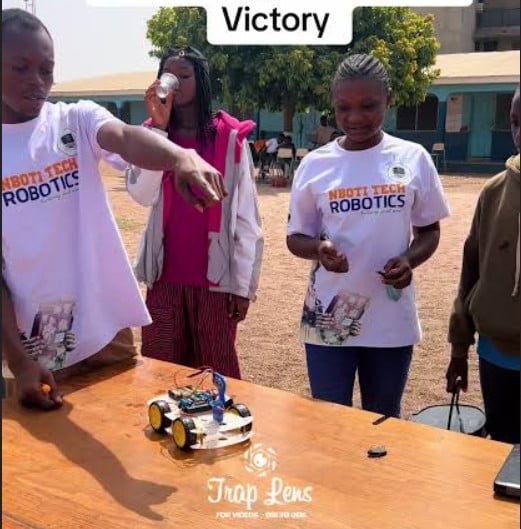
Initiatives such as Nboti Tech, which is bringing practical technology and STEM education closer to learners in rural Ghana, demonstrate what is possible when opportunity is taken to the child instead of waiting for the child to travel to the opportunity.
But initiatives like these need partners.
A rural STEM laboratory does not have to begin as a multimillion-cedi project. Companies can provide laptops, robotics kits, electronic components, internet connectivity, solar power systems, science equipment and teacher training.
Businesses can also sponsor technology professionals and university students to mentor rural learners.
Most importantly, companies should move beyond simply donating equipment.
A room filled with computers that nobody can maintain or effectively use is not transformation.
CSR programmes should support sustainable STEM centres with trained facilitators, maintenance budgets, reliable connectivity and measurable learning outcomes.
Companies could adopt schools for three to five years and track how many students are trained, projects developed, competitions entered and learners progressing into STEM-related education.
This is not charity.
It is investment in Ghana’s future workforce.
The companies that will need engineers, programmers, technicians, scientists, data specialists and technology professionals tomorrow can help develop those talents today.
Government certainly has the primary responsibility for providing quality education. But the scale of Ghana’s educational challenge requires partnerships involving government, communities, universities, development organisations and the private sector.
And geography must not determine destiny.
A child in Abomosu, Bunkpurugu, Nkwanta, Sefwi, Keta or any other rural community deserves an opportunity to explore technology just as much as a child in Accra or Kumasi.
Talent does not suddenly appear when a child reaches the city.
Talent already exists in our villages. What is missing is opportunity.
Corporate Ghana has the resources, networks and technical capacity to help close that gap.
Let us therefore rethink CSR.
Alongside boreholes, scholarships, donations and community projects, let us build STEM laboratories. Let us establish robotics centres. Let us connect rural schools to the digital world.
And let every major company consider adopting at least one rural school for practical STEM development.
The next great Ghanaian inventor may already be sitting in a village classroom.
The question is whether we will give that child the tools to discover what he or she can become.
Innovation has no postcode. Talent exists everywhere. Opportunity should too.
Corporate Ghana, take STEM to the villages.

Frank Ayim Damptey, © 2026
This Author has published 202 articles on modernghana.com. More I am a Ghanaian business leader, entrepreneur, industrial development professional, researcher and author with over two decades of experience in senior executive and technical roles.
I currently serve as the Chief Executive Officer of Tata Beverages Company Limited and Tata Industrial Company Limited, where I provide strategic leadership in manufacturing, product development, business growth and the promotion of locally manufactured products.
My professional experience spans a broad range of industries, including beverage and brewing, soap manufacturing, water treatment, paint and ink production, agriculture and agro-processing, food processing, technology and industrial manufacturing.
Beyond Ghana, I have provided consultancy and technical advisory services to start-ups and emerging businesses in Liberia, Sierra Leone, Burkina Faso and Nigeria. Through these engagements, I have supported entrepreneurs and businesses in product development, manufacturing processes, equipment selection, quality improvement and the establishment of sustainable production operations.
I am a strong advocate for Made-in-Ghana products, entrepreneurship, industrialisation, local value addition and the growth of small and medium-sized enterprises (SMEs). I firmly believe that Ghana and Africa’s long-term economic transformation will depend on our ability to produce more of what we consume, add value to our locally available resources and build competitive industries that create sustainable employment.
My interests extend beyond manufacturing to agriculture, food security, STEM education, innovation, healthcare, entrepreneurship and national development. I am particularly passionate about practical solutions that can strengthen local industries, create opportunities for young people and reduce Africa’s excessive dependence on imports.
As an author and contributor to ModernGhana, I regularly write on business, manufacturing, agriculture, entrepreneurship, economic development and other issues of national and continental importance. Through my writing, I seek to stimulate constructive public discussion, challenge conventional thinking and advocate practical solutions to Ghana’s development challenges.
I have also undertaken and published research in areas related to manufacturing, food processing, innovation, local raw-material utilisation and sustainable industrial development. My research interests are driven by the belief that Africa possesses enormous resources that can be transformed through research, technology, entrepreneurship and industrialisation.
Throughout my professional journey, I have remained committed to promoting local manufacturing, entrepreneurship and African industrial development.
My philosophy is simple:
“Africa must produce more of what it consumes, process more of what it produces, and build competitive businesses capable of creating jobs and competing globally.”Column: Frank Ayim Damptey
Disclaimer: “The views expressed in this article are the author’s own and do not necessarily reflect ModernGhana official position. ModernGhana will not be responsible or liable for any inaccurate or incorrect statements in the contributions or columns here.”
Follow our WhatsApp channel for meaningful stories picked for your day.

Top Stories


49 minutes ago


Originally published on www.modernghana.com