

September 2, 2026
Ghana Gold Intelligence: Ghana’s Emerging Gold-Sector Architecture


Ghana Gold Intelligence: Ghana’s Emerging Gold-Sector Architecture
A September 2026 assessment of how mining, purchasing, financing, refining and reserve accumulation are being connected within Ghana’s gold economy — and what remains unfinished
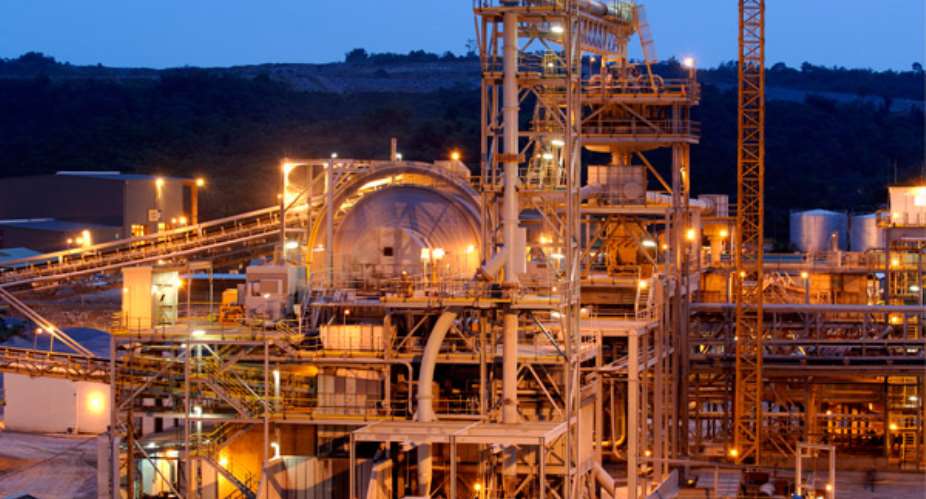
Tarkwa Mine processing facilities, Ghana. Photo: IAMGOLD, via Wikimedia Commons, CC BY-SA 3.0.
Through 2026, Ghana has moved in stages to connect gold mining, formal purchasing, financing and reserve accumulation more tightly than before.According to IMF documentation, the Ghana Gold Board (GoldBod) began conducting doré purchases directly from 1 April 2026; the Bank of Ghana stopped buying gold from large-scale miners from 1 June 2026; and a July 2026 memorandum of understanding formalised the transfer of the Domestic Gold Purchase Programme (DGPP) from the central bank to GoldBod, with government assuming programme costs from 1 July.
Separately, GoldBod’s own announcement with the Ghana Chamber of Mines set 1 July 2026 as the effective date for a new arrangement under which large-scale producers, including Newmont, Gold Fields and Zijin, sell 30 percent of their output to the state, replacing a 20 percent arrangement that had operated since 2022. Where this account relies on the correction prompt’s characterisation of the underlying IMF text rather than the document itself, it is presented as the likely institutional sequence rather than an independently verified reconstruction.
Most recently, GoldBod’s compulsory domestic-refining requirement for ASM gold took effect at the end of August 2026, with non-compliance risking suspension or revocation of buyers’ licences. None of these moves alone would justify a claim that Ghana has built an integrated gold economy. Read together, they raise a more testable question: is Ghana constructing a more connected gold-sector architecture — linking mining, formal purchasing, financing, refining and reserve accumulation — and, if so, what is already operational, what remains unfinished, and where has the associated financial risk actually moved?
Production and Purchasing: Two Different Datasets
Ghana’s Chamber of Mines put provisional national gold output at approximately 6 million ounces (roughly 170 tonnes) in 2025, up about 21 percent on 2024 and enough to make Ghana Africa’s largest producer for the year. Within that provisional total, the Chamber’s figures attribute around 3.1 million ounces to ASM and 2.9 million ounces to large-scale mining — the first year in the reported series in which ASM output has exceeded large-scale output. These splits should be read as provisional industry estimates rather than a finalised national statistical account.
A separate dataset, from GoldBod and government sources, measures gold that moved through formal purchasing and export channels rather than estimated total output: parliamentary testimony in June 2026 put GoldBod’s cumulative purchases at 135.8 tonnes between January 2025 and May 2026, of which 135.2 tonnes came from the ASM sector. These figures are not directly comparable — one estimates physical production within a calendar year, the other describes purchases across a 17-month window that may include carry-over stock and large-scale offtake deliveries — and the gap between them has not been reconciled in the public record.
Reserves: A Disclosed Rebalancing, Not a Simple Subtraction
Bank of Ghana gold holdings grew from about 8.7 tonnes in 2021 to over 40 tonnes by October 2025, according to Governor Johnson Pandit Asiama — an accumulation driven largely by the DGPP, which at its peak had pushed gold’s share of gross international reserves above 40 percent, well beyond the roughly 20 percent typically recommended for a diversified reserve portfolio. The Bank subsequently disclosed a partial divestment of approximately 22.24 tonnes as part of a deliberate rebalancing exercise, converting bullion into other foreign-exchange assets; the Governor was explicit that this represented a change in the composition of reserves, not a depletion of national assets.
The sequence that follows should be understood in light of that disclosed decision rather than as contradictory figures: Bank of Ghana data show reserves at 18.6 tonnes in December 2025, 19.2 tonnes in February 2026, 20.8 tonnes in March 2026, and 24.4 tonnes by June 2026, alongside gross international reserves of about $12.94 billion and roughly five months of import cover at that point. The public record supports this general trajectory; it does not establish that every intermediate movement follows mechanically from a single subtraction.
From Gold Production to Gold Infrastructure
The significance of the changes under way is not that GoldBod has become a larger buyer of gold. It is that Ghana is increasingly connecting the physical gold economy with its foreign-exchange and reserve architecture: mining (large-scale and ASM) → licensed buyers and aggregators → GoldBod purchasing and assaying → financing → domestic refining → export or reserve transfer → foreign-exchange inflow → Bank of Ghana reserve accounting → the Ghana Accelerated National Reserve Accumulation Policy (GANRAP), which targets reserves equivalent to 15 months of import cover by 2028.
Several links in that chain are now demonstrably operational. GoldBod, established under the Ghana Gold Board Act, 2025 (Act 1140), had licensed 1,184 buyers as of May 2026. In June 2026 it introduced an approved pricing threshold requiring licensed buyers to purchase at or below a GoldBod-published price, enforceable under Act 1140. Formalisation should not be overstated: GoldBod has significantly expanded formal purchasing infrastructure and increased the visibility and capture of ASM gold, but smuggling and unlicensed mining remain unresolved problems rather than eliminated ones — a 2025 SWISSAID analysis estimated Ghana lost about 229 tonnes of gold worth $11.4 billion to smuggling and trade gaps between 2019 and 2023, the scale of leakage the current reforms are aimed at closing.
What Changed at GoldBod
Until early 2026, gold purchasing for the central bank was handled mainly by the Precious Minerals Marketing Company (PMMC), acting as the Bank of Ghana’s buying agent while the Bank financed purchases and carried the pricing risk. GANRAP, approved by Cabinet and Parliament, took formal effect on 3 August 2026, establishing a collaborative financing model built with the Ministry of Finance, the Bank of Ghana, commercial banks and other market participants. GoldBod’s chief executive, Sammy Gyamfi, has described this as a deliberate move to gradually reduce reliance on the Bank of Ghana as an intermediary; on 3 August 2026, GoldBod raised $75 million directly from commercial banks in a transaction completed within 48 hours without central-bank intermediation, which the CEO described as one of the earliest tests of the new financing architecture.
The model’s first full month produced measurable results. GoldBod reported $1.315 billion in foreign-exchange generation in August 2026, of which $668.21 million was sold to commercial banks through spot sales and funded forward arrangements, and $646.59 million was made available to the Bank of Ghana for reserve accumulation under GANRAP. The board projected $1.4 billion for September, split roughly evenly between the two channels. This is meaningful evidence that the architecture is producing measurable financial flows rather than existing only on paper — but it proves one month of operational activity, not long-term sustainability, and it does not by itself establish that the model is economically optimal or that Ghana has completed an integrated gold economy.
Where the New Risks Actually Sit
The reform does not make risk disappear. It changes who carries it, how it is financed, where it appears on institutional balance sheets, and which body is accountable for it.
Bank of Ghana balance-sheet risk has been substantially reduced. The direct financing and pricing exposure that generated IMF-estimated losses exceeding $1.7 billion in 2025 — about 1.5 percent of GDP — no longer sits with the central bank in the same form. The IMF attributes those losses largely to Gold-for-Reserves doré purchases, driven by service and assay fees, discounts applied to gold sold on to off-takers, and the accounting gap between the informal-market rate used to buy gold domestically and the Bank’s own reference rate for valuation purposes. Separately, the Bank’s own 2025 financial statement reported a loss of about GH₵22 billion, with one detailed breakdown distinguishing a gross programme cost of roughly GH₵21.9 billion from a narrower net figure of about GH₵9.05 billion. These figures describe different accounting and institutional boundaries; the article does not treat GoldBod as having “lost” either figure, and no consolidated reconciliation between the IMF and Bank of Ghana numbers is currently available.
Government fiscal risk is less clearly resolved. GoldBod remains state-owned, and whether government would need to backstop it under sustained stress has not been publicly specified.
GoldBod operational risk has increased, as the institution now runs licensing, aggregation, pricing enforcement, financing and refining coordination at a scale it did not previously manage alone.
Market and price risk is live and quantified. GoldBod CEO Sammy Gyamfi told Reuters in July 2026 that GoldBod’s 2026 planning assumption had been an average gold price near $5,000 an ounce and weekly purchases of around 2.5 tonnes — an internal planning assumption, not a market forecast. A price pullback during the year had already reduced earnings expectations relative to that assumption, even as purchase volumes held up.
Financing risk has shifted in structure rather than in a simple, fully specified way. The new arrangement moves operational financing exposure away from the Bank of Ghana toward GoldBod’s relationships with commercial banks, off-takers and the wider government-backed institutional framework. The ultimate allocation of stress losses within the broader public-sector architecture — how much would fall on GoldBod, government, or other counterparties in a downturn — remains an important unresolved question, not a settled arrangement.
The Links Ghana Has Not Yet Completed
Refining illustrates the difference between installed capacity, certification and demonstrated throughput — three distinct things that should not be collapsed into one another. Gold Coast Refinery, established in 2016 with a refining capacity of more than 80 tonnes a year, is working with South Africa’s Rand Refinery — Africa’s leading LBMA Good Delivery–accredited refiner — which is providing technical, operational and commercial supervision toward the objective, publicly welcomed by LBMA chief executive Ruth Crowell in February 2026, of Gold Coast Refinery eventually applying for LBMA Good Delivery status itself.
Separately, Gold Coast Refinery holds Responsible Jewellery Council (RJC) Code of Practices certification, obtained in 2022 — a distinct responsible-sourcing standard, not an LBMA accreditation and not evidence of one. As of the most recent reporting available, none of Ghana’s four licensed refineries appears on the LBMA’s Good Delivery List, and no public timetable for accreditation has been published.
LBMA Good Delivery status matters because it establishes that a refiner’s bars meet LBMA standards for acceptance in the global wholesale bullion market, which can improve market access and commercial terms; it does not reduce to a simple binary of full spot price versus automatic discount, and the article does not treat it as such.
Actual throughput also remains modest relative to purchases. GoldBod’s supply contract with Gold Coast Refinery, signed in January 2026, set weekly deliveries at one tonne; an amendment in March 2026 converted that figure from a floor into a ceiling. GoldBod disclosed in August 2026 that about 7.1 tonnes of gold it had purchased that year were then being refined locally — evidence of active domestic refining, not confirmation that the full refining-to-export-or-reserve cycle had already been completed for that volume — a small figure relative to the 50–54 tonnes GoldBod says it purchased from ASM in the first half of 2026 alone.
GoldBod has signed contracts with only two of Ghana’s four licensed refineries — Gold Coast Refinery and Royal Ghana Gold Refinery, the latter of which still needed additional equipment to run at stated capacity as of April 2026. The end-August 2026 compulsory domestic-refining requirement for ASM gold now tests this capacity directly, ahead of any accreditation being in place — the tension at the centre of the current policy.
The structural point is straightforward: Ghana’s institutional gold architecture — purchasing, pricing enforcement, financing — is developing faster than its accredited domestic refining capacity.
What to Watch Next
Several indicators will show whether this architecture consolidates or comes under strain: whether GoldBod’s financing model sustains comparable FX generation through a full price cycle, including a downturn; whether refined tonnage moves meaningfully beyond single digits as a share of total purchases; whether Gold Coast Refinery completes LBMA Good Delivery accreditation; and whether the new 30 percent large-scale offtake arrangement remains commercially and institutionally durable through its first full year, particularly after replacing the 20 percent arrangement that had operated since 2022.
Conclusion
Ghana has moved beyond treating gold solely as a mineral output and export stream. It is increasingly using gold as part of an economic and financial infrastructure connecting production, formalisation, aggregation, financing, foreign exchange, reserve accumulation and domestic refining — and the August 2026 financing results, alongside the reserve trajectory documented in the Bank of Ghana’s own data, show that chain now producing measurable flows rather than existing only on paper. But the architecture is incomplete. Its durability will depend on financing through a full gold-price cycle, refining throughput, Good Delivery accreditation, traceability, the eventual treatment of fiscal risk, and whether domestic value addition develops faster than the administrative architecture built around it. Ghana is not building an integrated gold economy. It is building — and testing — one.
A September 2026 assessment of how mining, purchasing, financing, refining and reserve accumulation are being connected within Ghana’s gold economy — and what remains unfinished.
By Joe-William Ohene-Frimpong
Sources
Primary sources
- International Monetary Fund — Ghana: 2026 Article IV Consultation and Sixth Review
-
International Monetary Fund — Lessons from the Bank of Ghana’s Domestic Gold Purchase Programme
-
GoldBod — Mandatory Local Refining of Gold Doré Before Export
-
GoldBod — US$75 Million Directly Raised from Commercial Banks
-
Bank of Ghana — Summary of Economic and Financial Data, July 2026
Secondary / corroborating sources

Joe-William Ohene-Frimpong, © 2026
Ghanaian-German economic analyst, book author, and economic publicist based in Germany. More Joe-William Ohene-Frimpong is a Ghanaian-German economic analyst, book author, and economic publicist based in Germany. His work examines corporate strategies, industrial competitiveness, international markets, investment, and the structural conditions that shape long-term business and economic success.
His four published books reflect two complementary areas of work. In his publications on German industrial excellence, he examines both internationally renowned German companies with globally recognised brands and strong market positions, and highly specialised companies that remain largely unknown outside their respective industries while holding leading or world-leading positions in specialised global niches.
“German Excellence: The 25 Iconic German Companies that Conquered the US — And How You Can Apply Their Strategies to Your American Business” analyses the success strategies of 25 internationally recognised German companies, including the role of product quality, continuous technical innovation, strategic patience, and enduring customer trust.
“German Excellence Part II: Further 25 Iconic German Companies that Conquered the US — And How You Can Apply Their Strategies to Your American Business” extends this analysis to a further group of German companies, including businesses whose capabilities are of structural importance to global supply chains and industrial infrastructure, examining the strategic value of enabling positions and technical depth.
“Hidden Champions 2026: The 25 German World Market Leaders Nobody Knows — And How to Apply Their Winning Playbook to Your Business” focuses specifically on the less visible side of German industrial strength: highly specialised companies that may have little public recognition beyond their industries, yet command leading or world-leading positions in their respective niches. The book examines how technical excellence, specialised expertise, sustained innovation, focused market strategies, and long-term consistency enable such companies to build and defend exceptional positions in global markets.
His fourth publication, “Ghana: Africa’s No. 1 Gold Producer: The Complete Investment Guide for Entrepreneurs and Business Leaders from the US and Europe — Opportunities, Strategies, and Risks in the World’s Most Exciting Gold Market”, approaches Ghana’s gold sector from an investment and strategic perspective. It combines historical context with an analysis of the country’s gold heritage, the regulatory architecture of the Ghana Gold Board, investment opportunities, market entry, legal frameworks, and operational and commercial risks, including land rights and currency fluctuations.
Across these works, Ohene-Frimpong examines how companies develop specialised capabilities, technological expertise, strategic positioning, and durable competitive advantages, and how these strengths can translate into international market leadership. His work also considers how natural-resource advantages, investment frameworks, market structures, and institutional conditions can contribute to sustainable economic value creation.
Taken together, his publications explore corporate strategy, industrial excellence, international competitiveness, investment, global markets, natural resources, and economic development. His perspective draws on the depth of German industrial experience and the broader European business environment while maintaining an international outlook on Ghana, global markets, and cross-border economic activity.Column: Joe-William Ohene-Frimpong
Disclaimer: “The views expressed in this article are the author’s own and do not necessarily reflect ModernGhana official position. ModernGhana will not be responsible or liable for any inaccurate or incorrect statements in the contributions or columns here.”
Follow our WhatsApp channel for meaningful stories picked for your day.

Top Stories




Originally published on www.modernghana.com