September 3, 2026
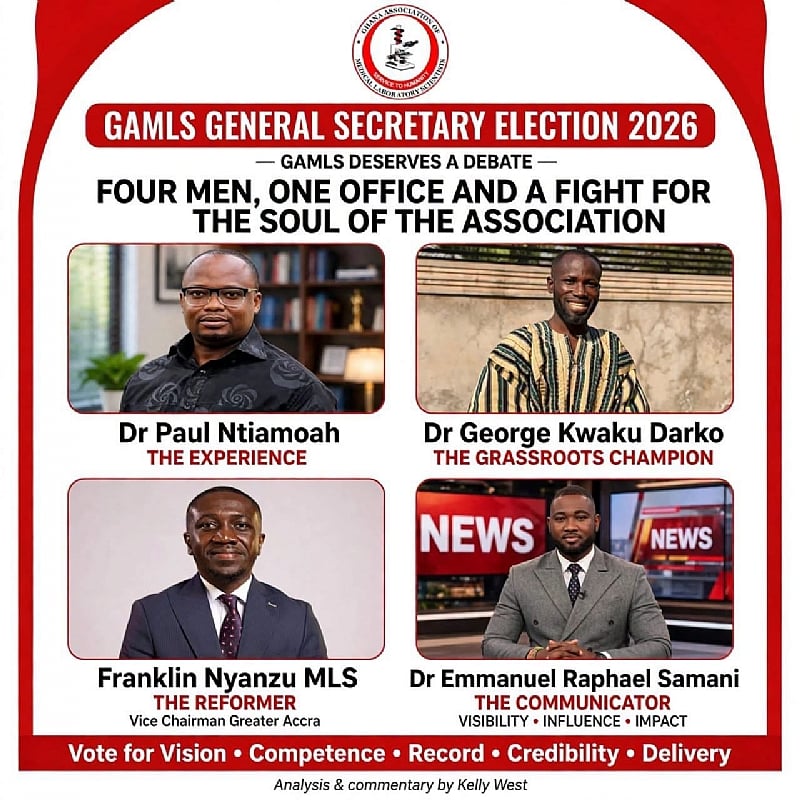
GAMLS General Secretary Race: Four Men, One Office — And A Fight For The Soul Of The Association


Thu, 03 Sep 2026 Feature Article
GAMLS General Secretary Race: Four Men, One Office — And A Fight For The Soul Of The Association
Ntiamoah, Darko, Nyanzu and Samani enter a contest that could determine whether GAMLS chooses continuity, grassroots renewal, reform or a louder national voice.
The battle for the General Secretary position of the Ghana Association of Medical Laboratory Scientists (GAMLS) is no longer a quiet succession exercise.
It is becoming a political contest.
With nominations open and four candidates now declaring their intentions, the race has acquired the ingredients of a serious professional election: experience, competing visions, leadership records, reform rhetoric, mobilisation and, inevitably, electoral arithmetic.
The names are now firmly on the table:
Dr. Paul Ntiamoah.
Dr. George Kwaku Darko.
MLS Franklin Nyanzu.
Dr. Emmanuel Raphael Samani.
Four men. One office. One Secretariat.
And the stakes are bigger than who gets to sign correspondence or preside over meetings.
The General Secretary is effectively the engine room of an association. It is where communication, coordination, records, institutional memory and follow-through converge. A strong General Secretary can make an executive administration work. A weak one can turn even good policies into paperwork and promises.
That is why GAMLS members must resist the temptation to reduce this election to friendship, familiarity, regional loyalties or campaign slogans.
This election deserves scrutiny.
NTIAMOAH: EXPERIENCE UNDER THE MICROSCOPE
Dr. Paul Ntiamoah comes into the contest with a formidable professional résumé.
Nearly two decades in medical laboratory science, coupled with experience at facility, district, regional and national levels and participation on the National Executive Council, gives him a considerable institutional advantage.
His campaign is essentially asking members to trust experience.
And that is a legitimate argument.
An organisation as complex as GAMLS needs people who understand its history, structures, relationships and institutional processes.
But experience also comes with a dangerous question:
What will you do differently?
The electorate should not be satisfied merely because a candidate has been around the system for a long time.
Long service must translate into institutional insight, administrative competence and a credible programme for the future.
Ntiamoah therefore has an opportunity — and a burden — to demonstrate why his experience should be interpreted as readiness rather than simply longevity.
DARKO: THE GRASSROOTS CARD
Dr. George Kwaku Darko is approaching the contest from the grassroots.
His self-description — Grass Root Oriented, Advocate, Innovative Thinker — is a deliberate political statement.
Professional associations sometimes suffer from a familiar problem: national executives speak for members without always hearing members.
Darko appears to be positioning himself against that possibility.
He speaks of building on the Association’s achievements while introducing practical and innovative initiatives that create lasting value.
His message of “Leadership through Service. Unity through Action. Progress through Innovation” gives him a platform that combines continuity with change.
But political language must eventually meet administrative reality.
What precisely is the innovation?
How will the regions be better integrated?
What structures will change?
What measurable improvements should members expect?
Those are the questions his campaign must answer.
NYANZU: THE REFORMER WITH NATIONAL LEADERSHIP EXPERIENCE
Then there is Franklin Nyanzu.
His candidacy may carry particular political weight because his leadership experience is not confined to one level of the profession.
He is Vice Chairman of GAMLS, Greater Accra Region, and a former President of the National Health Students’ Association of Ghana (NAHSAG).
That is a significant leadership record.
Nyanzu’s declaration is unmistakably reformist.
He says his regional experience has brought him face-to-face with the concerns of members and convinced him that GAMLS is ready for reform.
His proposition is particularly sharp: the Association must be “not only vocal but organised, not only respected but effective.”
That is perhaps one of the most important questions confronting the electorate.
Is GAMLS merely going to continue speaking, issuing statements and holding programmes, or can it build the organisational machinery necessary to convert professional influence into actual outcomes?
Nyanzu is putting reform and organisational effectiveness on the ballot.
But reform is an expensive political promise.
Members will want to know what precisely he intends to reform, how he will do it and whether he has the coalition-building capacity to carry the Association with him.
SAMANI: THE COMMUNICATOR ENTERS THE FRAY
Dr. Emmanuel Raphael Samani is the newest entrant, but his campaign brings a different weapon to the contest: communication.
With nearly a decade at the laboratory bench and a background spanning broadcast journalism, health communication and public advocacy for medical laboratory scientists, Samani is building his candidacy around the visibility and influence of the profession.
His opening line is deliberately provocative:
“We cannot be indispensable in the clinical setting and invisible at the table.”
That is not simply campaign poetry.
It speaks to the perennial concern of professional groups: being essential to the health system while having insufficient influence over the decisions that govern that system.
Samani wants GAMLS to become more visible, more influential and more impactful.
His three-word political identity says it all:
VISIBILITY. INFLUENCE. IMPACT.
His argument is that the General Secretary controls much of the machinery through which the Association communicates, coordinates and follows through.
If that machinery is efficient, GAMLS becomes harder to ignore.
If it is slow, fragmented or ineffective, the profession loses opportunities to influence the national conversation.
It is a compelling proposition.
But again, the electorate must demand the policy details.
THIS IS NOT JUST A FOUR-WAY RACE. IT IS A CHOICE OF DIRECTION.
The fascinating aspect of this contest is that the candidates appear to represent four different electoral instincts.
Ntiamoah offers experience.
Darko offers grassroots orientation and innovation.
Nyanzu offers reform and organisational effectiveness.
Samani offers visibility, communication and influence.
That makes this election considerably more interesting than a simple popularity contest.
It gives GAMLS members a genuine choice about the kind of Secretariat they want.
Do they want the steady hand of experience?
Do they want stronger grassroots engagement?
Do they want institutional reform?
Do they want a more aggressive public and professional voice?
Or, perhaps, do they want a combination of all four?
BUT WHERE IS THE PLAN?
This is where the campaign must now become serious.
Declarations are over.
The posters will come.
The endorsements will come.
The regional meetings will come.
The WhatsApp campaign will come.
The mobilisation will come.
But none of these should substitute for policy.
Every candidate should be challenged to publish a clear roadmap.
GAMLS members deserve answers on communication.
They deserve answers on regional coordination.
They deserve answers on implementation of Congress resolutions.
They deserve answers on institutional documentation and records.
They deserve answers on member engagement.
They deserve answers on advocacy.
And they deserve answers on how the Secretariat will be transformed from an administrative office into an effective instrument of professional power.
THE POLITICS OF NUMBERS
There is another reality the candidates cannot ignore.
Four credible candidates competing for one position creates the possibility of vote fragmentation.
That makes organisation critical.
A candidate does not win a professional election merely because colleagues like him.
He wins because supporters are identified, mobilised and actually turn up to vote.
Regional networks will matter.
Professional relationships will matter.
Past leadership records will matter.
Generational considerations will matter.
And, perhaps most importantly, the ability to build alliances beyond one’s immediate constituency will matter.
The candidate who assumes that personal popularity is enough could discover on election day that popularity and votes are not always the same thing.
GAMLS SHOULD DEMAND A DEBATE
If the Association is serious about professional leadership, the four candidates should be subjected to a proper national debate.
Let them sit together.
Let them defend their records.
Let them explain their visions.
Let them answer questions from members.
Let them tell GAMLS what they would do in their first 100 days.
Let them explain how they would handle conflict between national and regional structures.
Let them tell members how they would make the Secretariat more responsive.
And let the electorate compare the answers.
That would be more useful than another round of campaign slogans.
THE VERDICT MUST BE ABOUT GAMLS
The danger in professional elections is that the contest can become personal.
It must not.
The question before GAMLS is not which candidate has the most friends.
It is not which candidate belongs to which region.
It is not who has the loudest supporters.
It is not who can produce the most impressive campaign artwork.
The question is brutally simple:
Who can make GAMLS work better?
Dr. Paul Ntiamoah has put experience on the table.
Dr. George Kwaku Darko has put grassroots leadership and innovation on the table.
Franklin Nyanzu has put reform and organisational effectiveness on the table.
Dr. Emmanuel Raphael Samani has put visibility, influence and impact on the table.
Now they must all submit to the same test.
Vision. Competence. Record. Credibility. Delivery.
The winner will not merely become General Secretary.
He will become the person expected to keep the Association’s national machinery moving when the campaign posters have disappeared and the applause has stopped.
That is why this election matters.
Four candidates. One Secretariat. One mandate.
And when GAMLS members finally enter the voting booth, they should remember one thing:
Do not vote merely for the man you know. Vote for the man who knows what to do.
Medical Laboratory Scientist
Michael Agbesi Kelly

Michael Agbesi Kelly, © 2026
This Author has published 117 articles on modernghana.comColumn: Michael Agbesi Kelly
Disclaimer: “The views expressed in this article are the author’s own and do not necessarily reflect ModernGhana official position. ModernGhana will not be responsible or liable for any inaccurate or incorrect statements in the contributions or columns here.”
Follow our WhatsApp channel for meaningful stories picked for your day.
Top Stories


Originally published on www.modernghana.com