
September 8, 2026
Agriculture Becomes Stronger When Knowledge, Innovation And The Right People Come Together


Agriculture Becomes Stronger When Knowledge, Innovation And The Right People Come Together
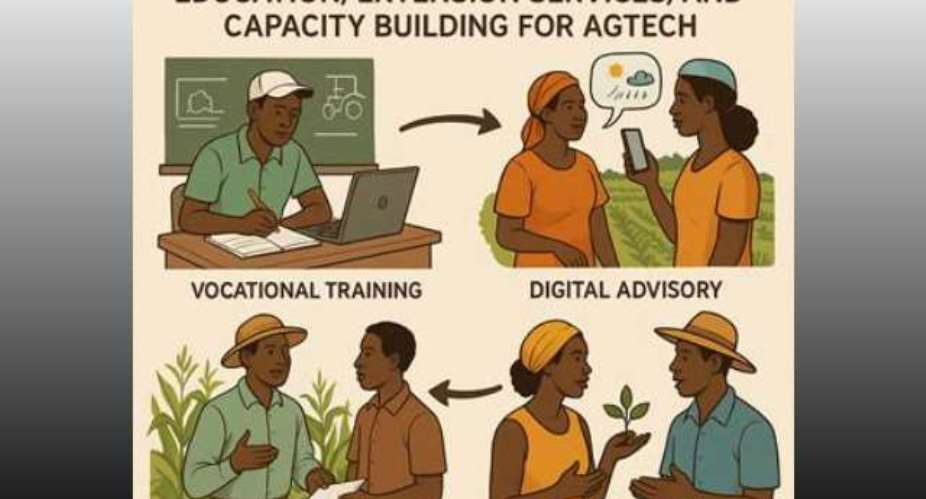
Agriculture is no longer simply about putting seeds into the soil and waiting for the rains. Modern agriculture is increasingly driven by knowledge, technology, innovation and people with the skills to turn ideas into productive enterprises.
For Ghana and Africa to achieve sustainable food security, agriculture must be treated not only as a traditional occupation but as a modern business and an important part of industrial development.
It begins with knowledge.
Farmers need access to reliable information about improved seeds, soil fertility, irrigation, pest and disease management, climate-smart agriculture, mechanisation, post-harvest management and market opportunities. Agricultural research institutions and universities may develop excellent technologies, but their real value is realised only when that knowledge reaches farmers and is translated into improved productivity.
Then comes innovation.
Technology is changing agriculture around the world. Precision farming, drones, improved irrigation, artificial intelligence, satellite information, biotechnology, improved crop varieties, digital marketplaces and modern processing technologies are creating opportunities to produce more efficiently and sustainably.
Africa cannot afford to remain on the sidelines of this transformation.
But neither knowledge nor technology can transform agriculture without the right people.
We need farmers who are willing to embrace better methods, scientists developing solutions for local conditions, extension officers transferring knowledge, engineers designing appropriate machinery, entrepreneurs establishing processing businesses, financial institutions providing suitable capital and policymakers creating an environment in which agricultural enterprises can prosper.
Young people must also be central to this transformation. Agriculture should not be presented to the next generation merely as subsistence farming. It should be presented as an industry encompassing production, engineering, biotechnology, food processing, logistics, packaging, marketing, data science and international trade.
Ghana has significant opportunities in cocoa, cassava, maize, rice, oil palm, coconut, soybean, fruits, vegetables, poultry and many other agricultural value chains. Yet producing raw agricultural commodities alone will not deliver their full economic potential.
We must connect the farm to the factory and the factory to the market.
Cassava can become industrial starch and high-quality flour. Oil palm and coconut can support edible oils, soaps and cosmetics. Maize and soybean can strengthen poultry and livestock production. Fruits can become juices, concentrates and dried products. Cocoa can generate considerably more value when processed into finished and semi-finished products.
This is where agriculture becomes industrialisation.
The future of African agriculture will therefore depend on collaboration. Farmers cannot do it alone. Neither can governments, universities, researchers nor businesses.
When researchers work with farmers, when universities work with industry, when financial institutions support agribusinesses, when entrepreneurs invest in processing and when governments provide infrastructure and appropriate policies, agriculture becomes stronger.
Africa already has the land, resources and entrepreneurial potential. The challenge is to connect them effectively.
—and when they do, farming becomes more than food production. It becomes a foundation for jobs, industry, exports and economic transformation.

Frank Ayim Damptey, © 2026
This Author has published 210 articles on modernghana.com. More I am a Ghanaian business leader, entrepreneur, industrial development professional, researcher and author with over two decades of experience in senior executive and technical roles.
I currently serve as the Chief Executive Officer of Tata Beverages Company Limited and Tata Industrial Company Limited, where I provide strategic leadership in manufacturing, product development, business growth and the promotion of locally manufactured products.
My professional experience spans a broad range of industries, including beverage and brewing, soap manufacturing, water treatment, paint and ink production, agriculture and agro-processing, food processing, technology and industrial manufacturing.
Beyond Ghana, I have provided consultancy and technical advisory services to start-ups and emerging businesses in Liberia, Sierra Leone, Burkina Faso and Nigeria. Through these engagements, I have supported entrepreneurs and businesses in product development, manufacturing processes, equipment selection, quality improvement and the establishment of sustainable production operations.
I am a strong advocate for Made-in-Ghana products, entrepreneurship, industrialisation, local value addition and the growth of small and medium-sized enterprises (SMEs). I firmly believe that Ghana and Africa’s long-term economic transformation will depend on our ability to produce more of what we consume, add value to our locally available resources and build competitive industries that create sustainable employment.
My interests extend beyond manufacturing to agriculture, food security, STEM education, innovation, healthcare, entrepreneurship and national development. I am particularly passionate about practical solutions that can strengthen local industries, create opportunities for young people and reduce Africa’s excessive dependence on imports.
As an author and contributor to ModernGhana, I regularly write on business, manufacturing, agriculture, entrepreneurship, economic development and other issues of national and continental importance. Through my writing, I seek to stimulate constructive public discussion, challenge conventional thinking and advocate practical solutions to Ghana’s development challenges.
I have also undertaken and published research in areas related to manufacturing, food processing, innovation, local raw-material utilisation and sustainable industrial development. My research interests are driven by the belief that Africa possesses enormous resources that can be transformed through research, technology, entrepreneurship and industrialisation.
Throughout my professional journey, I have remained committed to promoting local manufacturing, entrepreneurship and African industrial development.
My philosophy is simple:
“Africa must produce more of what it consumes, process more of what it produces, and build competitive businesses capable of creating jobs and competing globally.”Column: Frank Ayim Damptey
Disclaimer: “The views expressed in this article are the author’s own and do not necessarily reflect ModernGhana official position. ModernGhana will not be responsible or liable for any inaccurate or incorrect statements in the contributions or columns here.”
Follow our WhatsApp channel for meaningful stories picked for your day.
Top Stories

14 minutes ago


Originally published on www.modernghana.com