September 6, 2026
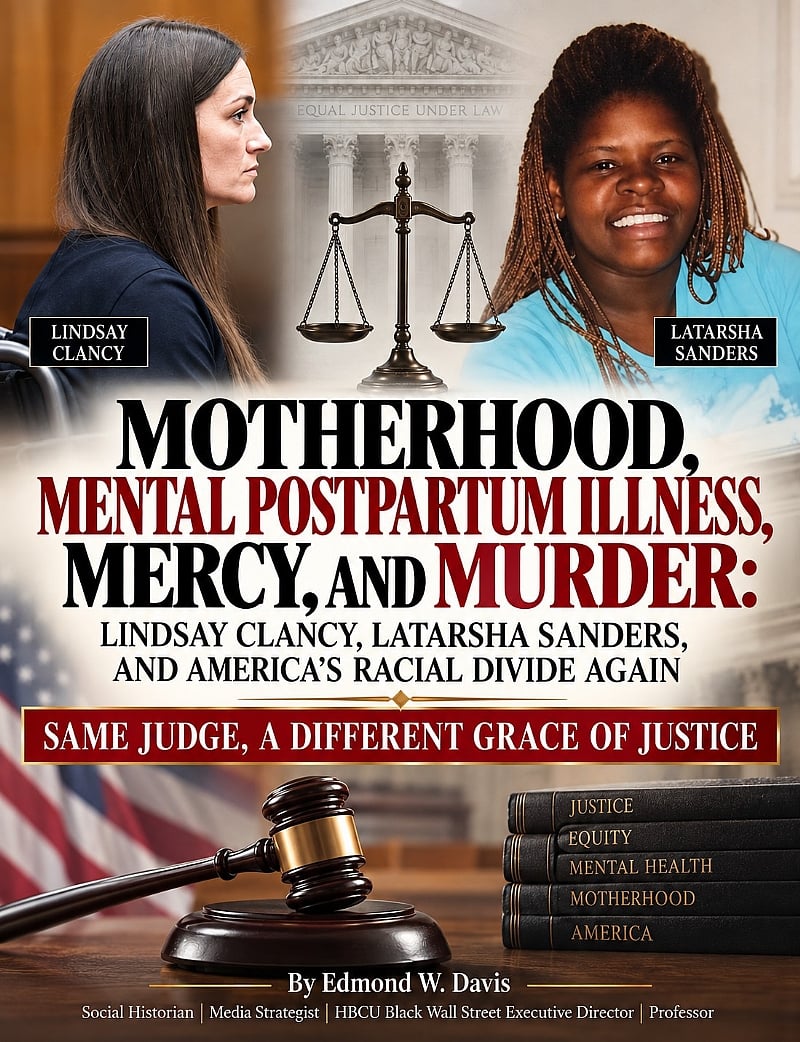
Motherhood, Mental Postpartum Illness, Mercy, And Murder: Lindsay Clancy, Latarsha Sanders, And America’s Racial Divide Again


Sun, 06 Sep 2026 Feature Article
Motherhood, Mental Postpartum Illness, Mercy, And Murder: Lindsay Clancy, Latarsha Sanders, And America’s Racial Divide Again
Same Judge, A Different Grace Of Justice
Three children must remain at the center of the Lindsay Clancy case: Cora Clancy, 5; Dawson Clancy, 3; and Callan Clancy, 8 months old.
They were killed in their Duxbury, Massachusetts, home on January 24, 2023. Their mother, Lindsay Clancy, admitted killing them. Her defense argued that severe mental illness, including postpartum psychosis, rendered her not criminally responsible.
Prosecutors argued that she deliberately killed the children and understood that her actions were wrong.
After seven days of deliberations, Plymouth County Superior Court Judge William F. Sullivan declared a mistrial on September 4, 2026, because the jury could not unanimously resolve whether Clancy was criminally responsible.
Compassion for serious mental illness is not the problem. Unequal compassion is. That distinction becomes impossible to ignore when Clancy’s case is placed beside that of Latarsha Sanders, a Black mother from Brockton, Massachusetts.
In February 2018, Sanders killed her sons, Edson “Marlon” Brito, 8, and La’Son Brito, 5. She raised a lack-of-criminal-responsibility defense. A jury convicted her in 2022 of two counts of first-degree murder, resulting in two sentences of life without parole.
Then Massachusetts’ highest court intervened.
On August 6, 2026, the Massachusetts Supreme Judicial Court ordered Sanders a new trial. The court concluded that relevant evidence concerning Sanders’s mental deterioration while awaiting trial should have been admitted and that excluding it was prejudicial.
And who tried Sanders? Judge William F. Sullivan—the same judge who presided over Lindsay Clancy’s trial. Reuters subsequently highlighted that connection precisely, reporting that Sullivan had presided over both cases and that Massachusetts’ highest court overturned Sanders’s convictions after concluding that critical mental-health evidence had been improperly excluded.
The Boston Globe has gone even further editorially, arguing that the two cases are “inextricably linked” and raising questions about equitable treatment of the two mothers.
This is no longer merely a story about two mothers.
It is a story about two mothers, five dead children, one courthouse, one judge, mental illness—and two dramatically different journeys through American justice.
SAME JUDGE, DIFFERENT COURTROOM REALITIES
The final days of the Clancy trial produced another remarkable development.
After concerns arose about a juror and the panel remained deadlocked, Sullivan called the jurors individually to sidebar. CBS Boston reported that Sullivan briefly questioned each juror before again instructing the entire jury on reasonable doubt. The defense wanted a juror removed; prosecutors argued Sullivan’s individual questioning and subsequent instruction were appropriate. Sullivan declined to remove the juror.
CBS’s legal analyst described the situation as “very rare” and warned that a judge in such circumstances must avoid appearing to coerce a verdict.
It would therefore be inaccurate to declare individual juror questioning itself unprecedented. Courts can investigate possible juror misconduct or inability to follow instructions.
But this was unquestionably extraordinary enough to generate an emergency appeal to Massachusetts’ highest court before the mistrial was finalized.
Now consider the contrast.
Clancy’s jury heard weeks of testimony about psychiatric treatment, medications, postpartum illness, and competing expert interpretations of her mental state.
Sanders’s convictions, meanwhile, were overturned because her jury did not receive mental-health evidence the Supreme Judicial Court determined was relevant to evaluating criminal responsibility. Same judge. Same courthouse. Two mothers who killed their children. Mental illness is central to both defenses. But markedly different procedural histories.
WHO RECEIVES AMERICA’S PRESUMPTION OF HUMANITY?
Postpartum Psychosis is not a political talking point. It is a serious psychiatric condition. The National Institute of Mental Health says postpartum psychosis can involve delusions, hallucinations, mania, paranoia, and confusion and describes it as a psychiatric emergency requiring immediate hospitalization.
That deserves compassion, treatment, and serious consideration in a courtroom. But mental illness does not automatically establish legal insanity. The legal question is whether a particular defendant’s mental condition satisfied Massachusetts’ standard for lack of criminal responsibility at the time of the killings.
The uncomfortable question is whether American institutions hear these defenses differently depending upon who is asking to be heard. There is empirical reason to ask.
A peer-reviewed experiment involving 216 participants examined race and mental disorder in mock insanity trials. Participants were significantly more likely to return a guilty verdict when the hypothetical Black defendant had schizophrenia rather than depression, while the same significant difference was not observed for the white defendant. The researchers concluded that racial bias can be exacerbated in insanity cases involving racialized defendants. That study does not prove racism determined the Sanders verdict or the Clancy mistrial. But it examines racial disparities legitimately.
ANDREA YATES, DEANNA LANEY—AND OTHER AMERICAN CASES
The Clancy-Sanders comparison belongs to a much longer American history.
Andrea Yates, a white Texas mother, drowned her five children in 2001. She was initially convicted. That conviction was overturned, and at her 2006 retrial, a jury found her not guilty by reason of insanity. She was committed to a state psychiatric hospital rather than returned to prison.
Deanna Laney, another white Texas mother, killed two sons and seriously injured another in 2003, saying God commanded her to do so. A Texas jury found her not guilty by reason of insanity in 2004.
Those outcomes should not be reduced to “white woman equals mercy.” Yates was initially convicted, and psychiatric commitment following an insanity verdict is not simply freedom.
More broadly, a published review in the Journal of the American Academy of Psychiatry and the Law examined 34 infanticide cases involving postpartum-psychosis insanity defenses. In the 26 cases from M’Naghten-standard jurisdictions, 12 resulted in NGRI findings and 12 in convictions. Among seven Model Penal Code cases, three resulted in NGRI findings and three in convictions.
That data demonstrates something important:
There is no automatic postpartum-psychosis escape hatch from criminal responsibility. The evidence matters. The diagnosis matters. The legal standard matters. And that is exactly why Sanders’s case is so troubling: her convictions were overturned because evidence relevant to that very determination was improperly withheld from the jury.
MERCY CANNOT HAVE A COLOR, GENDER, OR AGE
The Clancy case has generated enormous discussion about postpartum mental health, psychiatric treatment, and the boundaries between illness and criminal responsibility.
That discussion is necessary. But where was comparable national mobilization for Latarsha Sanders?
Where were the crowds demanding that America understand schizophrenia and psychiatric deterioration before defining a Black mother solely by the worst acts of her life? If psychiatric evidence matters when evaluating Lindsay Clancy, it must matter when evaluating Latarsha Sanders. If mental disease can contextualize Andrea Yates or Deanna Laney, then the courthouse door to that evidence must remain equally open when the defendant is Black, Latina, poor, unknown, or unable to attract national sympathy.
This is not an argument that mothers who kill their children should simply be released. Far from it. Cora. Dawson. Callan. Marlon. La’Son. Say their names. Five children died. Their humanity cannot disappear beneath debates about their mothers. But equal justice requires that the same legal system that remembers the humanity of one mentally ill defendant recognize the humanity of another.
Micah 6:8 commands us “to do justly, and to love mercy.” Justice and mercy occupy the same verse. James 2 warns believers against partiality.
If America repeatedly invokes Christian morality in its public life, those principles cannot stop at the courthouse steps. Mercy cannot have a ZIP code, and Justice’s address should be everywhere. Mental illness cannot have a preferred complexion, eye color, or tax bracket. And justice cannot change its eyesight depending upon who stands before the bench. The question now extends beyond whether Lindsay Clancy will face another trial or whether Latarsha Sanders will receive justice at her second.
The question is larger:
When two mothers stand before the same courthouse, the same judge, and the same justice system—with severe mental illness at the center of both defenses—does American justice see two human beings equally, or does race still influence whose illness we understand, whose humanity we recognize, and whose plea for mercy we are willing to hear? Massachusetts must confront that question. America should be watching. In the Patriot state of Massachusetts, crowds of empathy, grace, mercy, and compassion showed up for Yancy, but they went on strike for Sanders.
- Lindsay Clancy—2026 mistrial and criminal-responsibility defense
Associated Press—Key moments in the Lindsay Clancy case
AP examines the killings, Clancy’s mental-health treatment, competing psychiatric testimony, and the September 2026 mistrial.
- Latarsha Sanders—Massachusetts Supreme Judicial Court decision
Massachusetts Supreme Judicial Court — Commonwealth v. Sanders (2026)
The primary legal source. The opinion identifies William F. Sullivan as Sanders’s trial judge and explains why her convictions were reversed and a new trial ordered.
- Same Judge: Sullivan, Clancy, and Sanders
Reuters—Lindsay Clancy trial is latest high-profile murder case for Judge William Sullivan
Reuters directly examines Sullivan’s role in both cases.
- Individual questioning of the Clancy jurors
CBS Boston — Clancy jury dispute and individual juror questioning
Detailed reporting on Sullivan questioning jurors individually, the defense request to remove a juror, and the prosecution’s response.
Four other cases/research comparisons
- Andrea Yates—Texas
CBS News/AP—Andrea Yates found not guilty by reason of insanity
Covers the 2006 insanity verdict following the deaths of Yates’s five children.
- Deanna Laney—Texas
CBS News — Tale of Two Killer Moms: Deanna Laney and Andrea Yates, contemporary reporting on Laney’s 2004 not-guilty-by-reason-of-insanity verdict and comparison with Yates.
- Thirty-four postpartum-infanticide cases
Journal of the American Academy of Psychiatry and the Law — Postpartum Psychosis and the Courts
A particularly useful scholarly comparison because it examines outcomes across 34 cases rather than relying on a few famous defendants.
- Race and the insanity defense
PubMed—Defendant race and mental disorder in insanity-trial decision-making
Peer-reviewed research examining whether defendant race and psychiatric diagnosis affect mock-juror decisions.
ABOUT THE AUTHOR
Edmond W. Davis is one of America’s top social historians, media strategists, and professors. Davis founded the National HBCU Black Wall Street Career Fest. A native of Philadelphia, PA, he, his wife, and his son currently live in Little Rock, Arkansas. area. Davis is committed to cultural empowerment and educational equity through storytelling and civic engagement. In 2026, Davis was a grand marshal at the 38th Annual African American History Month Celebration Parade, the largest in the U.S. during Black History Month. His life is told in the 2023 ‘Short Documentary of the Year’ at the Black Excellence Awards, titled ‘FROM GRIND TO GROWTH: The Edmond W. Davis Story. Davis was also the courthouse jailroom deputy on the NBC TV miniseries Bluff City Law.

Edmond W. Davis, © 2026
This Author has published 100 articles on modernghana.comColumn: Edmond W. Davis
Disclaimer: “The views expressed in this article are the author’s own and do not necessarily reflect ModernGhana official position. ModernGhana will not be responsible or liable for any inaccurate or incorrect statements in the contributions or columns here.”
Follow our WhatsApp channel for meaningful stories picked for your day.
Top Stories


Originally published on www.modernghana.com