August 30, 2026
History Is Meant To Understand Who We Are Today Not Create Nostalgia


Sun, 30 Aug 2026 Feature Article
History Is Meant To Understand Who We Are Today Not Create Nostalgia
Africa is a continent where history about people and events, have always been left unrecorded, creating a situation for these individuals and occurrences to be either forgotten or reviled without proof.
The documentary, “The Trials Of Winnie Mandela,” released in April this year, was an effort to preserve African oral history which is so important, because recording the past is not meant for nostalgia, but helps to bring understanding on who we are today, South African businessman, and executive producer of the documentary, Ivor Ichikowitz said, adding, “history doesn’t die when the people who made it die.”
He said “Winnie died in 2018, but the questions raised by her life are still extraordinarily relevant.” These according to him include “race, gender, political violence, inequality, resistance, propaganda and who ultimately gets to write a country’s history.”
In addition, Ichikowitz said, for younger Africans in particular, these questions matter, as they inherited societies shaped by struggles, they did not personally experience. For this reason, if the witnesses to these events were allowed to disappear without recording their testimony, future generations will inherit somebody else’s interpretation of history.
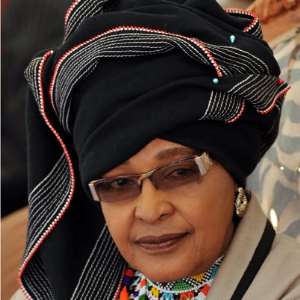
Truth be told, if there was ever, a South African, whose life is one that has become topical, even after her death, which must be Winnie Mandela, wife of Nelson Mandela. For many, she was the face of the fight against apartheid, while others think otherwise.
The seven-part documentary, which has been described by some as a “contested legacy of Winnie Madikizela-Mandela,” is largely through her own words, and the perspective of her granddaughters, Princess Zaziwe Manaway and Princess Swati Mandela-Dlamin. It was aimed at looking beyond traditional media portrayals to reveal Winnie’s multifaceted roles as a mother, grandmother, political leader, and a central pillar of the anti-apartheid struggle.
As reviews on the documentary rage on, one would wonder why anyone will bother to waste time to tell Winnie’s story, but Ichikowitz said his motivation was purely history.
“I realised many years ago that South Africa had come through one of the most extraordinary and tumultuous liberation struggles in modern history, but if we do not capture the testimony of the people who actually lived it, those voices would eventually disappear,” he said.
Though so much has been written about Winnie, extraordinarily little of her history had been told, and so the documentary did this through her own voice. When the project started, they initially thought it was going to be a conventional one that might take a year, but the deeper they got involved, the more they realised that one could not understand Winnie without understanding apartheid, the liberation struggle, psychological warfare, the Mandela family and the enormous personal consequences of that struggle.
Ichikowitz said, it therefore became an extraordinary journey of more than a decade, adding that, “when we started, I genuinely believed it would take about 12 months and result in a conventional feature-length documentary. Instead, we spent years filming and researching. For roughly eight years, the camera crew was filming around two days every week.”
“We interviewed an enormous range of people — friends, family members, political colleagues, journalists, lawyers, opponents, members of the security establishment and people who openly disliked Winnie. The wider African Oral History Archive has recorded hundreds of people involved in South Africa’s political transformation, and that archive became an enormously important resource for the series,” he said.
On how much it cost to produce, Ichikowitz said “I haven’t publicly put a precise figure on the production, and I don’t think the financial number is ultimately the important part of the story. What I can say is that this was an extraordinarily ambitious production and probably one of the highest-budget documentary projects ever undertaken in Africa. “
He said “we spent more than a decade researching, filming, interviewing, and working through an enormous archive because the story deserved to be told to a world-class standard. You cannot put a financial value on preserving testimony that otherwise disappears when people die. The interviews and archival material we collected don’t end with this documentary. They become part of the historical record available to future generations.”
The documentary has received mixed reviews which cut across racial lines, although inevitably, people come to Winnie with quite different historical experiences. “For many Black South Africans, particularly those who lived through apartheid, Winnie was never simply the controversial figure portrayed internationally. She was the woman who remained among the people, who was detained, tortured, banished, and relentlessly persecuted, but continued to be a visible face of resistance,” Ichikowitz said.
For many white South Africans, the documentary is perhaps more uncomfortable because it challenges a version of Winnie that became deeply embedded in public consciousness. Ichikowitz who grew up as part of a society that was encouraged to judge Winnie without necessarily understanding what had been done to her, said the film asked, “both Black and white South Africans to look again — not necessarily to agree, but to examine the evidence.”
One thing that the documentary can be commended for, is how it portrayed that Winnie Mandela should not be reduced to either a saint or a monster. “For decades, people tried to precisely do that. Her admirers wanted a saint, and her enemies wanted a villain. Neither gives you the truth. She was enormously courageous and extraordinarily resilient. She also made mistakes and took decisions which remain deeply controversial,” he said.
Ichikowitz was quick to add that, “you cannot understand those decisions without understanding what apartheid did to her. She was imprisoned, tortured, separated from her children, banished and subjected to relentless surveillance and psychological warfare.”
For all her efforts to help fight apartheid, Ichikowitz said “history has not always been fair to Winnie Mandela. Nelson became the global symbol of reconciliation — deservedly so. But while Nelson was imprisoned, Winnie lived the struggle every day on the streets of South Africa. She paid an extraordinary price for that.”
“Internationally, particularly in parts of the Western media, her story was frequently reduced to controversy and violence. The scale of her contribution to keeping the liberation struggle visible inside South Africa was often diminished,” he added.
In spite of this, Ichikowitz said their job was not to “correct one simplistic narrative by replacing it with another. We weren’t trying to rehabilitate Winnie or manufacture a heroine. Our responsibility was simply to put more of the evidence on the table and allow people to decide for themselves.”

Francis Kokutse, © 2026
This Author has published 13 articles on modernghana.comColumn: Francis Kokutse
Disclaimer: “The views expressed in this article are the author’s own and do not necessarily reflect ModernGhana official position. ModernGhana will not be responsible or liable for any inaccurate or incorrect statements in the contributions or columns here.”
Follow our WhatsApp channel for meaningful stories picked for your day.

Top Stories

4 hours ago

5 hours ago


Originally published on www.modernghana.com