

September 3, 2026
Before We Ask Ghanaian Entrepreneurs To Produce More, Let Us Help Them Sell What They Already Produce


Thu, 03 Sep 2026 Feature Article
Before We Ask Ghanaian Entrepreneurs To Produce More, Let Us Help Them Sell What They Already Produce
We constantly tell Ghanaian entrepreneurs to expand production, create jobs, add value to local raw materials and contribute to national development.
But there is a question we rarely ask:
Who will buy what they produce?
Before we encourage the Ghanaian entrepreneur to borrow money to purchase another machine, expand a factory or employ additional workers, perhaps we should first help that entrepreneur sell what is already sitting in the warehouse.
Production without a market is not industrialisation. It is inventory.
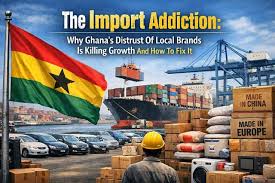
Across Ghana, small and medium-sized manufacturers are producing beverages, soaps, cosmetics, footwear, clothing, furniture, processed foods, pharmaceuticals and many other products. Yet these businesses must compete in their own country against an enormous range of imported products.
Competition itself is healthy. The problem arises when domestic manufacturers operate under conditions that make competition unnecessarily difficult.
The Ghanaian manufacturer pays for electricity, water, fuel, transportation, taxes, regulatory compliance, packaging, financing and sometimes imported raw materials. Interest rates and exchange-rate movements can further increase production costs.
After overcoming all these challenges, the entrepreneur finally puts a product on the market—only to find the shelves crowded with imported alternatives.
Then we ask the same entrepreneur: Why are you not producing more?
More for whom?
Ghana needs to rethink industrial policy from the perspective of the market, not merely production capacity.
Government is one of the largest purchasers of goods and services in the economy. Ministries, hospitals, schools, security agencies, district assemblies and other public institutions purchase enormous quantities of food, furniture, uniforms, cleaning products, beverages, stationery, pharmaceuticals and other supplies.
Where Ghanaian manufacturers can meet appropriate quality and price standards, public procurement should deliberately give them preference.
Imagine the impact if more school furniture were produced by Ghanaian carpenters and furniture companies; uniforms and protective clothing by local textile and garment businesses; cleaning products by Ghanaian manufacturers; and processed foods for public institutions sourced from domestic producers.
That is how industrial policy creates jobs.
We must also confront the question of imports.
Protecting Made-in-Ghana products does not mean banning every foreign product or shielding inefficient companies permanently from competition. Ghanaian businesses must improve quality, packaging, productivity and pricing.
But no serious country develops its manufacturing sector by allowing domestic industries to be overwhelmed indefinitely by imports that it has the capacity to produce competitively at home.
Strategic protection can include reasonable tariffs, enforcement of product standards, action against under-invoicing and smuggling, stronger local-content policies and targeted restrictions where necessary and consistent with Ghana’s trade obligations.
Quality standards must also apply equally. Ghanaian manufacturers should not go through expensive regulatory processes while substandard imported products find their way onto the market.
Consumers have a role as well.
Every purchasing decision has economic consequences. When we buy a Ghanaian-made product that offers acceptable quality and value, part of that money remains within the domestic economy. It helps pay Ghanaian workers, distributors, farmers, transporters, suppliers and taxes.
But patriotism alone cannot sustain an industry.
We cannot simply tell Ghanaians to “Buy Ghana” while local businesses struggle with high production costs. Government must create conditions that enable Ghanaian products to compete on quality and price.
The conversation about entrepreneurship must therefore change.
Instead of always asking, “How can Ghanaian businesses produce more?”
We should also ask, “How can Ghanaian businesses sell more?”
Because when demand increases, production follows.
When factories receive more orders, they increase shifts. When production increases, more workers are employed. When businesses grow, the tax base expands. When local manufacturers replace some imports, Ghana reduces pressure on foreign exchange.
That is the industrialisation cycle we should be building.
Our entrepreneurs do not only need loans, training programmes and motivational speeches.
They need markets.
Before asking the Ghanaian manufacturer to buy another machine, employ another worker or produce another thousand units, let us first make sure that what has already been produced has a fair opportunity to reach the Ghanaian consumer.
Made-in-Ghana must not become Made-in-Ghana-but-unsold.
Protecting and expanding the market for Ghanaian products is not merely about helping individual entrepreneurs. It is about protecting jobs, conserving foreign exchange, strengthening domestic industries and building an economy that produces more of what it consumes.
If we truly want Ghanaian businesses to produce more, then let us first help them sell more.

Frank Ayim Damptey, © 2026
This Author has published 200 articles on modernghana.com. More I am a distinguished Ghanaian business leader and entrepreneur, serving as the Chief Executive Officer of Tata Beverages Company Limited and Tata Industrial Company Limited. With over two decades of experience in senior executive roles, I brings extensive expertise across multiple industries, including brewing, soap manufacturing, water treatment, paint and ink production, agriculture, technology, and food processing.
Beyond my leadership in Ghana, I have provided consultancy services to several start-up companies across Liberia, Sierra Leone, Burkina Faso, and Nigeria, helping to drive growth and innovation within West Africa’s industrial sector.
My work with Tata Beverages reflects my unwavering commitment to delivering high-quality products and advancing local manufacturing standards. As an author and thought leader, I have also contributed insightful articles to Modern Ghana, sharing my perspectives on business, development, and industry trends.I also have a few published research findings.Column: Frank Ayim Damptey
Disclaimer: “The views expressed in this article are the author’s own and do not necessarily reflect ModernGhana official position. ModernGhana will not be responsible or liable for any inaccurate or incorrect statements in the contributions or columns here.”
Follow our WhatsApp channel for meaningful stories picked for your day.

Top Stories


Originally published on www.modernghana.com