
September 7, 2026
Africa Must Break Cycle Of Failed Governance
5 hours ago | Opinion
Africa Must Break Cycle Of Failed Governance


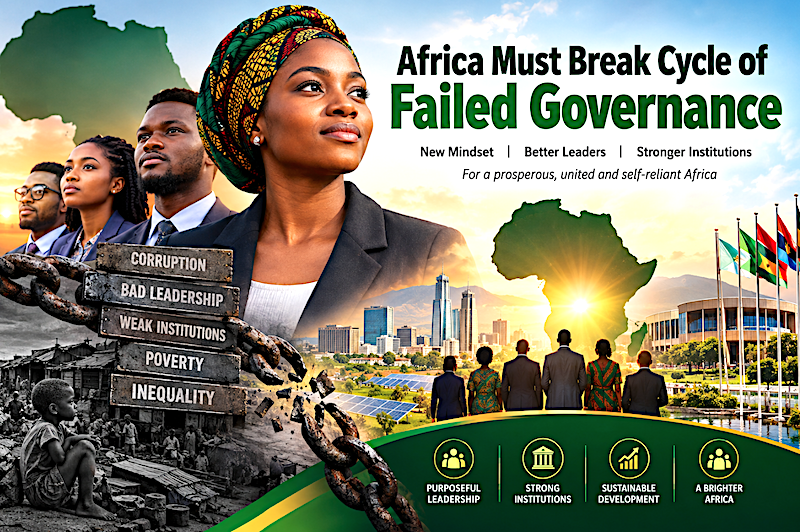
Africa must head calls made at the recent Mindset Reset Forum convened in Rwanda, to develop a new generation of purposeful leaders and strong institutions if it is to break a cycle of governance failures that continues to undermine continents development ambitions.
Africa has made significant progress but continues to fall short of its ambitions. The continent continues to grapple with similar governance and development challenges despite decades of policies, institutions and frameworks designed to address them. The continent has not been short of policies and plans. Yet many of the challenges identified over the years continue to persist.

The challenge is not whether African countries have the right policies and development plans, but whether countries have the institutional capacity, leadership and political discipline to turns those plans into results.
Make no mistake, for Africa to achieve its ambitions, leadership and institutional effectiveness must be placed at the centre of the continent’s struggle to translate its considerable human and natural resources into sustained development.
The continent’s nascent progress, must acknowledge that many of these gains rest on fragile foundation. Apparently, alongside new wealth, hundreds of millions of African still endure extreme poverty. Alongside high-tech hubs of innovation, many Africans are crowded into shantytowns without power or clean water-a level of poverty that’s an assault on human dignity.

Many African countries remain caught in a rent seeking political economy, where political power can be used to secure access to resources other than drive productive and inclusive development.
There is need for a shift towards development oriented political economy supported by a new generation of leaders. Africa needs visionary and selfless leaders equipped with a different mindset, and devoted to serve the citizens.
Most important, more should be done to develop leaders – capable committed leaders, who understand Africa’s challenges and are prepared to pursue solutions beyond short term political interests. Africa is in dire need of leaders who care about the welfare of society and people they serve.
Also required is a new generation of leaders capable of mobilising around Africa’s contemporary priorities. Leadership is the missing ingredient in Africa’s soup. Poor leadership has cost Africa dearly – it is the reason why the systems are weak, and the continent has not prospered as it should.
To make headway and tackle today’s complex challenges, Africa requires leadership capable of building effective institutions, strengthening economies and improving the lives of citizens.
Leadership plays an indispensable role in the advancement of any society. How far people will go largely depends on who is leading them. Leadership drives the direction of people, and it takes them to the right destination.
Until we understand that good leadership is the magic wand that will turn our economy around, we will keep knocking at a door that never seems to open. We will keep begging from those who have to beg from us.
Enough resources are never enough when poor leadership is at the helm of affairs. When we faithfully create a system that fetes the politician at the expense of the poor, everyone’s biggest dream will be to become a politician despite having no iota of leadership.
Wherever political leadership is the easiest escape from the problems of the people, political leadership becomes one of the problems of the people.
Beyond changing individual politicians and governments, focus should be on making a leadership development a long-term process. African societies must identify, develop and demand leaders capable of serving the public interest. At the same time, more should be done to create conditions that allow capable and committed leaders to emerge.
Equally important, African countries must strengthen their institutional capacities. Africa must focus on building strong and durable institutions beyond individual leaders. Strong institutions are essential for transforming Africa’s natural resources, youthful population and economic potential into sustainable development.
Mr Obonyo is a Public Policy analyst. Email: [email protected]
Disclaimer: “The views expressed on this site are those of the contributors or columnists, and do not necessarily reflect TheNigerianVoice’s position. TheNigerianVoice will not be responsible or liable for any inaccurate or incorrect statements in the contributions or columns here.”
Originally published on www.thenigerianvoice.com