

September 7, 2026
The Hormuz Deadlock: When Power Fails to Deliver Surrender


The Hormuz Deadlock: When Power Fails to Deliver Surrender
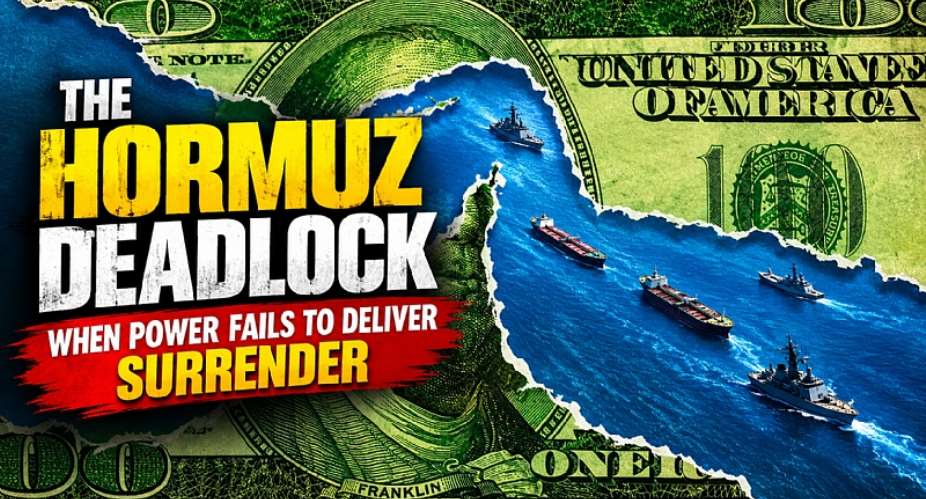
Wars are easy to start, but they can take years to escape. History repeatedly suggests that the exhibition of power gradually loses its force with time. Whether it is Russia in Ukraine or the United States in Iran, both fronts reveal the same strategic problem: a dominant power may demand surrender at the highest possible price, but in the modern world, that demand increasingly collides with the dignity and sovereignty of smaller states. Even a militarily weaker country now possesses the political instinct to resist humiliation. Can military power really force surrender when national dignity becomes part of the battlefield?
The U.S.-Iran war now appears to be trapped in a dangerous deadlock, with neither side able to claim a decisive strategic victory. Iran is facing severe economic destruction, while the United States is confronting its own economic and political disturbances. Oil prices remain elevated, and the conflict has entered a new phase. U.S. forces have struck Iranian oil tankers after Iranian missile attacks on U.S. Navy vessels, turning the energy sector itself into another battlefield. If six months of military pressure have failed to produce surrender, what makes Washington believe that another escalation will deliver a different result?
This development exposes the contradiction between Washington’s early expectations and the reality on the ground. On the first day of the war, President Donald Trump suggested that the conflict could either go long or end within days. Six months later, the United States and Iran are still exchanging attacks. The administration may describe the conflict in diminishing terms, but the battlefield tells another story. Has the Trump administration underestimated the political resilience of Iran, or has it overestimated the ability of military superiority to produce a political settlement?
This brings the Strait of Hormuz into the centre of the dispute. Before the war, approximately 20 million barrels of crude oil and petroleum products passed through the Strait every day, making it one of the world’s most important energy chokepoints. Now the real question is how much oil is actually getting through. The Trump administration has claimed progress in keeping the waterway open, with U.S. officials pointing to a figure of around 17 million barrels in a single day. Yet analysts have cautioned that a single day’s movement does not provide the complete picture. The more important question is the multi-day average—and here the picture becomes much less favourable for Washington.
According to the figures cited by Bloomberg, U.S. Energy Secretary Chris Wright said that flows had been averaging around 8 million barrels per day. If the pre-war level was approximately 20 million barrels per day, an average of 8 million represents a dramatic reduction in the volume of oil moving through the Strait. The 17-million-barrel figure may therefore be possible on a particular day, but it does not necessarily demonstrate that Hormuz has returned to normal. So can Washington genuinely claim that it has restored control of the world’s most important energy chokepoint when average flows remain far below the pre-war level?
The deeper dispute is therefore not simply about how much oil is moving through Hormuz, but who has the authority to determine how it moves. Iran and Oman have developed a temporary navigational framework aimed at maintaining safe passage while preserving their respective sovereign rights. Iran’s position remains strict: tankers should use designated routes and arrangements involving Oman and Iran. From Tehran’s perspective, this is not merely an operational issue but a question of sovereignty. Can an external military power impose a navigation regime on a strategic waterway when the coastal states themselves are demanding ownership of the security mechanism?
That is precisely where the Trump administration’s position becomes difficult. Washington appears unwilling to accept an arrangement that gives Tehran and Muscat the primary political ownership of the Hormuz question. Yet the Iranian-Omani framework cannot simply be dismissed because it challenges American preferences. The Strait passes through the territorial waters of Iran and Oman, making sovereignty an unavoidable part of the equation. The United States may possess superior naval power, but naval power alone cannot permanently replace regional legitimacy. Is the Hormuz crisis therefore becoming less a question of naval supremacy and more a question of sovereignty and regional legitimacy?
And what role is Pakistan playing in this increasingly complicated equation? Recent visits by Mohsin Naqvi and Field Marshal Asim Munir cannot, by themselves, be presumed to have created trust in Washington’s latest approach. Pakistan has already invested political capital in regional diplomacy and in the emerging Mecca regional security framework. But if the Iran-Oman understanding is not incorporated into the broader regional settlement, how can Tehran be expected to accept a deal negotiated around its sovereignty rather than with it?
If Abbas Araghchi is expected to facilitate or oblige a wider arrangement, another question becomes unavoidable: How can Araghchi accept or advance a regional security deal without Iran first accepting the underlying framework and its terms? And if Pakistan is attempting to act as a bridge between competing positions, is Islamabad actually shaping the emerging security architecture, or is it simply being asked to endorse decisions already made by larger powers?
The real lesson of Hormuz is becoming clear: wars may demonstrate power, but negotiations determine the durability of that power. Washington can strike tankers, Iran can threaten shipping, and both sides can continue to claim strategic advantage. But neither has yet solved the political problem. If neither side can achieve a decisive victory, why should the world expect the deadlock to end through further escalation rather than diplomacy?
Pakistan’s opportunity lies not in choosing a side, but in pushing for a regional framework in which Iran, Oman and the Gulf states have genuine ownership of the security mechanism, while the United States receives credible guarantees for freedom of navigation. If the Mecca framework is truly intended to become a regional security architecture, can Pakistan transform its diplomatic role from facilitator to strategic architect—or will it remain another chapter of promises without implementation?

Saqlain Abid Tarrar, © 2026
Political Commentator | MS Power Engineering | NFPA-Certified Electrical EngineerColumn: Saqlain Abid Tarrar
Disclaimer: “The views expressed in this article are the author’s own and do not necessarily reflect ModernGhana official position. ModernGhana will not be responsible or liable for any inaccurate or incorrect statements in the contributions or columns here.”
Follow our WhatsApp channel for meaningful stories picked for your day.

Top Stories


27 minutes ago


Originally published on www.modernghana.com