August 13, 2026
Morocco steps up border security over fears of new mass crossing into Ceuta


Morocco steps up border security over fears of new mass crossing into Ceuta
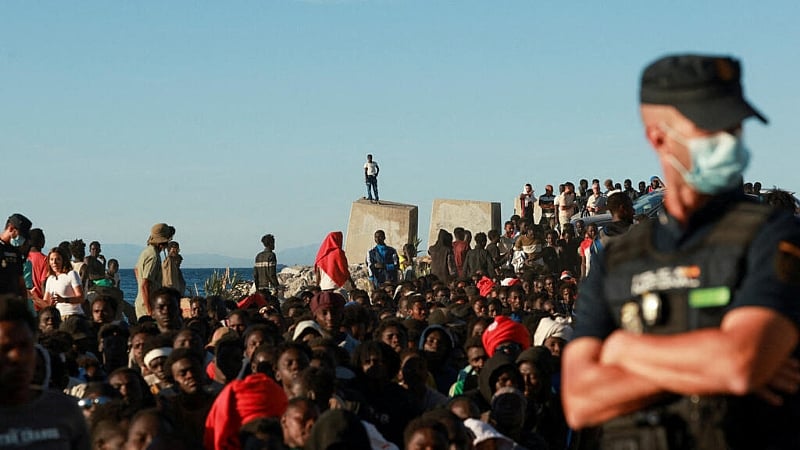
Migrants wait in line to receive food from the Red Cross, following mass crossings from Morocco into the Spanish territory of Ceuta, 3 August 2026. – © Violeta Santos Moura / Reuters
The Moroccan Interior Ministry said on Thursday that security monitoring had been reinforced in areas close to both crossings, while Spanish authorities warned that the border remained closed and urged people not to act on misleading information circulating online.
Messages shared in Moroccan social media groups have called for another attempt to enter Ceuta on Saturday, although it remains unclear who is behind them.
The warnings follow the dramatic events of late July, when around 72,000 migrants swam around border barriers or climbed over the breakwater separating Ceuta from Morocco.
The rush was driven partly by false rumours online suggesting that the border had been opened.
Almost all of those who entered Ceuta have since returned to Morocco, but the episode caused political shockwaves in Spain and elsewhere in Europe.
At least 80 people died during the attempted crossings, according to official figures, while human rights groups have reported a higher toll.
Ceuta migrants caught between humanitarian disaster and diplomatic row
‘Continuous vigilance’
Fresh social media messages are also reportedly encouraging would-be migrants to try to reach Melilla, Spain’s other autonomous city on the North African coast.
Together, Ceuta and Melilla form the European Union’s only land borders with Africa.
Morocco’s Interior Ministry said that “all necessary measures have been taken to counter” any further attempt at an illegal crossing.
It said authorities were maintaining “continuous vigilance” around both Ceuta and Melilla, although it did not provide details on the number of personnel deployed or the equipment being used.
Videos circulating on social media show hundreds of Moroccan police officers wearing riot gear near the border, with water cannons and ambulances also visible.
Moroccan news outlet Hespress reported that equipment for deploying tear gas and stun grenades had also been moved to the frontier.
More than 20,000 Moroccan security personnel are deployed around Ceuta each day, a senior Moroccan diplomat previously told the Associated Press. Speaking on condition of anonymity, the source said the operation cost hundreds of millions of dollars. People who attempted to cross into the Spanish enclave of Ceuta return to the northern Moroccan town of Fnideq, on 1 August 2026.
EU ministers agree Schengen zone ‘not the problem’ in Ceuta migrant influx
Spanish warning
Moroccan authorities have also arrested a group of people suspected of encouraging the latest crossing attempts, according to the Interior Ministry.
It said those detained were being investigated for alleged “incitement activities”, without providing further details.
Spanish Defence Minister Margarita Robles, who visited Ceuta on Wednesday, said authorities must focus on those encouraging migrants to attempt crossings.
She said it was “everyone’s responsibility to deal with those who are directing these movements”, adding that any aggression against Ceuta or Melilla would be considered an aggression against Spain as a whole.
“What happened cannot happen again,” Robles said.
Spain’s Civil Guard also issued a direct warning to potential migrants on social media. “Neither is the border with Spain open, nor will it be,” the message said, in Spanish and French.
It also warned that new containment barriers had been installed and that anyone crossing them would be returned.
“Don’t let yourself be deceived,” it added, accompanied by a photograph of a barrier erected in Ceuta following the 31 July breach.
The surge placed intense pressure on Ceuta’s infrastructure and revived wider European concerns over migration routes through North Africa.
(with newswires)

RFI
All the news from France, Europe, Africa and the rest of the world.Page: rfi

Top Stories


Originally published on www.modernghana.com