
September 5, 2026
More Than Reading: What Family Literacy Really Gives Rural Women


More Than Reading: What Family Literacy Really Gives Rural Women
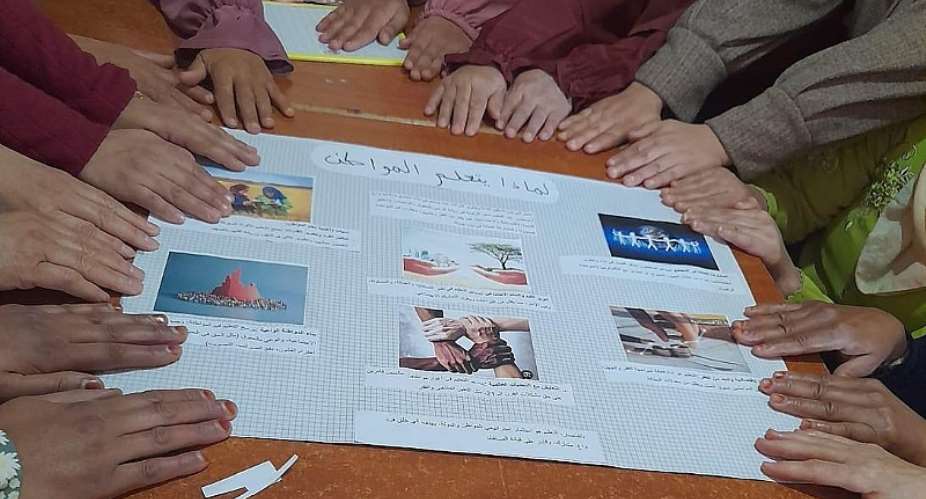
September 8th is International Literacy Day. Hundreds of millions of adults worldwide still cannot read a bill, a bus number, or a text message. At the High Atlas Foundation, family literacy classes are changing that for rural Moroccan women.
Before Class Even Starts
In IMAGINE workshops, illiteracy often surfaces before any literacy-specific activity does. A woman is handed a pen for an exercise, sometimes one that doesn’t even require writing, and she hands it back: “I can’t do this, I don’t know how to read or write.” Sometimes she asks her child to hold the pen instead.
This happens no matter what the actual task is, whether it’s drawing a diagram, signing an attendance sheet, or sketching out a goal. If a woman can’t read, she often assumes from the start that she can’t take part. Facilitators of the IMAGINE experience say this is especially common in new communities, where admitting you never learned to read still feels shameful. Most women only say it out loud once they feel like they are in a safe, judgement-free space.
The scale of it is significant. In many workshops, more than 80% of participants never learned to read, having left school around age seven or eight. Younger women usually know the basics, while older women often do not. Some arrive at these workshops hopeful about the opportunity in front of them, only to lose confidence once the conversation turns to ideas they can’t follow because they can’t read.
Why Women Want to Learn
The most common reason women give for wanting to learn to read is practical: they want to run a cooperative or business, and that requires reading and writing. But it’s rarely the only reason. Facilitators also hear women say they want literacy to help their children with homework, to text and communicate on a smartphone, or to read the Quran on their own. One woman, who spoke Arabic fluently but couldn’t read numbers, used to stay home rather than risk taking the wrong bus. She can read the numbers now after taking literacy classes.
Along the way, literacy classes end up teaching skills that go beyond reading itself, like checking food expiration dates or basic numeracy. Women say they put these skills to use right away, outside of class, in their own houses and communities.
What Actually Changes
Facilitators describe a shift in confidence as much as skill. One instructor put it simply: without literacy, a woman is more vulnerable to being taken advantage of. She might hand her goods to someone else to sell because she can’t check the numbers herself. Once she can read, she can do all of it on her own and doesn’t need to rely on someone else’s word.
The effects extend into the household, not just the individual. Women describe being able to check their children’s homework for the first time, or read bills that used to be a mystery to them. That is by design, as the program is build around the family, not just the women attending the class, and involving husbands and children was always part of the goal.
One visible sign of progress shows up on attendance sheets. In early sessions, women sign with a simple line or mark instead of their name. Over the following weeks, they start writing the first letters of their actual names. They also tend to sit close together at first, so they can copy from a neighbor, and gradually start sitting apart, writing on their own.
A Class That Kept Going On Their Own
In Achbarou village, a literacy class that started around four years ago is still meeting every week, two years after initial funding behind it ran out. No one is required to attend, and no one is paid to teach it anymore, yet the classes kept going because the group’s carpet cooperative business kept growing. Members had the need to read invoices and track sales to run it, so the class simply became a normal part of their week rather than something tied to a program.
What Facilitators Remember Most
Asked for their strongest memories from the program, facilitators shared two stories that stayed with them.
One facilitator visited a mountain village after the September 2023 earthquake. Homes were destroyed, and the women there cried describing everything they’d lost. But one of their top priorities was keeping their literacy classes. They said losing those too would mean sitting and waiting for help instead of doing something to grow and move forward themselves.
Another facilitator described a different scene in another village, where women called their weekly sessions, which mixed literacy with sport, games, and music, the best part of their week. They said it provided them a space to learn from each other where they genuinely enjoy being together.
Why Literacy
When making the case for family literacy over other kinds of urgent priorities like tree planting, waste management, or cultural preservation, the answer is clear: literacy is foundational. Most other training and workshops around any topic depend on people being able to read and write the material in front of them, so without it, those programs have less to build on. There is also an effect on confidence. Knowing how to read means a woman can manage her own affairs instead of depending on someone else to read for her.
This September 8th, the point worth remembering is simple. For the women in these programs, literacy was never just about reading. It is the skill that everything else depends on: their businesses, their children, and their independence.
Disclaimer: “The views expressed in this article are the author’s own and do not necessarily reflect ModernGhana official position. ModernGhana will not be responsible or liable for any inaccurate or incorrect statements in the contributions or columns here.”
Follow our WhatsApp channel for meaningful stories picked for your day.

Top Stories


Originally published on www.modernghana.com