

August 22, 2026
Did Afenyo-Markin and the Propaganda Circus on GoldBod do any wrong?


Sat, 22 Aug 2026 Feature Article
Did Afenyo-Markin and the Propaganda Circus on GoldBod do any wrong?
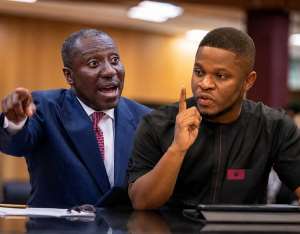
There is a serious national conversation to be had about GoldBod, the Bank of Ghana, the Domestic Gold Purchase Programme, public finances and the environmental consequences of gold mining. Unfortunately, Alexander Afenyo-Markin appears determined to turn that conversation into a political courtroom in which the verdict is delivered before the evidence is examined.
The first problem is the claim that GoldBod itself made a US$1.7 billion loss in 2025. The IMF material cited in this controversy discusses losses associated with the Bank of Ghana’s Domestic Gold Purchase Programme. Indeed, the IMF has separately warned that losses from the DGPP and GoldBod’s activities should not be borne by the central bank.
That distinction matters.
Afenyo-Markin is entitled to question government. He is entitled to demand accountability. He is entitled to scrutinise GoldBod’s finances. But he is not entitled to make the IMF say what the IMF did not say.
If the claim is that GoldBod made the entire US$1.7 billion loss, then the challenge is embarrassingly simple: show us the exact page, paragraph and sentence where the IMF says that.
The IMF’s discussion identifies several components of the reported financial outcome, including fees paid to GoldBod, discounts and exchange-rate effects. That is not the same as saying GoldBod itself incurred or caused the entire loss. And GoldBod has presented audited 2025 accounts showing an operational surplus of GH¢907 million and an overall surplus exceeding GH¢5.4 billion.
One can disagree with GoldBod’s accounting. One can demand further audits. One can question whether all programme-related risks are captured in its standalone accounts. In fact, Afenyo-Markin has made precisely that argument.
But disagreement is not evidence.
What is even more troubling is the apparent transformation of an accounting debate into a threat of political retribution. Afenyo-Markin has spoken of a future “day of reckoning” for GoldBod officials.
Really?
Since when did an alleged institutional loss automatically become a criminal offence?
A state institution can make an accounting loss without its CEO being a criminal. A valuation loss is not automatically stealing. An exchange-rate loss is not automatically corruption. A policy cost is not automatically financial crime. Before anybody talks about arrest, prosecution and punitive or onerous bail conditions, they should identify the specific offence, the statutory elements and the evidence connecting the individual to the offence.
And frankly, one cannot escape the impression that this has become unusually personal. The repeated focus on Sammy Gyamfi raises a legitimate question: Is this really about GoldBod, or is Sammy Gyamfi himself the target?
If there is evidence of wrongdoing, produce it. If there is a crime, identify it. If there is a loss caused by misconduct, demonstrate the causal connection.
But please, spare Ghanaians the theatre of treating every large number in an IMF report as a criminal indictment.
Ghanaians are discerning. They can read. They can interrogate documents. They can distinguish Bank of Ghana losses from GoldBod’s standalone accounts, accounting effects from criminal conduct, and political propaganda from evidence.
Afenyo-Markin may speak with the gravitas of a man delivering the final judgment of the Supreme Court. But a serious voice does not make an unproven claim serious evidence. There are quite a number of allegations he has made that turned out to be inaccurate, to the extent that he was exposed on live television after fact-checkers established that one of his claims was untrue. It is therefore wise for him to hasten slowly and exercise greater caution in making such assertions. Such conduct is unbecoming of a person occupying the office of Minority Leader.
It is therefore fair to compare his performance with that of prominent Minority Leaders who occupied the position before him and distinguished themselves through their effectiveness, discipline and substantive contributions to parliamentary discourse.
But accountability must begin with the truth not with a political conclusion looking for evidence.

Evans Mawunyo Tsikata, © 2026
This Author has published 94 articles on modernghana.comColumn: Evans Mawunyo Tsikata
Disclaimer: “The views expressed in this article are the author’s own and do not necessarily reflect ModernGhana official position. ModernGhana will not be responsible or liable for any inaccurate or incorrect statements in the contributions or columns here.”
Follow our WhatsApp channel for meaningful stories picked for your day.

Top Stories


Originally published on www.modernghana.com
