

August 31, 2026
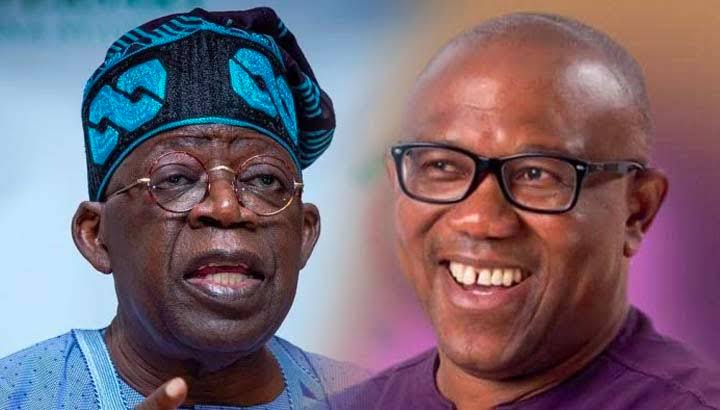
2027: Tinubu Asked To Step Down For Peter Obi
4 hours ago | General News
2027: Tinubu Asked To Step Down For Peter Obi


The Igbo Heroes and Icons Foundation (IHIF) has challenged President Bola Tinubu to step aside for Nigeria Democratic Congress presidential candidate, Peter Obi, in the 2027 presidential election.
The foundation made the call while rejecting moves by the Renewed Hope for Greater Nigeria (RHGN), a group supporting Tinubu, to persuade Obi to withdraw from the presidential race and back the incumbent.

RHGN had, through its Deputy National Leader (South-East), Mazi Franklin Ngoforo, announced plans to engage Igbo leaders, including Ohanaeze Ndigbo and former Commonwealth Secretary-General, Chief Emeka Anyaoku, in a bid to convince Obi to support Tinubu’s ambition to complete eight years in office.
But reacting in a statement on Sunday, IHIF National Coordinator, Chinedu Nsofor, said Obi should be allowed to exercise his constitutional right to contest the 2027 election.
Nsofor, whose organisation has adopted Obi as its preferred candidate while campaigning for an Igbo president in 2027, urged RHGN to redirect its efforts towards persuading Tinubu to support the Igbo presidency project.

He argued that Tinubu stepping down for Obi would promote what he described as equity, justice and fairness in the country’s political leadership.
According to him, Nigerians should be allowed to freely determine their preferred leaders through the ballot box rather than being pressured to support predetermined political arrangements.
“In any civilised clime, conscience based on equity, fairness and justice supremely prevails in all dealings. This fairness, equity and justice guarantee unity, peace, progress and national cohesion, particularly in a country like Nigeria where cultural and tribal diversities are highly pronounced,” Nsofor said.
He maintained that the Igbo had made significant contributions and sacrifices towards Nigeria’s unity and deserved an opportunity to produce the country’s president.
Nsofor argued that since the return to democratic rule in 1999, presidential power had largely alternated between the North and South-West, with the South-South also producing a president.
He cited former President Olusegun Obasanjo, a Yoruba, who served for eight years, while former Presidents Umaru Yar’Adua and Muhammadu Buhari, both from the North, collectively spent 11 years in office. He added that former President Goodluck Jonathan of the South-South served for five years.
“After Buhari’s tenure in May 2023, every right-thinking Nigerian expected that it was to be the turn of the Igbo to produce the successor to Buhari. But that was not to be,” he said.
The IHIF coordinator further contended that the Igbo had not enjoyed a sustained opportunity to lead Nigeria since independence, unlike the Yoruba and Hausa-Fulani, whom he said had produced presidents for considerably longer periods.
He claimed that an Igbo had occupied the presidency for only about six months on an interim basis, and questioned whether the principle of federal character had been fairly applied in the distribution of key national offices.
Nsofor specifically questioned whether an Igbo jurist had ever been appointed Chief Justice of Nigeria despite what he described as the contributions of eminent jurists from the South-East.
Despite his argument for an Igbo presidency, however, Nsofor said ethnicity and religion should not override competence in determining who becomes president in 2027.
He urged voters to prioritise candidates with the requisite education, knowledge and capacity to govern.
“Let us avoid electing a leader that does not know the balance of ninety-seven percent removed from hundred percent… University graduates should be preferred to school certificate holders for presidential candidate; not graduates without certificates,” he said.
Nsofor described the 2027 election as an opportunity to alter the pattern of political leadership in Nigeria and test what he called an “untried” national leadership base.
“Doing one thing in the same way every time will not give a different result. Let us shift this national leadership base to this untried tribe — the Igbo tribe — and see what happens.
“The forthcoming 2027 presidential election is the golden opportunity to explore this governmental leadership revolutionary change,” he stated.
Originally published on www.thenigerianvoice.com