

September 4, 2026
Senator Buba, Banditry And The Social Media Mercenaries
4 hours ago | Opinion
Senator Buba, Banditry And The Social Media Mercenaries


I approach national security and intelligence operations with deliberate caution. Revealing successes too early can compromise ongoing missions; failures narrated without context can sound like conspiracy theories. Allegations against individuals working at the sensitive intersection of intelligence, non-kinetic security strategy, and politics can inflict irreversible reputational damage—even when entirely fabricated.

That caution explains my initial reluctance to write on the recent viral video purporting to show “high profile bandit kingpins” on a visit to the residence of Senator Shehu Umar Buba of Bauchi South. But the scale of the circulation, and the pattern behind it, now demand public clarification.
I have known Senator Buba for about two years, during investigations into non kinetic approaches to counter insurgency in Northern Nigeria. In that period, senior security and intelligence officials — including the Office of the National Security Adviser under Malam Nuhu Ribadu — provided information that did not support any of the banditry allegations repeatedly circulated against him. This does not certify perfection; it simply reflects what the evidence showed.
The campaign against him is not new. The allegations took formal shape in September 2024, when Bauchi State Governor Bala Mohammed, once an ally of Senator Buba, petitioned President Bola Ahmed Tinubu. The petition claimed that the senator, through an aide named Yahaya Ibrahim, sponsored a bandit kingpin to the 2024 Hajj and distributed motorcycles to bandits. Senator Buba denied the claims, insisted he had no aide by that name, and explained that his Hajj sponsorships — like his scholarships, medical outreach and other empowerment initiatives — are based on recommendations from community and religious leaders, and that he does not personally screen or identify the beneficiaries. No investigation has contradicted his explanation.
After the petition failed to gain traction, the same narratives resurfaced through social media influencers with far lower evidentiary thresholds. Since mid 2025, photographs and videos alleging Buba’s support for bandits have surfaced periodically. In professional verification chats with mainstream media organisations and senior editors who had received similar allegations and multimedia — including a respected Abuja bureau chief who is also a media scholar with strong investigative credentials, the publisher of Zagazola, and a US‑based northern Nigerian journalist‑activist — all examined the materials and declined to publish them because they found no substantiation. Their restraint was professional judgment, not fear.

Nevertheless, Senator Buba petitioned security agencies to investigate the disinformation network. Several suspects — including a lawyer and three influencers — were arrested, while a fifth suspect, Hassan, fled the country.
On October 30, 2025, the suspects were arraigned before Justice Rita Ofili Ajumogobia on charges of criminal conspiracy, cyberstalking, defamation, advance fee fraud, and extortion. The prosecution alleges they broadcast false videos accusing Senator Buba — the then Chairman of the Senate Committee on National Security and Intelligence — of sponsoring banditry and causing a breakdown of law and order. The extortion charge suggests the campaign may have been more commercial than political at that time.
In July 2026, a fresh petition emerged—this time against Muhammad Abdullahi Abubakar, SAN, former Bauchi governor and APC gubernatorial candidate —for defaming Senator Buba. Filed by Jay Adl Attorneys, it alleged cyberstalking, criminal defamation, incitement, and disturbance of public peace, following viral statements in which Abubakar questioned the senator’s wealth and insinuated “blood money.” The political context is clear: Senator Buba defected from the APC to the PRP and is now the PRP’s gubernatorial candidate. The disinformation campaign, the rivalry, and the legal proceedings are intertwined.
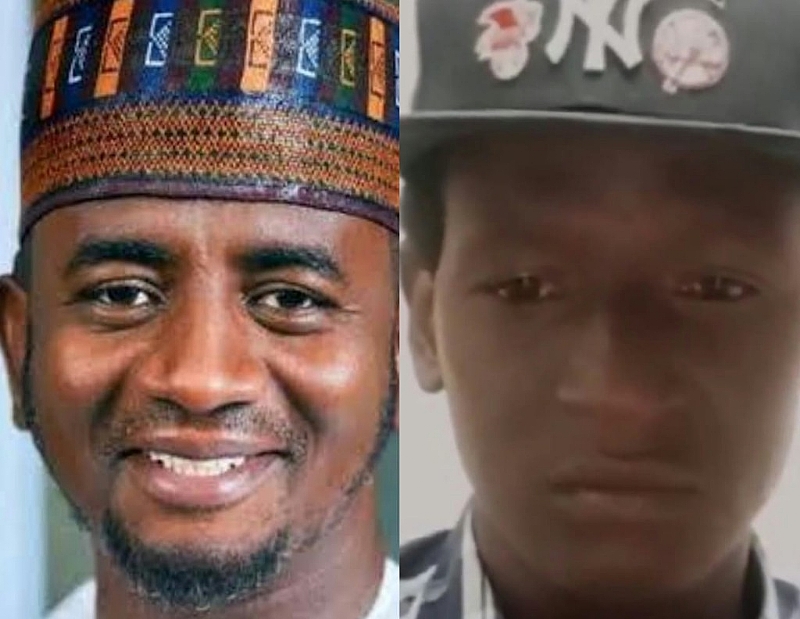
Meanwhile, the latest episode came in August 2026 when a content creator known as “D English Alhaji” circulated a video claiming to show bandit kingpins at a senator’s residence. PRNigeria’s fact check established that the video was a splice of two unrelated clips: Kaduna based Hajj returnees visiting Senator Buba in 2023, speaking Fulfulde/Fulani, and a separate group of individuals displaying passports and speaking English. Neither clip involved bandits. The content creator later interviewed Hassan — the fugitive suspect — who supplied the footage. The interview went viral with some funny allegations.
By the way, how can anyone seriously believe a narrative by the same Hassan in the interview claiming that bandits were brought to Abuja — of all places — to be trained by security agencies? How does such an implausible story even survive a moment of scrutiny
This pattern reveals the architecture of modern disinformation: an old fabrication, rejected by responsible media, is retrieved, re edited, and repackaged for amplification by social media operators who understand that novelty can make old lies feel new. Algorithms reward outrage, giving reckless content creators a competitive advantage over those who exercise restraint. This is not accidental; it is structural.
I am cautious about character testimony, but after two years of engagement with Senator Buba in contexts where performance matters more than presentation, some observations are relevant. He is a man of few words, not given to the theatrics of Nigerian politics. His work in non kinetic security—persuasion, community engagement, de-radicalisation—has, by credible accounts, helped reduce abductions along the Abuja Kaduna expressway and in Birnin Gwari, among others. Such work cannot be publicised without compromising community leaders or inviting sabotage from actors who profit from instability.
His philanthropic record is independently documented. A Trust TV documentary captured the breadth of his medical outreach across Bauchi and Plateau, showing Muslims and Christians among the beneficiaries. Monthly medical support programmes of that scale leave traces in communities and hospitals; they are not easy to fabricate.
None of this places Senator Buba beyond scrutiny. Public officials must be examined. But the evidence consistently shows that the allegations against him — sponsoring banditry, hosting bandit kingpins — are manufactured, and the machinery producing them is driven by electoral competition rather than civic concern.
When recycled footage, political rivalry, and social media algorithms converge, even a debunked falsehood can acquire a second life. In such an environment, a public figure’s communication strategy becomes as important as the truth itself.
Yushau A. Shuaib, the author of ‘An Encounter with the Spymaster’ and ‘MNI versus MNIPR in NIPSS ’, [email protected]
Disclaimer: “The views expressed on this site are those of the contributors or columnists, and do not necessarily reflect TheNigerianVoice’s position. TheNigerianVoice will not be responsible or liable for any inaccurate or incorrect statements in the contributions or columns here.”
Originally published on www.thenigerianvoice.com