

August 15, 2026
Governor Eno’s People-driven Leadership Attracts Global Recognition
4 hours ago | Tributes
Governor Eno’s People-driven Leadership Attracts Global Recognition


The leadership qualities of Akwa Ibom State Governor, Pastor Umo Eno, continue to earn him recognition from public and private institutions within and outside Nigeria.

If you had told the people of Ikot Ekpene 10 years ago that a pastor who loved singing and feeding people would one day stand before African presidents and defence chiefs to receive an award for governance, many would have smiled and said, “God dey.”
A few weeks ago in Banjul, the capital of The Gambia, that smile turned to pride. At the Sir Dawda Jawara International Conference Centre, the 19th Security Watch Africa Conference and Awards brought together presidents, ministers, generals, and diplomats from across the continent. The theme was simple and weighty: ‘How do we make Africa safer, and how do we govern so that ordinary people can feel it?’
Among the names called was Governor Pastor Umo Eno of Akwa Ibom State.
Last week, the Chairman of the DTN@100 Organising Council, Bolaji Okusaga, also announced Governor Eno as the South-South winner in the Outstanding Governor Awards category. The award was part of the DTN@100 Heroes Awards, decided through nationwide public voting across the six geopolitical zones. Other winners included Dauda Lawal of Zamfara (North-West), Bala Mohammed of Bauchi (North-East), Abdullahi Sule of Nasarawa (North-Central), Peter Mbah of Enugu (South-East), and Babajide Sanwo-Olu of Lagos (South-West).

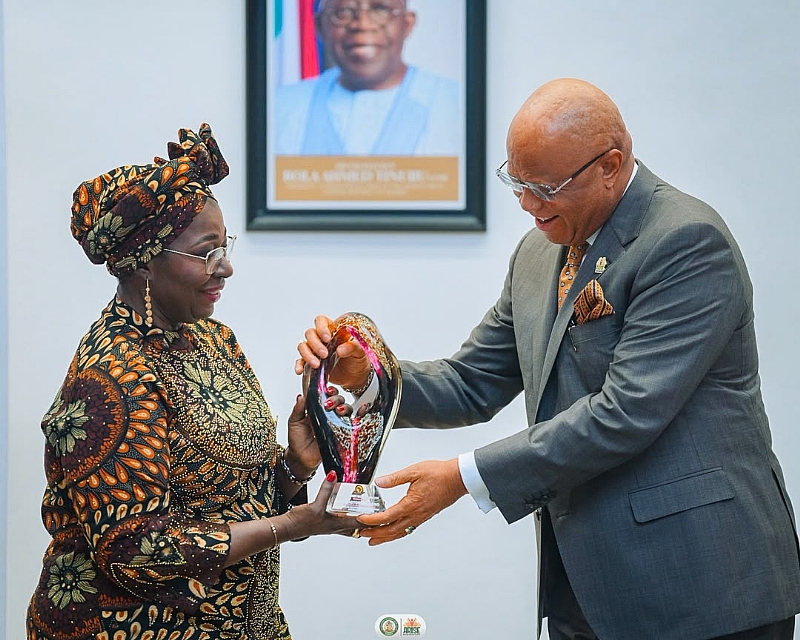
Governor Eno could not attend the Banjul ceremony. He was represented by Akwa Ibom State Deputy Governor, Senator Akon Eyakenyi. When “African Leader in People-Centric Governance Award” was announced, the hall erupted in applause, and back home in Uyo, the people rejoiced.
President Adama Barrow of The Gambia was also honoured that night. So were Nigeria’s Minister of Defence, General Christopher Musa, the Nigeria Police Force, the South African Defence Force, the Kenya Navy, and Akwa Ibom’s Commissioner of Police, CP Baba Mohammed Azare. But the story Akwa Ibom people kept repeating was about their governor.
Because this was not an award for big grammar or big titles. It was for something closer to home: putting people first. That is Eno.
Those who know him say he did not enter politics to chase power. He started by building businesses, creating jobs, and pastoring. He would tell his church members, “If government cannot reach you, let the church reach you. If the church cannot, let your neighbour.” Somewhere along the line, he decided the best way to reach more people was to enter government itself.
When he became governor in 2023, he came with one document and one phrase: the ARISE Agenda. ARISE stands for Agricultural Revolution, Rural Development, Infrastructure and Security, Education, and Tourism. But on the streets, people translated it differently: “Arise and help us.” And he did.
He did not begin with press conferences. He began with roads. Over 1,346 kilometres of roads and bridges have been constructed across the state. If you have ever been stuck for hours on a bad road in the rain with children in the back seat, you know what that means. It means a mother in Eket can now get to a hospital in Uyo on time. It means a farmer in Oruk Anam can take his cassava to market without half of it spoiling.
Then came food. He established the Ibom Model Farm and launched the Tree Crop Revolution. The idea was not just to talk about agriculture on television. It was to put seedlings in the ground and money in farmers’ pockets. In a country where food prices have broken many homes, Akwa Ibom people began hearing a new word: “we are planting.”
Healthcare came next, because a sick person cannot farm or go to school. His administration inaugurated the 350-bed Ibom International Hospital. More than 300,000 residents were enrolled in the State Health Insurance Scheme. For many families, that card is the difference between borrowing money and sleeping at night.
Then there were the homes. Over 455 solar-powered Compassionate Homes for vulnerable citizens are being built — for widows, the elderly, and those long forgotten. They are solar-powered so that even when the national grid fails, there is light. People call them “Eno houses.” Not because he put his name on them, but because people needed a name for the kindness.
Tourism and investment followed, because Eno kept saying Akwa Ibom must not just survive, it must sell itself to the world. The ARISE Palm Resort. The International Convention Centre. The remodelling of Ibom International Hotel. The expansion of Ibom Air’s regional operations. And the big dream: the Ibom Deep Seaport.
Education has not been left out. Beyond building modern classrooms equipped with gadgets and recruiting and retraining teachers, Eno’s policy has sent hundreds of qualified Akwa Ibom children to study abroad.
In Banjul, he said it plainly through his deputy: “From land, through our extensive road network, to air through Ibom Air, and to sea through the Ibom Deep Seaport, Akwa Ibom is ready to partner with the world.”
That line travelled. Investors listen when a state says it is open by road, by air, and by sea.
But awards like the one Security Watch Africa gave are not about popularity. They are about security and governance. And that is where the emotional core of Eno’s story lies.
Nigeria faces security challenges. Everyone knows: kidnapping, communal clashes, banditry. Eno did not pretend otherwise. In Banjul he said, “These challenges are not peculiar to Nigeria.” But he added that they can be overcome through collaboration, innovation, and sustained commitment. So what did he do at home?
First, he created a Ministry of Internal Security and Waterways and appointed a retired military officer to lead it. Not a politician. A soldier who understands the terrain.
Second, he established the Ibom Community Watch and integrated 2,272 gazetted Village Youth Presidents into the state’s security architecture. In most places, youth leaders are ignored until there is trouble. Eno gave them a role in keeping the peace. Now, the young man who knows every path in the village is the one calling the police when he sees strangers.
Third, a modern Security Command and Control Centre was built and equipped with cameras and other technological gadgets, manned by trained personnel.
The result is what Akwa Ibom people speak of proudly: the state is consistently ranked among Nigeria’s safest. Business people who were afraid to come are returning. Churches hold night vigils without fear.
Patrick Agbambu, the International Coordinator of Security Watch Africa, said during the award: “Governor Eno was honoured because he demonstrated conscientious and people-driven leadership.” He said the award recognized a style of governance that puts citizens at the centre.
That phrase, people-centric, is what Eno keeps repeating.
In Banjul, speaking to presidents and generals, Eno said: “The true measure of governance lies in its ability to improve the lives and welfare of citizens. Governance must go beyond political leadership to improving the material conditions of the people. Meaningful development can only thrive where lives and property are protected, and the rule of law is upheld.”
He dedicated the award to President Bola Ahmed Tinubu, and to the people of Akwa Ibom. Not to himself. To the market women, the teachers, the policemen, the youth presidents.
“I received the African Leader in People-Centric Governance Award presented by Security Watch Africa.
I dedicate this honour to His Excellency, President Bola Ahmed Tinubu, GCFR; Mr. Udom Emmanuel, CON; Distinguished Senator Godswill Obot Akpabio, GCON; members of the State Executive Council; and the good people of Akwa Ibom State. This recognition belongs to all of us and reflects what we can achieve through unity, collaboration, and a shared commitment to service.
I thank Security Watch Africa for this honour and reaffirm my commitment to continue serving our people with diligence, humility, and the fear of God.”
That humility is why the story is touching people.
A teacher from Ukanafun said her sister received one of the Compassionate Homes. “She cried for three days,” the teacher said. “Not because of the house. Because someone remembered her.”
A driver who plies the Uyo-Calabar route said, “Before, that road was hell. Now I do two trips and still get home early. My wife is happy.” A nurse at Ibom International Hospital said, “We have equipment now. Patients don’t die waiting.”
These are small stories. But governance is just a collection of small stories.
Eno also used the Banjul stage to speak about Nigeria. He commended President Bola Ahmed Tinubu for efforts to strengthen the country’s security architecture through collaboration with the Armed Forces and other agencies. Then he made a point that resonated with diplomats: transnational threats require shared intelligence, coordinated responses, and deeper partnerships. No country can fight insecurity alone.
He also made the case for investment. Nigeria, he said, remains one of Africa’s most attractive destinations because of its large market, youthful and tech-driven population, abundant natural resources, and democratic stability. It was not just a speech. It was an invitation.
And he did not avoid the hard conversation. He reiterated his support for State Police — “grassroots policing.” The idea that the people who know the community should help protect it. In Akwa Ibom, he has already started that model with the Village Youth Presidents.
Back in Banjul, after the award, people asked: Who is this pastor-governor?
They heard about a man who sings in church and still signs road contracts. A man who tells his cabinet, “If a policy does not touch a poor person, go back and rewrite it.” A man who, according to Security Watch Africa, was chosen not because he shouted the loudest, but because he delivered quietly.
That is why the award matters. In Africa, people are tired of leaders who appear only during elections. They are tired of ribbon-cutting without follow-up. Eno’s story resonates because it feels different. Roads are counted in kilometres, not promises. Patients are counted in hundreds of thousands, not speeches. Homes are counted, one by one.
Of course, there is still work. No governor can fix everything in two years. Prices are still high. Youth unemployment remains. The Deep Seaport is still a work in progress. But people see movement. And in governance, movement gives hope.
In Banjul, the night ended with handshakes and photos — President Barrow, the governor’s representative, generals, commissioners. But the image that stayed with many Akwa Ibom people was not the photo. It was the statement made on their behalf: that security, inclusive leadership, and people-centred governance are the pillars of sustainable growth. That is Eno’s philosophy in one sentence.
He did not grow up in a palace. He grew up in a church and in business. He knows what it means to meet a payroll. He knows what it means to pray for a contract. He knows what it means to bury someone who could not afford a hospital bill. So when he governs, he governs like someone who remembers.
The International Coordinator said the conference was organized to “harness diverse thoughts, expertise, and ideas from across the continent toward developing practical solutions.” Eno brought one idea: start with the people.
Start with the woman selling fish who needs a good road. Start with the child who needs a hospital bed. Start with the widow who needs a roof and light. Start with the youth who needs to be trusted with security. If you do that, the big things will follow.
The recognitions kept coming. Okusaga said Eno and other DTN@100 winners emerged through a rigorous digital voting exercise that attracted thousands of verified votes from Nigerians at home and in the diaspora.
“The DTN@100 Heroes Awards were conceived not merely to recognize achievement, but to celebrate individuals and institutions whose leadership has created lasting value for Nigeria, and as a pipeline to select states, organisations, and individuals to be featured in the Nigeria Grand Book.
The quality of nominations, the scale of public participation, and the credibility of the voting process reaffirm that Nigerians are eager to honour excellence wherever it is found,” Okusaga said.
Receiving the Publisher and Chairman of Daily Times, Mr. Fidelis Anosike, and his delegation following his selection for the Times Heroes Award, Eno said: “I see this recognition as a call to greater service, accountability, and responsible leadership. Our administration will remain focused on improving lives through the ARISE Agenda, especially with projects such as the ARISE Compassionate Homes and Model Primary Schools in rural communities.
I dedicate this honour to God, the people of Akwa Ibom State, members of our team, my predecessors, and everyone contributing to the progress of our state.”
Today in Akwa Ibom, when people hear “African Leader in People-Centric Governance” and “Times Heroes Award,”
they don’t think of trophies in a glass case. They think of the road that was fixed, the hospital that was opened, the house that was given. They think of Eno.
Originally published on www.thenigerianvoice.com