

September 4, 2026
Ghana Must Be Ready And Willing To Feed Itself


Fri, 04 Sep 2026 Feature Article
Ghana Must Be Ready And Willing To Feed Itself
Ghana cannot continue talking about economic independence while depending heavily on foreign countries to feed its people.
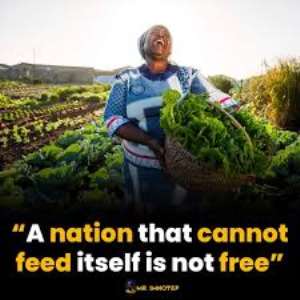
We have fertile land, hardworking farmers, agricultural research institutions, a large domestic market and millions of young people searching for jobs. Yet ships and trucks continue bringing into Ghana enormous quantities of rice, poultry, tomatoes and tomato products, vegetable oils and other foods that we have the potential to produce or process locally.
This should concern us.
Every unnecessary food import is not merely a product entering Ghana. It represents foreign exchange leaving the country and a potential production opportunity being lost.
Consider poultry. Ghanaian farmers have complained for years about high feed costs, expensive credit and competition from imported frozen chicken. Meanwhile, Ghana continues importing large quantities of poultry to satisfy domestic demand.
Then there is rice.
Rice has become a major part of the Ghanaian diet, yet imported brands continue to occupy significant space in our shops and supermarkets despite years of campaigns encouraging consumers to buy Ghana rice.
Tomatoes present an equally troubling picture. Ghanaian tomato farmers sometimes struggle to find profitable markets while traders and processors depend on imported fresh tomatoes and tomato products.
Vegetable oil tells a similar story. Ghana has the agricultural potential to expand oil palm, soybean, coconut and other oilseed production and build stronger domestic refining and processing industries. Yet imported vegetable oils remain prominent in the market.
Something is wrong with this economic arrangement.
We cannot tell Ghanaian farmers to produce more when they are uncertain about who will buy what they already produce.
Before asking farmers to increase production, let us first build markets for Ghanaian food.
Government itself can lead.
Schools, hospitals, prisons, security agencies and other public institutions purchase enormous quantities of food every year. Wherever local producers can meet appropriate standards, price and supply requirements, public procurement should deliberately prioritise Ghanaian rice, poultry, cooking oil, vegetables and other locally produced foods.
But protecting Ghanaian agriculture does not mean closing our borders or banning everything imported.
It means creating fair conditions for domestic producers to compete.
Government must tackle high financing costs, irrigation deficiencies, inadequate storage, poor roads, post-harvest losses and expensive agricultural inputs. It must also deal firmly with smuggling, under-invoicing and substandard imports.
Our farmers cannot be expected to compete internationally while producing under some of the highest-cost conditions at home.
Agriculture must also be connected to industry.
Maize and soybeans should feed a competitive poultry industry. Oil palm, coconut and soybeans should supply vegetable-oil processors. Tomatoes should feed modern processing factories. Ghanaian rice should be properly milled, packaged, branded and distributed nationwide.
This is not simply about food.
It is about jobs.
When Ghana imports food that could competitively be produced locally, we are also importing somebody else’s production while exporting potential employment opportunities.
The solution, however, cannot be patriotism alone. Ghanaian producers must deliver quality, consistency, good packaging and competitive prices. Consumers deserve value for their money.
The objective should be simple: Ghana must produce more of what it eats, process more of what it produces and import only where imports genuinely make economic sense.
We cannot control what happens to food prices on farms thousands of kilometres away. We cannot control wars, export restrictions or global shipping disruptions.
But we can decide how seriously we take our own agriculture.
Ghana has the land. We have the farmers. We have the market.
What we need is the political will, investment and national determination to connect them.
A country that cannot increasingly feed itself cannot claim true economic independence. Ghana must be ready—and willing—to feed itself.

Frank Ayim Damptey, © 2026
This Author has published 202 articles on modernghana.com. More I am a Ghanaian business leader, entrepreneur, industrial development professional, researcher and author with over two decades of experience in senior executive and technical roles.
I currently serve as the Chief Executive Officer of Tata Beverages Company Limited and Tata Industrial Company Limited, where I provide strategic leadership in manufacturing, product development, business growth and the promotion of locally manufactured products.
My professional experience spans a broad range of industries, including beverage and brewing, soap manufacturing, water treatment, paint and ink production, agriculture and agro-processing, food processing, technology and industrial manufacturing.
Beyond Ghana, I have provided consultancy and technical advisory services to start-ups and emerging businesses in Liberia, Sierra Leone, Burkina Faso and Nigeria. Through these engagements, I have supported entrepreneurs and businesses in product development, manufacturing processes, equipment selection, quality improvement and the establishment of sustainable production operations.
I am a strong advocate for Made-in-Ghana products, entrepreneurship, industrialisation, local value addition and the growth of small and medium-sized enterprises (SMEs). I firmly believe that Ghana and Africa’s long-term economic transformation will depend on our ability to produce more of what we consume, add value to our locally available resources and build competitive industries that create sustainable employment.
My interests extend beyond manufacturing to agriculture, food security, STEM education, innovation, healthcare, entrepreneurship and national development. I am particularly passionate about practical solutions that can strengthen local industries, create opportunities for young people and reduce Africa’s excessive dependence on imports.
As an author and contributor to ModernGhana, I regularly write on business, manufacturing, agriculture, entrepreneurship, economic development and other issues of national and continental importance. Through my writing, I seek to stimulate constructive public discussion, challenge conventional thinking and advocate practical solutions to Ghana’s development challenges.
I have also undertaken and published research in areas related to manufacturing, food processing, innovation, local raw-material utilisation and sustainable industrial development. My research interests are driven by the belief that Africa possesses enormous resources that can be transformed through research, technology, entrepreneurship and industrialisation.
Throughout my professional journey, I have remained committed to promoting local manufacturing, entrepreneurship and African industrial development.
My philosophy is simple:
“Africa must produce more of what it consumes, process more of what it produces, and build competitive businesses capable of creating jobs and competing globally.”Column: Frank Ayim Damptey
Disclaimer: “The views expressed in this article are the author’s own and do not necessarily reflect ModernGhana official position. ModernGhana will not be responsible or liable for any inaccurate or incorrect statements in the contributions or columns here.”
Follow our WhatsApp channel for meaningful stories picked for your day.

Top Stories


49 minutes ago


Originally published on www.modernghana.com