

September 1, 2026
From Kurdistan to Balochistan: A Tough Lesson from Turkey’s Strategic Struggle


From Kurdistan to Balochistan: A Tough Lesson from Turkey’s Strategic Struggle
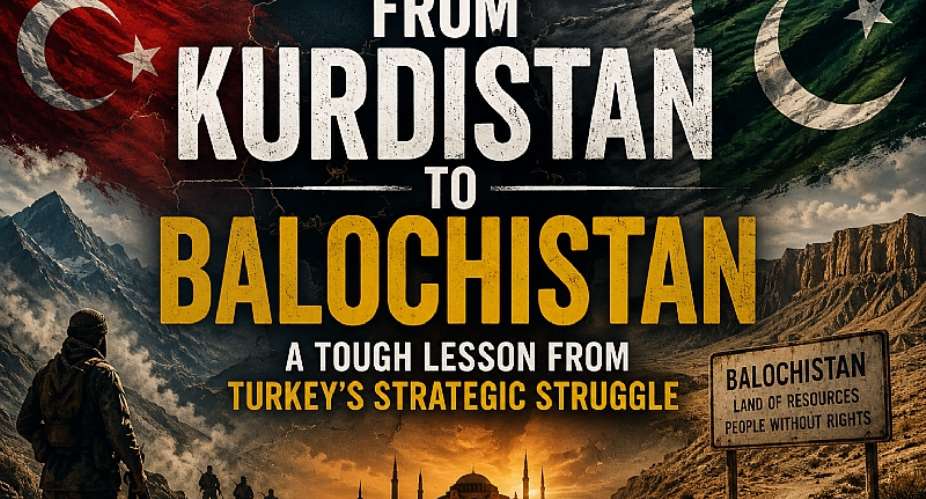
History offers more than memories of past wars; it provides a reference for understanding how conflicts evolve and, more importantly, how they eventually end. Modern warfare is no longer determined solely by conventional military strength. Intelligence, political legitimacy, public confidence and the ability to separate militants from the wider population have become equally important.
Pakistan’s growing defence relationship with Turkey should therefore be viewed beyond military equipment, joint exercises and conventional defence cooperation. Islamabad may also benefit from studying Ankara’s decades-long experience in dealing with one of the most complicated insurgencies in the region.
The most important question is: can military power alone permanently defeat an insurgency when the political environment that sustains it remains unresolved?
Balochistan, Pakistan’s largest province, covering approximately 43 percent of the country’s landmass, remains at the centre of serious security and political challenges. The province faces violence from Baloch nationalist militant organisations as well as religiously motivated armed groups, including the TTP. Security operations have disrupted militant networks, but repeated attacks raise a more difficult policy question.
If decades of military operations have not completely eliminated the insurgency, should Pakistan continue relying primarily on a reactive security strategy?
The Kurdish insurgency in Turkey provides an important, though not identical, case study. The conflict between the Turkish state and the Kurdistan Workers’ Party (PKK) began in 1984 and continued for more than four decades, costing tens of thousands of lives.
The PKK was founded by Abdullah Öcalan in 1978 as a Marxist-Leninist organisation and initially demanded an independent Kurdish state. Over time, however, the political objectives surrounding the Kurdish question evolved toward autonomy, political representation and cultural rights.
Balochistan is fundamentally different from Turkey’s Kurdish regions. The history, geography and political structures are not the same. Yet there are parallels that Pakistan cannot afford to ignore. Baloch political activists and civil society voices have repeatedly raised concerns regarding political representation, economic development, missing persons and the distribution of natural resources.
Figures such as Dr. Mahrang Baloch and Sammi Baloch have become prominent voices in campaigns focused particularly on the issue of enforced disappearances and the grievances of affected families. Their activism should not automatically be confused with armed militancy. A mature state must be capable of distinguishing between peaceful political activism, civil-society dissent and those who directly engage in or advocate armed violence.
Can a state successfully defeat an insurgency while ignoring the grievances—real or perceived—that allow militant narratives to find an audience?
The argument frequently raised by Baloch political activists is that the province’s vast mineral and natural resources should generate greater economic benefits for the people living there. Violence against civilians and state institutions cannot be justified. However, dismissing every political grievance because militant groups exploit those grievances can also prove strategically dangerous.
A successful counter-insurgency strategy must distinguish between armed militancy and the wider political population.
Can Pakistan isolate militants without simultaneously making ordinary citizens feel politically isolated?
Turkey itself learned this lesson through decades of conflict. The collapse of the peace process in 2015 resulted in some of the bloodiest phases of the Kurdish conflict. Urban warfare intensified, followed by extensive Turkish military operations against PKK positions in northern Iraq and Syria.
Military pressure weakened militant capabilities, but the conflict did not simply disappear.
Pakistan faces a similar strategic dilemma in Balochistan. Security operations can protect infrastructure, eliminate militant commanders and disrupt supply networks. But military success is not always the same as political success.
If insurgents are pushed from one area to another but continue recruiting and finding sympathy among sections of the population, has the conflict actually been resolved—or merely relocated?
Turkey’s more recent political process provides perhaps the most important lesson. The Kurdish question demonstrated that even a state with significant military capacity eventually needs political mechanisms to create an exit from prolonged conflict.
The lesson for Pakistan is not that Balochistan should copy Turkey. Pakistan must develop its own political model, based on its own constitutional structure, geography and national realities.
But the essential question remains:
What is Pakistan’s long-term strategy for Balochistan beyond security operations?
Political engagement does not mean surrendering the writ of the state. Dialogue does not mean accepting violence. On the contrary, a strong state should possess the confidence to distinguish between militants who must be confronted and citizens whose political grievances must be heard.
Pakistan must strengthen civilian institutions, expand meaningful political representation, ensure transparent resource distribution and create credible channels for peaceful political engagement. The people of Balochistan must feel connected to Pakistan’s national project—not merely governed from a distance.
If the objective is lasting peace, should Pakistan not ask whether winning territory is enough—or whether it must also win trust?
Turkey’s strategic struggle demonstrates that even the most difficult conflicts eventually require a political mechanism. Security operations may remain necessary, but they cannot be the only pillar of a long-term strategy.
Pakistan must find its own mechanism—one that protects national security while addressing the political, economic and social conditions that allow conflict to survive.
The ultimate lesson from Turkey is simple but uncomfortable: a state can suppress violence through military power, but lasting peace requires political imagination.
For Pakistan, the real question is no longer whether Balochistan requires security.
It clearly does. The real question is whether security without a credible political strategy can ever deliver the permanent peace that Balochistan—and Pakistan—desperately needs.

Saqlain Abid Tarrar, © 2026
Political Commentator | MS Power Engineering | NFPA-Certified Electrical EngineerColumn: Saqlain Abid Tarrar
Disclaimer: “The views expressed in this article are the author’s own and do not necessarily reflect ModernGhana official position. ModernGhana will not be responsible or liable for any inaccurate or incorrect statements in the contributions or columns here.”
Follow our WhatsApp channel for meaningful stories picked for your day.
Top Stories


2 hours ago




Originally published on www.modernghana.com