

September 4, 2026
Delta State Liberalises Power Sector to Attract Private Investment
4 hours ago | Economy & Investments
Delta State Liberalises Power Sector to Attract Private Investment

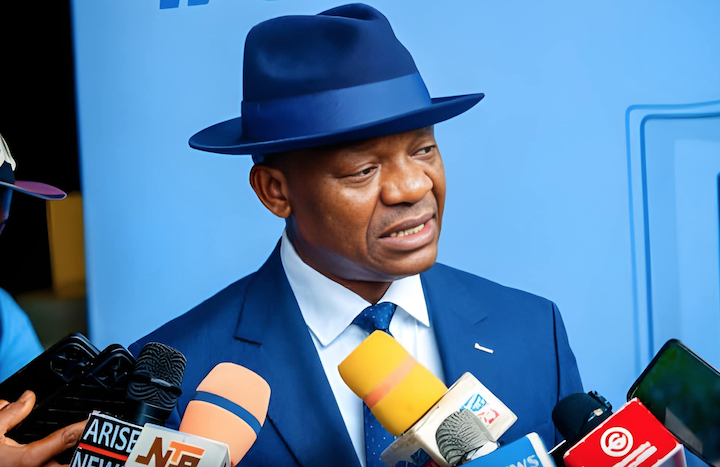
Mr. Charles Aniagwu (Delta State Commissioner for Works (Rural Roads) and Public Information)

The Delta State Government has embarked on a comprehensive reform of its energy sector. The primary objective is to attract robust private investments , boost the overall electricity supply, and systematically reduce the state’s reliance on Nigeria’s national grid.

This strategic shift was announced by the State Commissioner for Works (Rural Roads) and Public Information, Mr. Charles Aniagwu , during a press conference in Asaba. He addressed the media alongside the Executive Assistant to the Governor on New Media, Mr. Felix Ofou .
Mr. Aniagwu emphasized that the state does not intend to return to an outdated era of total government control over commercial businesses. Instead, the current administrative efforts are carefully structured to foster greater private-sector participation by leveraging public-private partnerships (PPPs) and progressive deregulation strategies.
To achieve this energy independence, the state government is looking to utilize its abundant natural gas reserves for localized electricity generation. A primary focal point for this initiative is the Kwale Free Trade Zone , which is a core component of Delta State’s special economic zone designed to house major industrial projects.
The government has already begun showcasing these opportunities to the international and local business communities. During the recent state economic summit, prospective investors were taken on a direct tour of the Kwale zone to verify the immediate availability of natural gas as a ready raw material for power plants.

Ultimately, boosting local power generation is expected to significantly ease pressure on the overburdened national grid , freeing up electricity for other consumers. Mr. Aniagwu highlighted the success of this strategy by pointing to the 8.5-megawatt Independent Power Plant located behind the state secretariat in Asaba, an operational facility that already allows the entire secretariat complex to run completely independent of the national grid.
“Once you have an alternative source of power for the secretariat, the energy that would have been consumed by the secretariat becomes available for homes and other users,” he explained.
The commissioner also revealed that the state has entered into a partnership with Supply Power to generate an additional 120 megawatts of electricity for the national grid, saying the initiative forms part of the government’s broader strategy to boost power supply and support small and medium-sized enterprises whose operations rely heavily on stable electricity.
He said the state government has equally intervened in areas traditionally considered the responsibility of electricity distribution companies, as it is determined not to allow poor power supply to hinder economic growth.
Aniagwu cited the extension of the electricity grid from Abraka towards the Ndokwa axis as one of such interventions, noting that the aim is to ensure more communities are connected to electricity.
He, however, expressed concern over the practice where residents and communities are required to provide transformers and other infrastructure, only for electricity distribution companies to subsequently collect bills without properly accounting for the investments made by the communities.
According to him, the state government is willing to continue supporting efforts to energise communities, as improved electricity supply will stimulate economic activity, create opportunities and potentially reduce security challenges linked to unemployment and idleness.
Aniagwu said the government is also collaborating with the Ministry of Energy and a committee set up to fine-tune the state’s energy regulatory framework. He explained that the proposed energy commission will be critical in regulating new power producers, determining appropriate pricing and overseeing distribution networks, noting that electricity distribution requires careful planning, including whether to deploy overhead, underground or other forms of power lines based on the peculiarities of each location.
He stressed that proper regulation was necessary to ensure that electricity expansion did not expose residents to electrocution or other hazards, while also ensuring fair pricing and protection of power infrastructure.
Aniagwu said the ultimate objective of the reforms was to create a more efficient and sustainable power sector capable of supporting businesses, communities and households across Delta State.
Originally published on www.thenigerianvoice.com